




01. Edit your sc4506 online
Type text, add images, blackout confidential details, add comments, highlights and more.

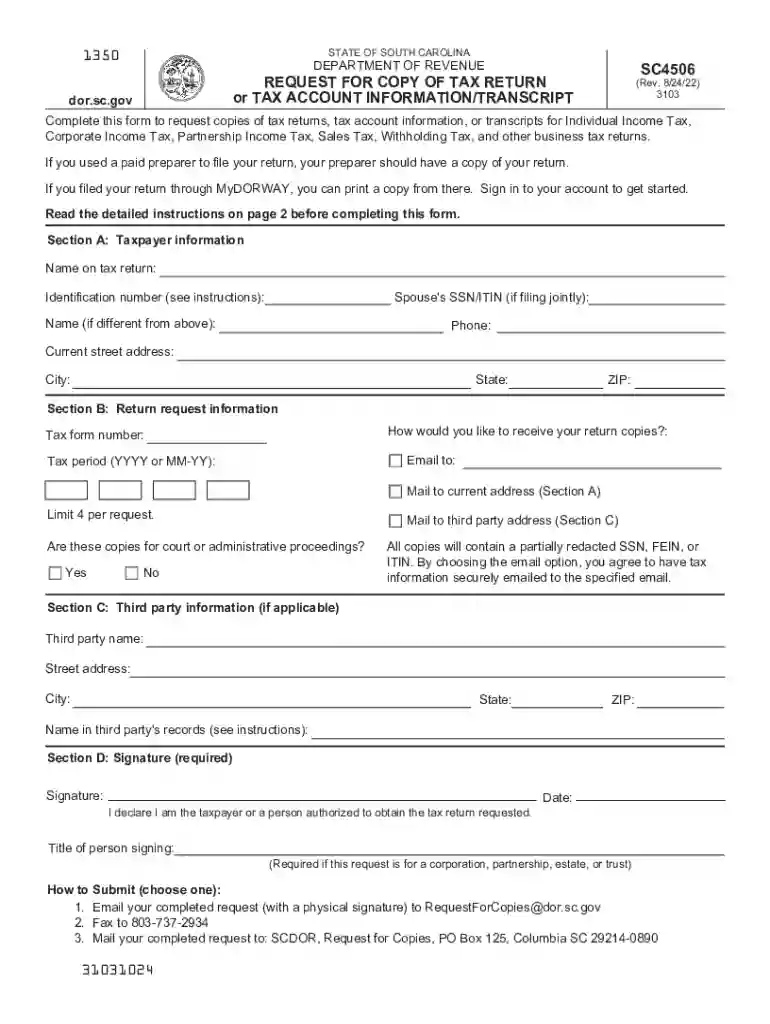
Type text, add images, blackout confidential details, add comments, highlights and more.

Draw your signature, type it, upload its image, or use your mobile device as a signature pad.

Send sc dor request via email, link, or fax. You can also download it, export it or print it out.
The SC 4506 is a form issued by the South Carolina Department of Revenue. It enables taxpayers to request duplicates of their previously filed tax returns, access their tax account information, or obtain transcripts related to various tax types. This document is crucial for taxpayers who need to verify their tax details for personal, business, or legal purposes. Understanding what the form allows and its key sections empowers taxpayers to use it effectively to manage their tax documentation requirements.
The effective use of the SC 4506 form hinges on its correct completion and submission. Taxpayers should carefully review each section of the form to ensure all fields are accurately and completely filled out. It is pivotal to include current and precise taxpayer information to avoid processing delays. Signatures are mandatory to validate the request. Submitting the form through the correct channels — whether via email, fax, or mail — ensures the request is processed in a timely manner. Understanding these nuances helps prevent errors that could prolong the retrieval of tax information.
Completing the SC 4506 with attention to detail enables taxpayers to efficiently request tax documents without unnecessary delays.
The SC 4506 form can serve various purposes:
These scenarios demonstrate the form's versatility in addressing different tax documentation needs.
Understanding the legal implications associated with the SC 4506 is crucial. The form should only be used by authorized individuals or duly appointed representatives to prevent unauthorized access to sensitive information. Privacy guidelines, as outlined by the South Carolina Department of Revenue, ensure taxpayers' data is handled securely and lawfully. Taxpayers should be aware of their rights and the form's limitations to protect themselves from the risk of unauthorized disclosures.
Several core elements are crucial for understanding and using the SC 4506 effectively:
These components ensure precise handling of tax documentation requests and uphold the integrity of the process.
Familiarity with specific terms associated with the SC 4506 can aid in its effective use:
Understanding these terms enhances comprehension and lightens the path for proper form usage.
The SC 4506 form offers multiple submission methods tailored to user convenience:
Knowing which method suits one's situation best aids in the smooth operation of document requests and retrievals.
South Carolina has specific regulations that affect the SC 4506’s usage:
These guidelines provide a structured approach to managing and fulfilling tax-related requests using the SC 4506.
We've got more versions of the sc4506 form. Select the right sc4506 version from the list and start editing it straight away!
At DocHub, your data security is our priority. We follow HIPAA, SOC2, GDPR, and other standards, so you can work on your documents with confidence.
Jun 6, 2016 HPE ProLiant DL360 Gen9 Server delivers increased performance with the best memory and I/O expandability packed in a 1U dense rack design.
Use Form 4506, Request for Copy of Tax Return, to request copies of tax returns. Automated transcript request. You can quickly request transcripts by using ourRead more
Visit MyDORWAY.dor.sc.gov to get started. Youll need your FEIN or SSN, License Number, and a Letter ID or copy of your last return. Tutorials are availableRead more


