




01. Edit your code 150 with amount and date online
Type text, add images, blackout confidential details, add comments, highlights and more.

Type text, add images, blackout confidential details, add comments, highlights and more.

Draw your signature, type it, upload its image, or use your mobile device as a signature pad.

Send form mcs 150 via email, link, or fax. You can also download it, export it or print it out.
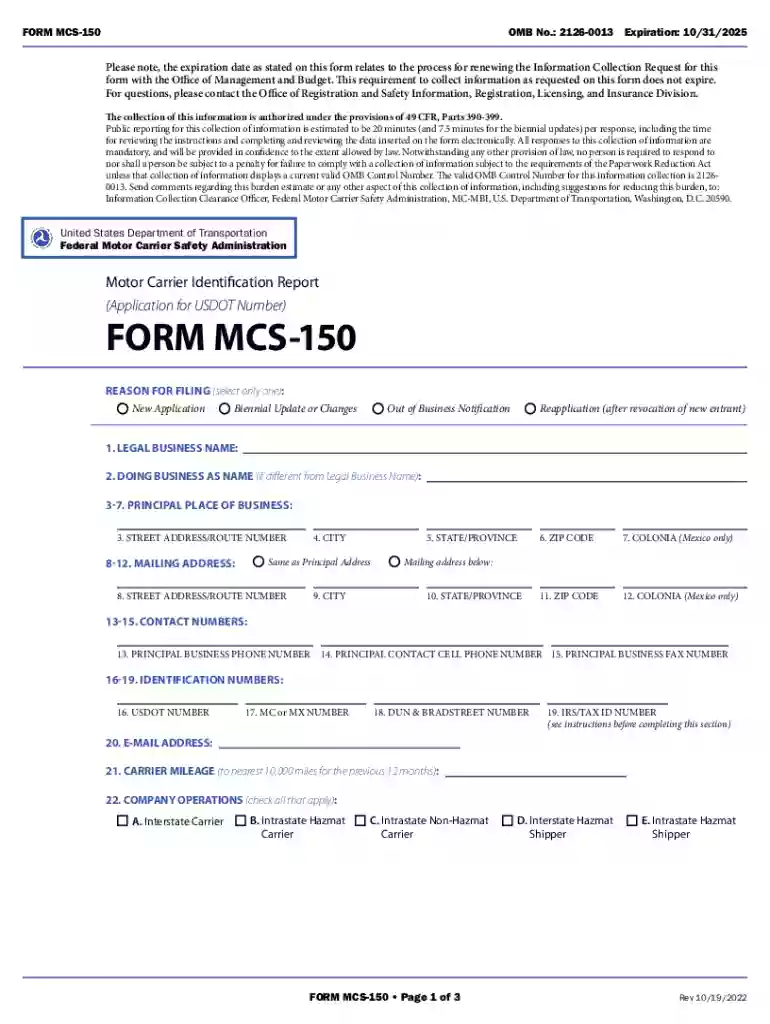
The MCS-150 form, known as the Motor Carrier Identification Report, is a critical document used by the Federal Motor Carrier Safety Administration (FMCSA) to gather essential information about motor carriers operating in interstate commerce. This form helps establish the carrier's operational profile, which aids in ensuring regulatory compliance and safety standards. Carriers use this form to apply for a USDOT Number, which is mandatory for commercial vehicles engaged in interstate transport. Periodic updates are required to maintain accuracy in the FMCSA's records.
The MCS-150 form serves multiple purposes, including registering new motor carriers and updating existing information. When filling out this form, carriers provide details about their operations, including address, types of cargo, and vehicle classification. This data is essential for the FMCSA to monitor compliance with safety regulations. Carriers must ensure their information is current by submitting updates every two years or when significant changes occur, such as an increase in the number of vehicles or changes in operating status.
Carriers can access the MCS-150 form through the FMCSA website, where it is available for download in PDF format. They can also complete it online via the Unified Registration System (URS), which guides through the process using an interactive interface. For those preferring a hard copy, the form can be requested by contacting FMCSA. Given the form's critical nature, ensuring access through multiple channels allows carriers to remain compliant without unnecessary delays.
Accurate completion of the MCS-150 form is crucial as it enables carriers to maintain compliance with federal regulations, preventing potential penalties. It ensures that regulatory authorities have accurate data, which supports safer roadways through effective monitoring of commercial transport. Additionally, the process guarantees that carriers receive a USDOT Number, a prerequisite for legal operation in interstate commerce. This assists in fostering a culture of safety and accountability within the transportation industry.
Failure to submit the MCS-150 form or maintain accurate information can lead to significant penalties, including fines and operational suspension. Non-compliance affects a carrier's ability to legally transport goods across state lines, disrupting business activities. Moreover, inaccurate filings can result in additional scrutiny from regulatory authorities, impacting the carrier's safety rating and reputation. Ensuring timely and correct submissions can circumvent these risks and promote a sustainable business operation.
The MCS-150 form can be submitted online via the FMCSA portal, offering a fast and efficient method for processing. Alternatively, carriers can mail a completed paper form to the FMCSA's designated address. Online submission is generally preferred for its speed and direct integration with the FMCSA's database. However, paper submissions are an option for those who prefer traditional methods or face technical challenges online, though this may result in longer processing times.
The MCS-150 form must be used in compliance with FMCSA regulations, which dictate precise rules for when new registrations and updates are required. It forms part of the legal documentation motor carriers need for lawful operation on interstate highways. Accurate filings ensure carriers meet federal standards for safety and operational transparency, aligning with legal requirements and contributing to a structured transport industry. Carriers must adhere to these stipulations to avoid potential legal disputes and maintain their operational licenses.
We've got more versions of the code 150 with amount and date form. Select the right code 150 with amount and date version from the list and start editing it straight away!
| Versions | Form popularity | Fillable & printable |
|---|---|---|
| 2026 | 4.7 Satisfied (25 Votes) | |
| 2025 | 4.2 Satisfied (58 Votes) | |
| 2024 | 4.6 Satisfied (35 Votes) | |
| 2024 | 4.8 Satisfied (53 Votes) | |
| 2023 | 4.7 Satisfied (30 Votes) | |
| 2022 | 4.8 Satisfied (63 Votes) | |
| 2018 | 4.7 Satisfied (62 Votes) | |
| 2016 | 4.3 Satisfied (282 Votes) | |
| 2007 | 4.4 Satisfied (561 Votes) | |
| 2005 | 4 Satisfied (32 Votes) | |
| 2004 | 4.2 Satisfied (68 Votes) | |
| 2003 | 4.6 Satisfied (31 Votes) | |
| 2000 | 4.3 Satisfied (61 Votes) |
At DocHub, your data security is our priority. We follow HIPAA, SOC2, GDPR, and other standards, so you can work on your documents with confidence.
The software described in this document is furnished under a license agreement. You can obtain a copy of that license by.Read more
Each motor carrier and intermodal equipment provider must file Form MCS-150, Form MCS-150B or Form MCS-150C with FMCSA as follows: (1) A U.S.-, CanadaRead more


