




01. Edit your mw506fr online
Type text, add images, blackout confidential details, add comments, highlights and more.

Type text, add images, blackout confidential details, add comments, highlights and more.

Draw your signature, type it, upload its image, or use your mobile device as a signature pad.

Send it via email, link, or fax. You can also download it, export it or print it out.
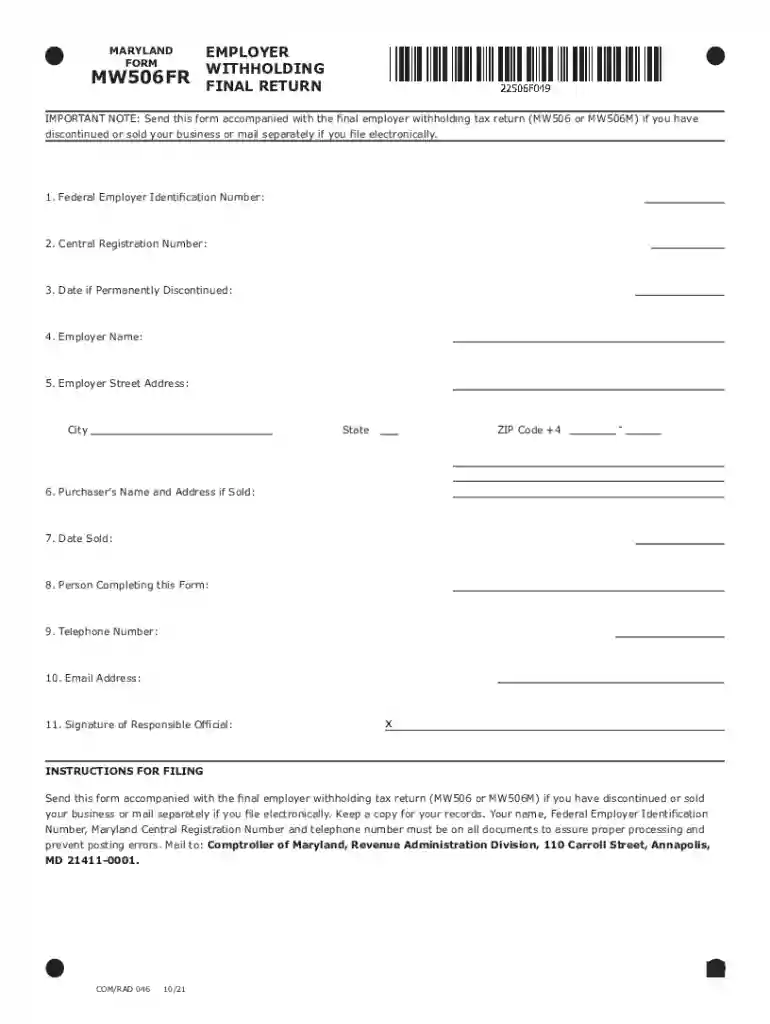
The Maryland Employer Form MW506FR Final Return is a mandated tax document used by businesses in Maryland to report their final employer withholding taxes when a business is either sold or permanently closed. This form finalizes the employer's tax obligations to the state, ensuring that all due taxes are settled. The MW506FR form gathers essential information such as employer identification numbers, details of business cessation, and contact information of the responsible party completing the form.
To effectively use the MW506FR, employers must accurately report the final payroll and corresponding tax withholdings up to the date of business closure or sale. Employers need to:
Depending on the complexity of the business's financial structure, consultation with a tax professional may be advisable to ensure complete accuracy.
Completing the MW506FR form involves a systematic approach to capture all necessary data:
Employing the MW506FR form ensures compliance with Maryland state law concerning tax obligations. It provides several benefits:
The MW506FR form is primarily used by:
These users benefit from the form’s clear structure in outlining final tax obligations.


To file the MW506FR form, you'll need:
The MW506FR form must be filed promptly upon business closure or sale. Key dates include:
Timely submission is crucial to ensure compliance and avoid being penalized.
Failure to file the MW506FR form or inaccurate reporting can lead to:
Understanding and meeting compliance requirements ensures that businesses avoid these financial consequences.
We've got more versions of the mw506fr form. Select the right mw506fr version from the list and start editing it straight away!
At DocHub, your data security is our priority. We follow HIPAA, SOC2, GDPR, and other standards, so you can work on your documents with confidence.
Nov 15, 2016 You may file and pay your withholding return via the following three electronic methods: bFile - File Withholding Returns (MW506) You may.Read more
FORM. MW506FR. EMPLOYER. WITHHOLDING. FINAL RETURN. IMPORTANT NOTE: Send this form accompanied with the final employer withholding tax return (MW506 or MW506M)Read more


