




01. Edit your form online
Type text, add images, blackout confidential details, add comments, highlights and more.

Type text, add images, blackout confidential details, add comments, highlights and more.

Draw your signature, type it, upload its image, or use your mobile device as a signature pad.

Send it via email, link, or fax. You can also download it, export it or print it out.
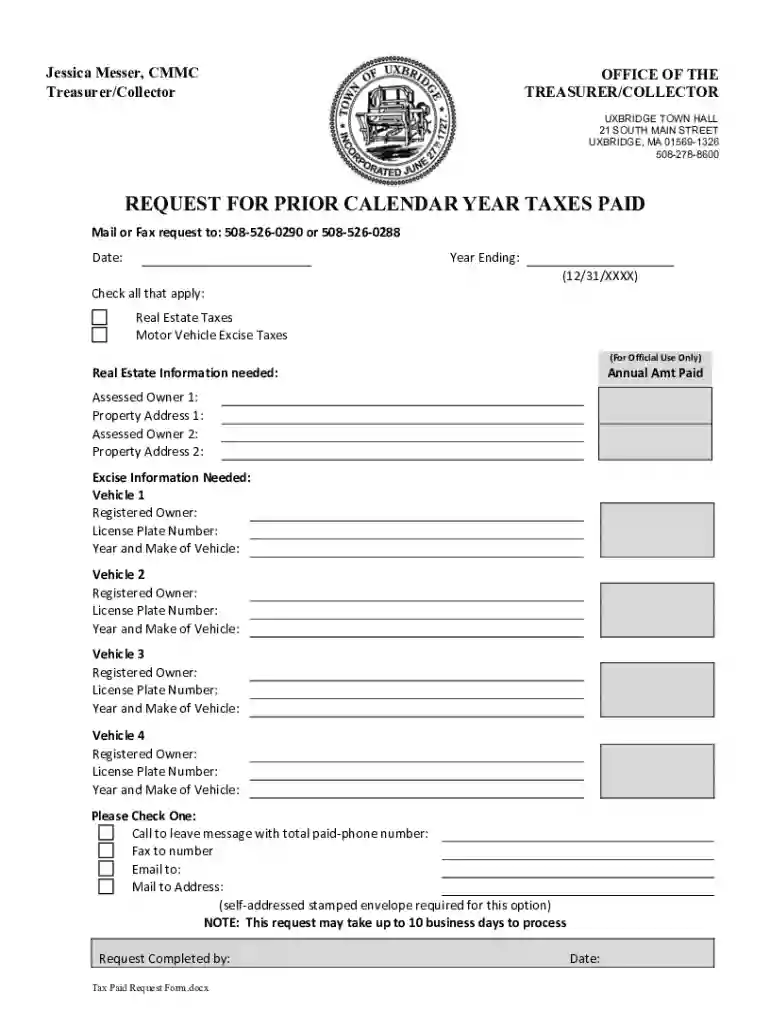
The Tax Paid Request Form is an official document used to request detailed information about taxes paid within a specific timeframe, typically the previous calendar year. Commonly used by individuals and businesses, this form facilitates the acquisition of records related to various tax payments, such as real estate taxes and motor vehicle excise taxes. The primary goal is to assist taxpayers in organizing their fiscal affairs and ensuring compliance with tax-related obligations by securing verifiable proof of payments made.
Filling out the Tax Paid Request Form accurately is essential for obtaining the desired tax records. Here’s a step-by-step guide on how to use the form effectively:
Consider a homeowner who needs proof of real estate taxes paid for refinancing purposes. They would complete the relevant sections for real estate taxes on this form, providing details like property address and personal information, to receive the required documentation.
Securing the Tax Paid Request Form is a straightforward process. It is typically available through the Treasurer/Collector office of the respective jurisdiction or local government entity.
In all cases, ensure you access the form from official and credible sources to prevent using outdated or incorrect versions.
The completion of the Tax Paid Request Form is straightforward, but precision is vital to avoid complications:
Understanding the key components of the Tax Paid Request Form will streamline the process of filling it out and ensure it serves its intended purpose.
The Tax Paid Request Form holds significant legal importance, serving both individuals and government entities in maintaining accurate financial reporting and compliance.
Due to variations in state tax laws, the regulations surrounding the Tax Paid Request Form can differ significantly across regions.
The use of the Tax Paid Request Form can differ based on individual or business needs.
We've got more versions of the Tax Paid Request Form form. Select the right Tax Paid Request Form version from the list and start editing it straight away!
At DocHub, your data security is our priority. We follow HIPAA, SOC2, GDPR, and other standards, so you can work on your documents with confidence.
Enter the tax form number here (1040, 1065, 1120, etc.) and check the appropriate box below. Enter only one tax form number per request. a Return Transcript,Read more
Dec 11, 2025 The fastest and easiest way to request an IPA is through your Online Services account. You can make your request call us at 518-457-5434
Feb 1, 2018 Use Form 7004 to request an automatic extension of time to file certain business income tax, information, and other returns. The extension willRead more


