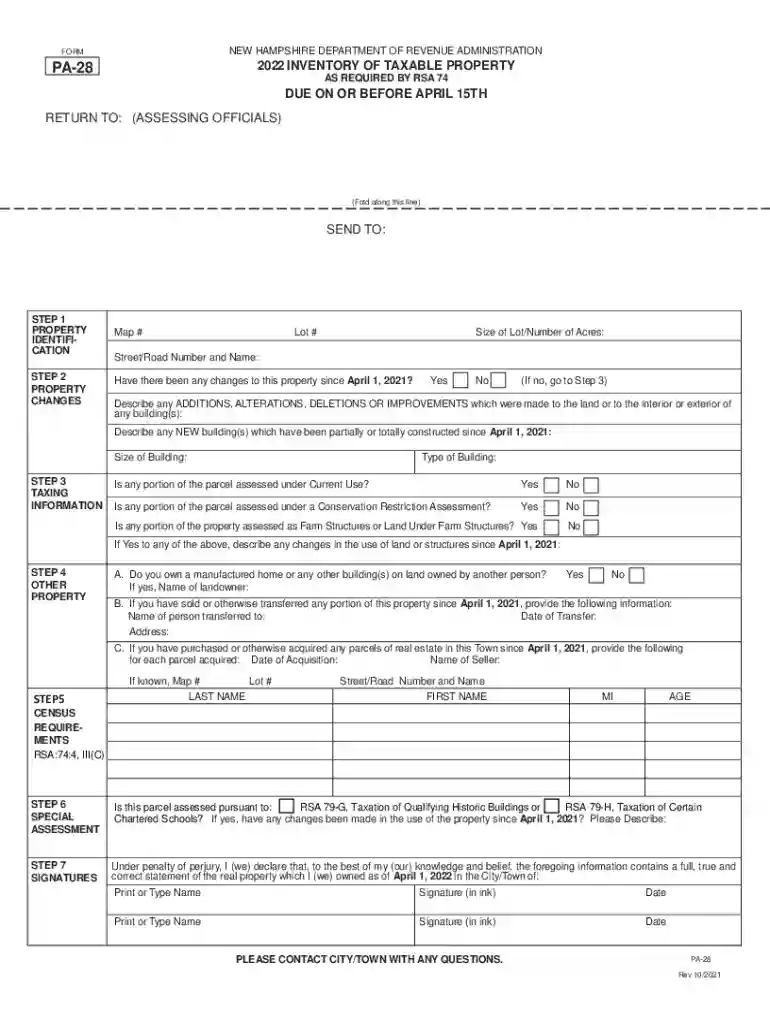
2022 INVENTORY OF TAXABLE PROPERTY DUE ON OR BEFORE ...-2026

Get Form
2022 INVENTORY OF TAXABLE PROPERTY DUE ON OR BEFORE ... Preview on Page 1

Here's how it works

01. Edit your form online
Type text, add images, blackout confidential details, add comments, highlights and more.

02. Sign it in a few clicks
Draw your signature, type it, upload its image, or use your mobile device as a signature pad.

03. Share your form with others
Send it via email, link, or fax. You can also download it, export it or print it out.

How to use or fill out 2022 INVENTORY OF TAXABLE PROPERTY DUE ON OR BEFORE ... with our platform

Form edit decoration
9.5
Ease of Setup
DocHub User Ratings on G2
9.0
Ease of Use
DocHub User Ratings on G2
  1. Click ‘Get Form’ to open the 2022 INVENTORY OF TAXABLE PROPERTY in the editor.
  2. Begin by entering your property identification details in Step 1, including the Map and Lot number, size of the lot, and street/road name.
  3. In Step 2, indicate if there have been any changes to the property since April 1, 2021. If yes, describe any additions or alterations made.
  4. Proceed to Step 3 and answer whether any portion of the parcel is assessed under Current Use or Conservation Restriction Assessment. Provide details on any changes since April 1, 2021.
  5. In Step 4, report on other properties owned on land owned by another person and provide information about any transfers or acquisitions since April 1, 2021.
  6. Complete Step 5 by entering occupant names and ages as of April 1, 2022. Ensure all signatures are provided in Step 7.

Start using our platform today for free to complete your form efficiently!

See more 2022 INVENTORY OF TAXABLE PROPERTY DUE ON OR BEFORE ... versions

We've got more versions of the 2022 INVENTORY OF TAXABLE PROPERTY DUE ON OR BEFORE ... form. Select the right 2022 INVENTORY OF TAXABLE PROPERTY DUE ON OR BEFORE ... version from the list and start editing it straight away!
Versions Form popularity Fillable & printable
2023 4.8 Satisfied (24 Votes)
2022 4.8 Satisfied (53 Votes)
2021 4.9 Satisfied (51 Votes)
2018 4.3 Satisfied (201 Votes)
2013 4.3 Satisfied (54 Votes)
be ready to get more

Complete this form in 5 minutes or less

Get form

Got questions?

We have answers to the most popular questions from our customers. If you can't find an answer to your question, please contact us.
Contact us
Georgias companies pay no state property tax on inventory or any other real or personal property.
Overstating your ending inventory means youll be understating COGS, meaning youll end up with a higher taxable income and, consequently, higher taxes to pay. Equally, understating your ending inventory means youll be overstating your COGS, resulting in a lower taxable income and lower taxes.
Businesses generally must use inventories for income tax purposes when necessary to clearly reflect income. To clearly reflect income, businesses must take inventories at the beginning and end of each tax year in which the production, purchase or sale of merchandise is an income-producing factor.
Inventory taxes are classified in the same column as a business tangible personal property tax. It is imposed on a companys unsold stock at the end of the year.
Yes, property taxes are deductible for federal income tax purposes, but only if certain conditions are met. You can claim a deduction for real estate taxes if: The property is not used for business purposes. The taxes are based on the assessed value of the property.

Security and compliance

At DocHub, your data security is our priority. We follow HIPAA, SOC2, GDPR, and other standards, so you can work on your documents with confidence.

Learn more
ccpa2
pci-dss
gdpr-compliance
hipaa
soc-compliance

People also ask

The fair market value is then assessed at rates established in the State Constitution. For manufacturers, real and personal property are both assessed at 10.5%. The assessment ratio for all other businesses is 6% for real property and 10.5% for personal property. (For homeowners, primary residences are assessed at 4%.)
It is imposed on a companys unsold stock at the end of the year. Inventory is taxed within the same bracket as furniture, tools, and/or equipment belonging to a business. This tax is separate from income tax, although there can be some interplay between the two.
Inventory tax is determined on a state level. There are currently 11 states that collect it: Arkansas, Alaska, Kentucky, Louisiana, Maryland, Mississippi, Oklahoma, Texas, Vermont, Virginia, and West Virginia. Its important to review each states property tax policies before deciding where to place your inventory.

Related links