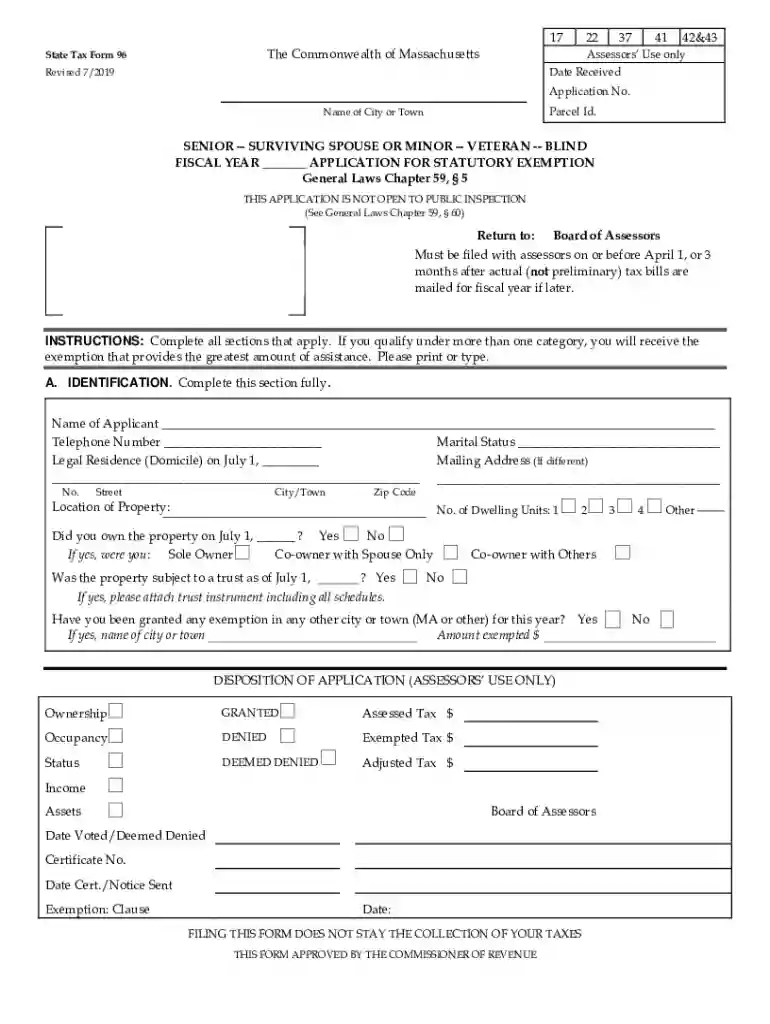
Lowellma.gov196572023-Clause-17-ApplicationSTATE TAX FORM 96-6 THE COMMONWEALTH OF MASSACHUSETTS ... 2026

Get Form
lowellma.gov196572023-Clause-17-ApplicationSTATE TAX FORM 96-6 THE COMMONWEALTH OF MASSACHUSETTS ... Preview on Page 1

Here's how it works

01. Edit your form online
Type text, add images, blackout confidential details, add comments, highlights and more.

02. Sign it in a few clicks
Draw your signature, type it, upload its image, or use your mobile device as a signature pad.

03. Share your form with others
Send it via email, link, or fax. You can also download it, export it or print it out.

Definition & Meaning

The Massachusetts State Tax Form 96, also known as the Clause 17 Application, is a critical document used by residents seeking property tax exemptions offered by the Commonwealth of Massachusetts. This form is designed specifically for seniors, surviving spouses, veterans, and blind individuals who meet specific criteria set by the state. The primary goal of this form is to provide financial relief to eligible applicants by reducing their property tax obligations, thus helping improve their financial well-being. By understanding the nuances of this form, applicants can ensure they are taking advantage of the tax benefits available to them.

Eligibility Criteria

Eligibility for the Clause 17 Application involves meeting specific conditions outlined by the state. These conditions include age requirements for seniors, military service verification for veterans, and official documentation of blindness or marital status for surviving spouses. Applicants must provide proof of income and assets, as these financial thresholds determine their eligibility. Understanding these criteria is vital for potential applicants, ensuring they gather the necessary documentation to support their application. Failure to meet the eligibility requirements will result in the denial of the tax exemption.


decoration image ratings of Dochub

Steps to Complete the Clause 17 Application

  1. Gather Necessary Documentation: Before completing the form, applicants should collect all relevant documents, including proof of identification, income statements, and any certificates that demonstrate eligibility.
  2. Fill Out the Form: Enter personal information accurately, such as name, address, and Social Security number. Ensure that all sections are completed to avoid processing delays.
  3. Attach Documentation: Include copies of all required documents, ensuring they are clear and legible. Attach them securely to the completed form.
  4. Review and Sign: Carefully review the information provided on the form for accuracy. Sign the document to affirm the truthfulness of the information.
  5. Submit the Form: Deliver the completed application and all attachments to the local assessor’s office by mail, online, or in person. Check with the local office for specific submission requirements.

Required Documents

When applying for the Clause 17 exemption, applicants must provide several key documents to substantiate their eligibility:

  • Proof of Identity: A government-issued ID such as a driver’s license or passport.
  • Financial Records: Recent income statements or tax returns to demonstrate income level.
  • Eligibility Verification: Documents proving age, veteran status, blindness, or marital status, such as birth certificates, discharge papers, or medical certificates.
  • Property Deeds: Ownership documentation to verify the property in question.

Filing Deadlines / Important Dates

The Clause 17 application must be submitted within the designated filing period, typically set by the local municipality. Deadlines are crucial as late submissions can disqualify applicants from receiving the exemption that tax year. Generally, applications are due annually, and it is important to check with the local tax office for specific cutoff dates, which may vary between cities and towns. Keeping track of these deadlines ensures continuous eligibility for tax relief.

Key Elements of the Clause 17 Application

The application contains several critical sections, each requiring specific information:

  • Applicant Information: Personal and contact details of the applicant.
  • Property Description: Information detailing the property for which the exemption is sought.
  • Eligibility Certification: A section where applicants attest to meeting the criteria for tax relief.
  • Financial Information: A summary of the applicant’s financial status to support the need for exemption.

Application Process & Approval Time

After submission, the application process involves review by the local assessor’s office, where staff verify all documentation and eligibility criteria. Approval time can vary but generally takes several weeks. During this period, applicants may be contacted for additional information or clarification. Communication with the assessor’s office is crucial to expedite processing and ensure no details are overlooked. Once approved, applicants will receive a notice confirming their tax exemption for the upcoming tax cycle.

Penalties for Non-Compliance

Non-compliance with the filing requirements can lead to disqualification from receiving the tax exemption. Failure to submit accurate or complete information, or missing the filing deadline, may result in penalties such as back taxes owed or a delay in processing future applications. It is important for applicants to adhere strictly to submission guidelines and provide truthful information to avoid these penalties. Regularly updating documentation and staying informed about changes in eligibility criteria can assist in maintaining compliance.

See more lowellma.gov196572023-Clause-17-ApplicationSTATE TAX FORM 96-6 THE COMMONWEALTH OF MASSACHUSETTS ... versions

We've got more versions of the lowellma.gov196572023-Clause-17-ApplicationSTATE TAX FORM 96-6 THE COMMONWEALTH OF MASSACHUSETTS ... form. Select the right lowellma.gov196572023-Clause-17-ApplicationSTATE TAX FORM 96-6 THE COMMONWEALTH OF MASSACHUSETTS ... version from the list and start editing it straight away!
Versions Form popularity Fillable & printable
2022 4.5 Satisfied (59 Votes)
2019 4.6 Satisfied (80 Votes)
2017 4.8 Satisfied (266 Votes)
2016 4.2 Satisfied (81 Votes)
2011 4.4 Satisfied (142 Votes)
be ready to get more

Complete this form in 5 minutes or less

Get form

Got questions?

We have answers to the most popular questions from our customers. If you can't find an answer to your question, please contact us.
Contact us
For instance, while most states set the bar at 65, states like Washington allow exemptions starting at 61. Alabama is the only state that offers total property tax exemption to seniors 65 and up.
Contact Your Assessors Office First, contact your local assessors office. They can answer questions about your assessment, provide appropriate paperwork, and assist with any special circumstances. Your assessors office may also provide information that could assist with your tax bill.
In the United States, there is no specific age at which seniors automatically stop paying taxes. However, as you get older, your tax responsibilities can change. Seniors often have different tax rules than younger taxpayers.
Massachusetts laws Includes clauses for real estate tax exemptions for blind persons, qualifying senior citizens, qualifying surviving spouses, minor children and elderly persons, qualifying veterans, and religious and charitable organizations.
You must be 70 or older. For Clauses 41C and 41C, the eligible age may be reduced to 65 or older, by vote of the legislative body of your city or town. You must own and occupy the property as your domicile.

Security and compliance

At DocHub, your data security is our priority. We follow HIPAA, SOC2, GDPR, and other standards, so you can work on your documents with confidence.

Learn more
ccpa2
pci-dss
gdpr-compliance
hipaa
soc-compliance

People also ask

Unlike the federal estate tax exemption ($13,610,000 in 2024) which is adjusted annually for inflation, the $2 million Massachusetts estate tax exemption is not indexed for inflation. Rather, the Massachusetts estate tax exemption will remain stagnant at $2 million annually, unless and until the law is changed.
Chapter 59, Section 5 Clause 41A: Elderly Tax Deferral Allows seniors 65 years of age or older who meet certain income and other requirements to defer all or a portion of their real estate taxes.