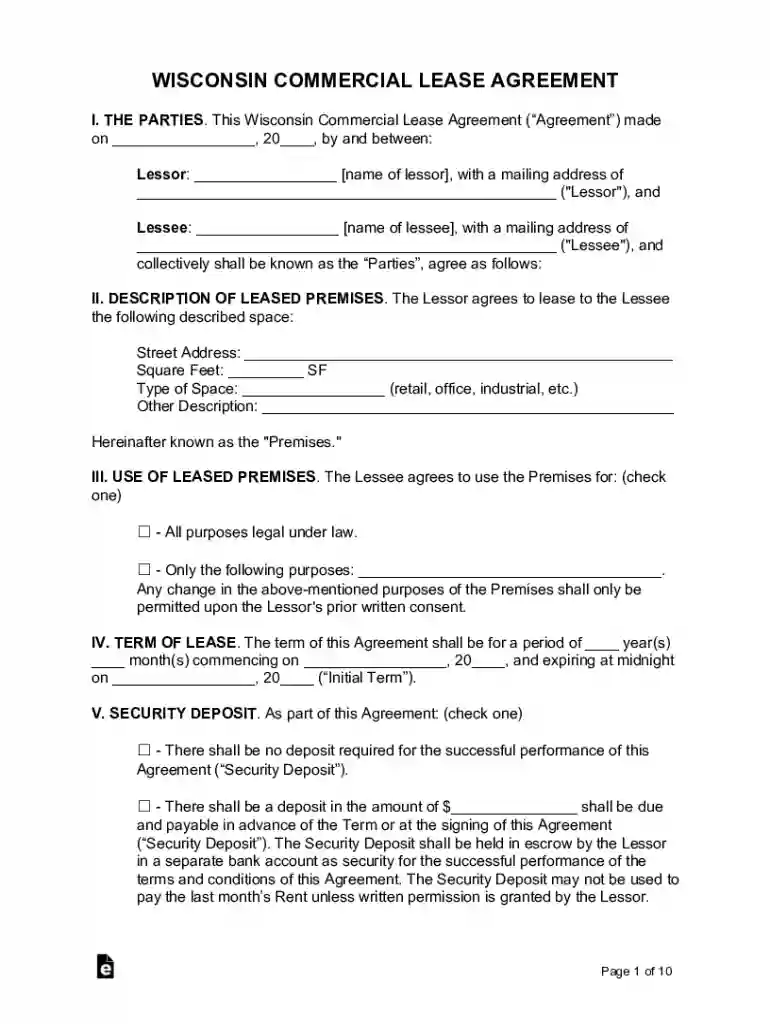
This Wisconsin Commercial Lease Agreement (Agreement) made 2026

Get Form
wisconsin commercial lease agreement Preview on Page 1

Here's how it works

01. Edit your wisconsin commercial lease agreement online
Type text, add images, blackout confidential details, add comments, highlights and more.

02. Sign it in a few clicks
Draw your signature, type it, upload its image, or use your mobile device as a signature pad.

03. Share your form with others
Send commercial lease agreement wisconsin via email, link, or fax. You can also download it, export it or print it out.

Definition and Meaning

The "Wisconsin Commercial Lease Agreement" is a legally binding document that outlines the arrangement between a lessor and a lessee for leasing commercial property. This agreement specifies critical details such as the identity of the parties involved, the property description, lease duration, and conditions under which the property can be used. The agreement serves to protect the rights and responsibilities of both the lessor and the lessee, ensuring a clear understanding of expectations and obligations.

Key Elements of the Wisconsin Commercial Lease Agreement

  • Parties Involved: The agreement identifies the lessor (property owner) and the lessee (tenant).
  • Leased Premises: It includes a detailed description of the property, including size, location, and specific features.
  • Lease Term: Specifies the duration of the lease, start and end dates, and any renewal options.
  • Rent Payment Structure: Details the base rent, any percentage rent, due dates, and acceptable payment methods.
  • Security Deposit: Outlines the amount required and conditions for its return.
  • Maintenance and Repairs: Specifies maintenance responsibilities of both parties.
  • Insurance Requirements: Details the types of insurance required by the lessee.

Steps to Complete the Wisconsin Commercial Lease Agreement

  1. Gather Required Information: Collect details such as the property address, personal details of the lessor and lessee, and lease terms.
  2. Fill Out the Agreement: Complete sections related to rent, lease duration, security deposit, and any specific terms agreed upon by both parties.
  3. Review Terms Carefully: Both parties should read the agreement thoroughly to ensure all terms are understood.
  4. Sign the Agreement: Once both parties agree, sign the document to make it legally binding. Legal compliance with the Electronic Signatures in Global and National Commerce (ESIGN) Act allows electronic signatures to be used.
  5. Distribute Copies: Ensure both parties have a copy of the signed agreement for their records.

State-Specific Rules for the Wisconsin Commercial Lease Agreement

Wisconsin state law governs the rules and regulations of commercial lease agreements. The lease terms must comply with Wisconsin statutes, which include specific provisions related to tenant rights, allowable fees, and maintenance obligations. Unique to Wisconsin, there may be additional requirements for disclosing lead paint hazards in older buildings or specific state taxes applicable to rental income.

Important Terms Related to the Wisconsin Commercial Lease Agreement

  • Base Rent: The fixed amount the lessee pays for occupying the leased premises.
  • Percentage Rent: An additional rent amount that may be based on the lessee’s gross sales generated at the property.
  • Renewal Option: Allows the lessee the right to extend the lease under specified conditions.
  • Subletting: Refers to the lessee's ability to rent the leased space to a third party, subject to the lessor's approval.

Legal Use of the Wisconsin Commercial Lease Agreement

The agreement provides a legal framework that ensures both parties fulfill their contractual duties. It is enforceable in a court of law should any disputes arise. Compliance with commercial real estate laws in Wisconsin is mandatory, and the agreement should reflect all negotiated terms to avoid any legal misinterpretations. Should modifications be necessary, amendments should be documented and signed by both entities.

How to Obtain the Wisconsin Commercial Lease Agreement

This agreement can be procured in various ways, including downloading standardized templates from trusted legal documentation platforms like DocHub. Alternatively, legal professionals can draft a customized version tailored to specific business needs. Documents should be reviewed for adherence to Wisconsin state law and the specific conditions relevant to the lease.

Software Compatibility and Digital Version Availability

The Wisconsin Commercial Lease Agreement can be managed digitally using platforms like DocHub, which enhances ease of use and collaboration. The document can be edited, signed, and shared online without converting formats, supporting PDFs, DOCs, and other file types. This compatibility with digital solutions aligns with modern business practices, ensuring the process is efficient and well-documented.

Business Types That Benefit Most from the Wisconsin Commercial Lease Agreement

Various businesses can benefit from using this lease agreement, including:

  • Retail Outlets: Stores leasing space in malls or standalone buildings.
  • Office-Based Companies: Firms needing office space resources.
  • Industrial Entities: Manufacturers or distributors leasing warehouses or production facilities.
  • Restaurants and Cafes: Dining establishments occupying commercial properties.

The agreement helps delineate clear expectations and responsibilities, ensuring a seamless operational environment.

See more This Wisconsin Commercial Lease Agreement (Agreement) made versions

We've got more versions of the This Wisconsin Commercial Lease Agreement (Agreement) made form. Select the right This Wisconsin Commercial Lease Agreement (Agreement) made version from the list and start editing it straight away!
Versions Form popularity Fillable & printable
2022 4.8 Satisfied (170 Votes)
2015 4.3 Satisfied (109 Votes)
be ready to get more

Complete this form in 5 minutes or less

Get form

Got questions?

We have answers to the most popular questions from our customers. If you can't find an answer to your question, please contact us.
Contact us
The most common types include Full Repairing and Insuring Lease (FRI) lease, Gross Lease, Net Lease and Percentage Lease.
Compare Commercial Lease Agreements Gross leases tend to benefit the tenant, whereas net leases are more landlord friendly. In a gross lease, the tenant has more control over how much is spent on such expenses as janitorial services and utilities.
Does a Wisconsin lease agreement have to be docHubd? In Wisconsin, rental agreements do not have to be docHubd as long as it meets the legal criteria and is signed by both parties. Landlords and tenants could choose to have their lease agreement docHubd, but it is not required.
However, generally a well-drafted lease should begin with a contents page and the lease itself will be ordered as follows: Details of the parties. Definitions and interpretation. Operative clauses. Schedules. Provisos. Signature.
Distinction Between NNN and Other Lease Agreements A Triple Net Lease (NNN) places the responsibility for property expenses on the tenant. This includes common area maintenance (CAM), property taxes, and insurance. In contrast, a Gross Lease includes these costs in a single rent payment, making it simpler for tenants.

Security and compliance

At DocHub, your data security is our priority. We follow HIPAA, SOC2, GDPR, and other standards, so you can work on your documents with confidence.

Learn more
ccpa2
pci-dss
gdpr-compliance
hipaa
soc-compliance

People also ask

If a tenant wants to terminate their lease agreement before the end of the lease term, they must provide the landlord with a notice of their intention to vacate the premises. The landlord may be entitled to a penalty fee, which is usually specified in the lease agreement.
If youre wondering what is the most common type of residential lease, the answer is the fixed-term lease. This lease type locks in tenants for a set period, typically 12 months, giving landlords predictable rental income and financial security.
Gross Lease Gross leases are most common for commercial properties such as offices and retail space. The tenant pays a single, flat amount that includes rent, taxes, utilities, and insurance. The landlord is responsible for paying taxes, utilities, and insurance from the rent fees.

Related links