




01. Edit your form online
Type text, add images, blackout confidential details, add comments, highlights and more.

Type text, add images, blackout confidential details, add comments, highlights and more.

Draw your signature, type it, upload its image, or use your mobile device as a signature pad.

Send it via email, link, or fax. You can also download it, export it or print it out.
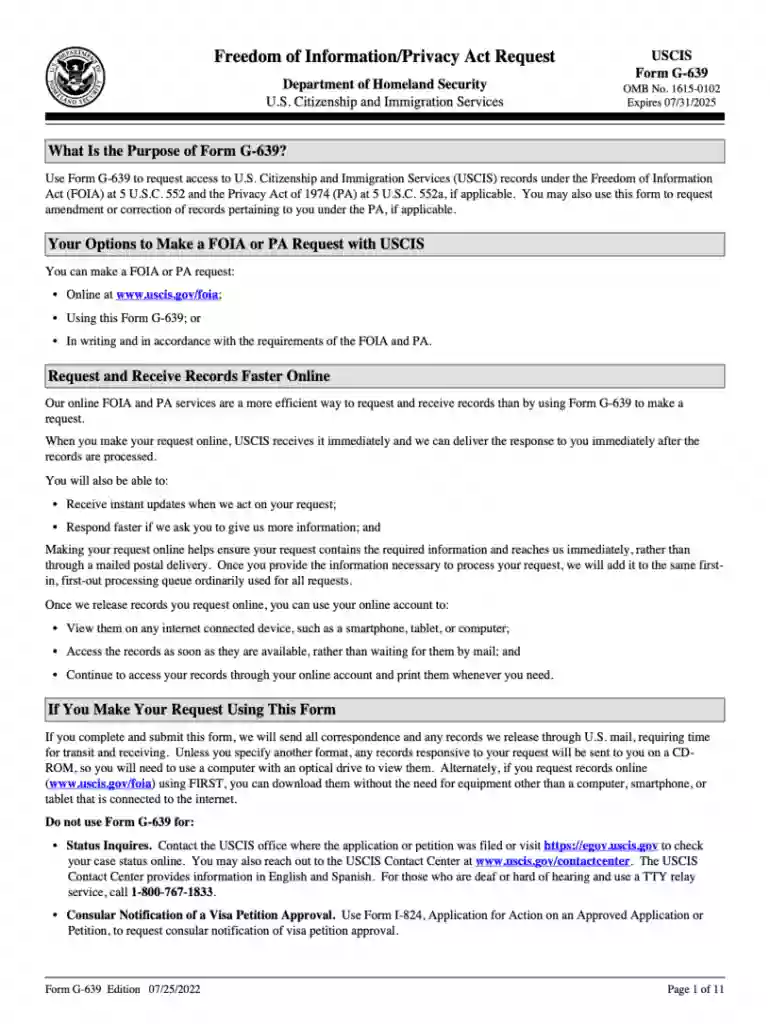
The USCIS G-639 Form, known as the "Freedom of Information Act/Privacy Act Request," is utilized to request access to records held by U.S. Citizenship and Immigration Services. This document is essential for individuals seeking copies of their immigration records for personal, legal, or administrative purposes. It enables users to acquire pertinent information related to immigration status, history, and other citizenship documentation that the USCIS maintains.
Completing the USCIS G-639 Form requires careful attention to detail to ensure accurate and successful submission. Below is a step-by-step guide:
Identify the Request Type:
Provide Personal Information:
Specify the Records Requested:
Sign and Date:
Attach Necessary Documentation:
Understanding the legal implications of using the USCIS G-639 Form is crucial:
Several critical components should be accurately filled out for the USCIS G-639 Form:
Understanding key terminology aids in accurately completing the form:
The USCIS G-639 Form is applicable in various scenarios. Several examples include:
There are several ways to submit the USCIS G-639 Form:
The USCIS G-639 Form is issued by:
United States Citizenship and Immigration Services (USCIS): A component of the Department of Homeland Security responsible for overseeing lawful immigration to the U.S.
Publication & Updates: USCIS regularly updates the form and instructions to reflect policy changes.
By understanding these aspects, individuals using the USCIS G-639 Form can efficiently navigate the process to access necessary immigration records. The precise use of this form ensures compliance with legal standards while facilitating access to vital information for various personal and professional purposes.
We've got more versions of the USCIS G-639 Form form. Select the right USCIS G-639 Form version from the list and start editing it straight away!
If you frequently work with documents kept in your Google Drive, DocHub is a superb solution for you to easily and quickly complete, edit, and sign them. This editor integrates properly with Google services, so you can export your USCIS G-639 Form from your Google Drive to the editor without the need of downloading and re-uploading it. Right-click on your file, select Open With → DocHub PDF Sign and Edit. In our editor, add and assign Signature Fields for all parties involved, then click on the Menu option above → Send → select how you want to share your form.
You may find and edit your USCIS G-639 Form online by using DocHub. Its simple but feature-rich design allows you to begin effective work right after you sign up your account. Create your account and add your document, then our user interface will guide you via our stress-free form completion experience.
At DocHub, your data security is our priority. We follow HIPAA, SOC2, GDPR, and other standards, so you can work on your documents with confidence.
Mar 1, 2016 This form is used to request access to information under the Freedom of Information and Privacy Acts.
Nov 3, 2022 Use Form G-639 to request access to U.S. Citizenship and Immigration Services (USCIS) records under the Freedom of Information.Read more
Download, The United States Government Manual. Open PDF In Browser, View PDF. The United States Government Manual Getting Started To begin searching withinRead more


