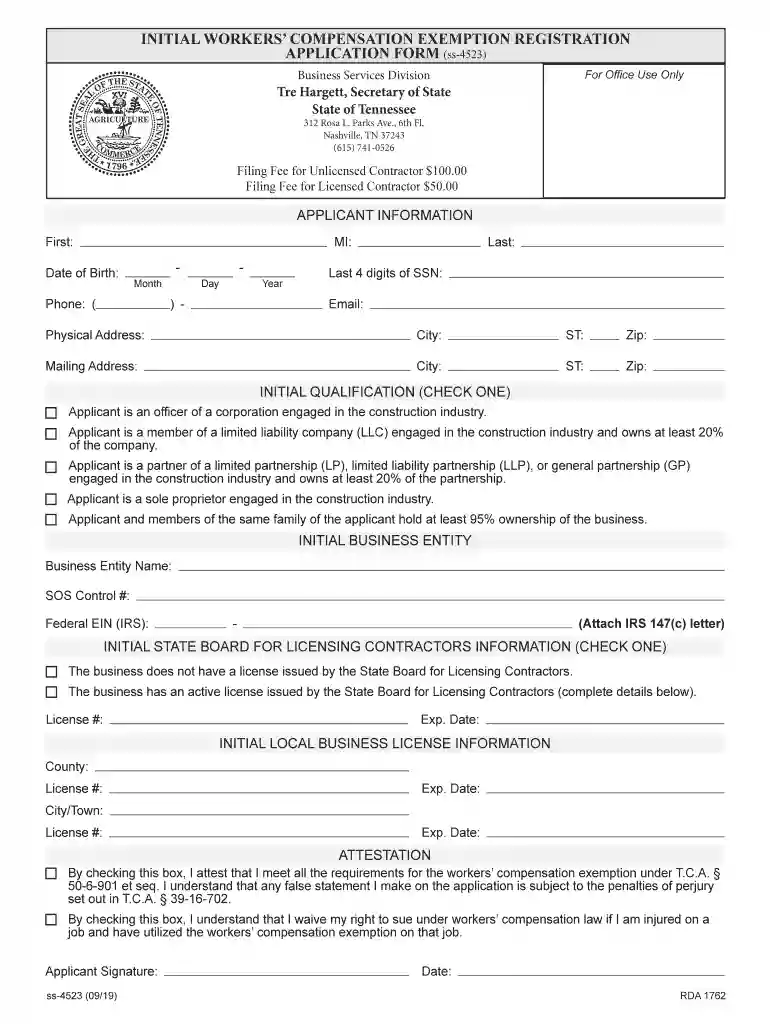
Worker compensation exemption registration 2026

Get Form
workers comp exemption tn Preview on Page 1

Here's how it works

01. Edit your workers comp exemption tn online
Type text, add images, blackout confidential details, add comments, highlights and more.

02. Sign it in a few clicks
Draw your signature, type it, upload its image, or use your mobile device as a signature pad.

03. Share your form with others
Send tn workers comp exemption via email, link, or fax. You can also download it, export it or print it out.

Definition and Meaning of Worker Compensation Exemption Registration

Worker compensation exemption registration is the process by which eligible individuals or businesses apply for exemption from mandatory workers' compensation insurance coverage in the construction industry. In Tennessee, this registration is crucial for contractors and subcontractors who wish to operate without the financial and legal burden of carrying workers' compensation insurance.

The primary intent of this registration is to provide protection for business owners and their employees by allowing certain qualified entities to opt-out of the state's workers' compensation program. This typically applies to sole proprietors and certain business classifications, which must meet specific criteria outlined in state regulations. By acquiring this exemption, businesses can allocate funds that would otherwise be used for insurance premiums towards other operational costs.

Important Terms Related to Worker Compensation Exemption Registration

Understanding the terminology associated with worker compensation exemption registration is essential for navigating the application process. These terms include:

  • Exemption Category: Classification of business or individual that qualifies for exemption status.
  • Entity Types: The different business structures, such as sole proprietorships, LLCs, and corporations, that may apply for exemption.
  • Filing Fee: The required payment submitted with the application, which can vary based on the type of exemption being sought.
  • Certificate of Exemption: The official document issued upon approval of the worker compensation exemption registration.

Clarifying these terms can prevent confusion during the registration process and ensure that applicants understand the requirements and implications of their decisions.

Steps to Complete the Worker Compensation Exemption Registration

The process for obtaining a worker compensation exemption registration involves several concise steps, which are as follows:

  1. Determine Eligibility: Assess whether your business qualifies for exemption based on the type of entity and compliance with Tennessee's criteria.
  2. Gather Required Documentation: Collect necessary documents, including ownership information, business licenses, and identification.
  3. Complete the Application Form: Fill out the worker compensation exemption registration application accurately, ensuring all required fields are completed.
  4. Submit Application and Payment: Send the completed application along with the filing fee to the appropriate state agency, either online or via mail.
  5. Await Confirmation: After submission, monitor the status of your application and wait for the issuance of the exemption certificate, which can take several weeks.

Each step is crucial to ensuring that the application is processed efficiently and correctly.

Who Typically Uses the Worker Compensation Exemption Registration

The worker compensation exemption registration is utilized primarily by certain business owners and professionals within the construction industry. Key users typically include:

  • Sole Proprietors: Individuals who own and operate their business without a formal corporate structure can apply for exemption if they meet the criteria.
  • Contractors and Subcontractors: Small to medium-sized construction firms often seek this exemption to avoid the financial burden of insurance premiums.
  • Home Builders and Renovators: Professionals looking to manage costs effectively during construction projects may pursue exemption to maintain profitability.
  • Independent Tradespeople: Electricians, plumbers, and other skilled laborers working independently may decide to register for exemption based on the nature of their work.

These groups frequently benefit from understanding and navigating the registration process so they can allocate resources to essential areas of their operations.


decoration image ratings of Dochub

Key Elements of the Worker Compensation Exemption Registration

Several fundamental components are vital for successfully completing the worker compensation exemption registration:

  • Application Form: The official document required for exemption registration, which includes fields for personal and business information.
  • Filing Fee: A fee that varies according to the exemption type and must be submitted with the application. This fee supports the processing of the application.
  • Required Documents: Supporting documentation that verifies the applicant's eligibility and business status, which may include tax identification numbers, proof of business ownership, and relevant licenses.
  • Attestation of Requirements: A declaration within the application that the applicant understands and agrees to meet the state's exemption criteria, including the acknowledgment of any waiver of rights regarding coverage.

These key elements must all be addressed to prevent delays and facilitate a smooth registration process, allowing business owners to operate without mandatory coverage.

See more worker compensation exemption registration versions

We've got more versions of the worker compensation exemption registration form. Select the right worker compensation exemption registration version from the list and start editing it straight away!
Versions Form popularity Fillable & printable
2019 4.8 Satisfied (52 Votes)
2013 4.3 Satisfied (139 Votes)
2011 4.1 Satisfied (36 Votes)
be ready to get more

Complete this form in 5 minutes or less

Get form

Got questions?

We have answers to the most popular questions from our customers. If you can't find an answer to your question, please contact us.
Contact us
New Jersey workers compensation law exempts unpaid interns, unpaid volunteers, independent contractors and sole proprietors with no employees from its workers comp law.
Sole Proprietorship: All sole proprietorships operating in New Jersey must maintain Workers Compensation insurance or be approved for self-insurance so long as any one or more individuals, excluding the principal owner, performs services for the business for prior, current or anticipated financial consideration*.
Independent contractors, sole proprietors, business partners, or LLC members in a firm with no employees dont typically need workers compensation. However, clients may request a copy of your workers comp certificate of insurance (COI) before continuing any work with you.
Minimum Earnings for Exempt Employees An employee must receive a salary of at least $684 per week to be considered exempt under rules from the Department of Labor. If you are paid a salary and make less than that per week or under $35,568 per year, you are not exempt and are entitled to receive overtime pay.
In California, independent contractors are generally not eligible for workers compensation coverage. These individuals are considered to be self-employed, and they typically negotiate their terms and conditions of employment. Independent contractors assume responsibility for their own insurance and tax liabilities.

Security and compliance

At DocHub, your data security is our priority. We follow HIPAA, SOC2, GDPR, and other standards, so you can work on your documents with confidence.

Learn more
ccpa2
pci-dss
gdpr-compliance
hipaa
soc-compliance