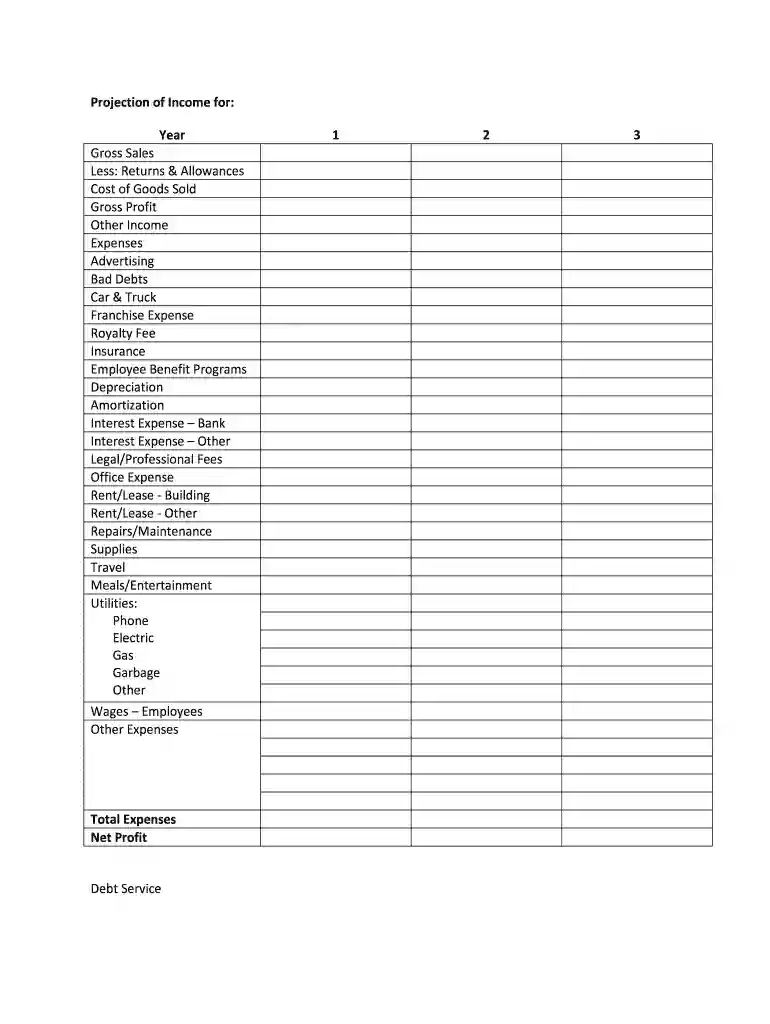
Year to date profit and loss statement 2026

Get Form
year to date profit and loss statement template Preview on Page 1

Here's how it works

01. Edit your year to date profit and loss statement template online
Type text, add images, blackout confidential details, add comments, highlights and more.

02. Sign it in a few clicks
Draw your signature, type it, upload its image, or use your mobile device as a signature pad.

03. Share your form with others
Send year to date profit and loss statement via email, link, or fax. You can also download it, export it or print it out.

How to use or fill out year to date profit and loss statement with our platform

Form edit decoration
9.5
Ease of Setup
DocHub User Ratings on G2
9.0
Ease of Use
DocHub User Ratings on G2
  1. Click ‘Get Form’ to open the year to date profit and loss statement in the editor.
  2. Begin by entering the 'Year' at the top of the form. This sets the context for your financial data.
  3. Fill in 'Gross Sales' by inputting total revenue generated before any deductions.
  4. Deduct 'Returns & Allowances' from Gross Sales to calculate your net sales. Enter this value in the designated field.
  5. Input 'Cost of Goods Sold' (COGS) to determine your gross profit. This includes all direct costs associated with producing goods sold.
  6. Calculate 'Gross Profit' by subtracting COGS from net sales, and enter this figure in the appropriate section.
  7. List all sources of 'Other Income', such as interest or investment income, in their respective fields.
  8. Detail each expense category, including Advertising, Employee Benefits, and Utilities. Ensure all fields are filled accurately for a comprehensive overview.
  9. Finally, calculate 'Total Expenses' and subtract it from 'Gross Profit' to find your 'Net Profit'.

Start using our platform today for free to streamline your document editing and ensure accurate financial reporting!

See more year to date profit and loss statement versions

We've got more versions of the year to date profit and loss statement form. Select the right year to date profit and loss statement version from the list and start editing it straight away!
Versions Form popularity Fillable & printable
2019 4.8 Satisfied (144 Votes)
be ready to get more

Complete this form in 5 minutes or less

Get form

Got questions?

We have answers to the most popular questions from our customers. If you can't find an answer to your question, please contact us.
Contact us
A good Year-to-Date (YTD) return is relative, but generally, exceeding the SP 500s average of around 10% annually (or 7% adjusted for inflation) is strong, with anything over 10% seen as excellent and 20%+ as exceptional, though short-term YTDs fluctuate wildly, so comparison to a relevant index (like the SP 500 for stocks) is key, not just absolute numbers. Key Benchmarks Expectations Long-Term Average: The SP 500 averages about 10% annually over the long haul (around 7% after inflation). Good ROI: A general positive ROI of 5-7% is reasonable, but over 10% is considered strong, notes SmartAsset.com. Excellent ROI: 20% or more is excellent, but often involves higher risk, according to Chase Bank. What Makes a YTD Return Good? Comparison to a Benchmark: The best measure is how your portfolio performs against its relevant index (e.g., SP 500 for U.S. stocks). Outperforming the Market: If the SP 500 returns 5% and your stock portfolio returns 10%, thats a good performance, says this YouTube video. Context Matters: A high YTD isnt everything; seasonality (like retail holidays) can affect short-term results, and risk tolerance matters, notes Investopedia. In Summary A good YTD return means your investment grew DocHubly since December 31st, ideally beating the broad market (like the SP 500) for that same period, showing you added value beyond just market growth. For financial advice, consult a professional. What Is Considered a Good Return on Investment? - SoFiA good return on investment is generally considered to be around 7% per year, based on the average historic return of the SP 500 SoFiHow Do I Calculate the Year-to-Date (YTD) Return on My Portfolio?What Is Considered a Good YTD Rate of Return? A good rate of return depends on how a portfolio compares to a similar benchmark. FoInvestopedia
A year-to-date profit and loss statement is a financial report that provides a snapshot of your companys financial performance for the current year. This statement summarizes the revenue, cost of goods sold, gross profit, expenses, and net income for your company from the beginning of the year to the current date.Sep 18, 2023
You can find your income statement in ATO online services through myGov or the ATO app. Your income statement will show your year-to-date: salary and wages.Jun 9, 2025
Year to date or YTD refers to the time between the beginning of the calendar year or fiscal year and the present day. It is a common metric in accounting and bookkeeping, and also useful for analyzing business trends and comparing performance data with competitors or the industry as a whole.
YTD returns calculate the profit or loss from an investment since the first day of the calendar year. Year-to-date return information helps analysts and investors assess how well portfolios and investments are performing. This can help them decide on their next move if an investment isnt showing any gains.Dec 15, 2025

Security and compliance

At DocHub, your data security is our priority. We follow HIPAA, SOC2, GDPR, and other standards, so you can work on your documents with confidence.

Learn more
ccpa2
pci-dss
gdpr-compliance
hipaa
soc-compliance

People also ask

Gather what you need Step 1: Determine your companys revenue. Step 2: Calculate your companys cost of goods sold. Step 3: Calculate your companys gross profit/loss. Step 4: Determine your companys operating expenses. Step 5: Calculate your companys operating profit/loss.
Year to Date (YTD) Profit Loss Statement The year to date profit and loss statement will report all the different PL lines from the beginning of the year up to the date of reporting. These results are usually reported against results for the same period last year (LY) and the budgeted numbers for the same period.
To calculate the YTD return, subtract the starting period value from the current period value, and divide the resulting figure by the starting year value. In the final step, multiply the figure in decimal notation by 100 to convert the YTD figure into a percentage.

year to date profit and loss statement example