




01. Edit your louisiana sales tax return instructions online
Type text, add images, blackout confidential details, add comments, highlights and more.

Type text, add images, blackout confidential details, add comments, highlights and more.

Draw your signature, type it, upload its image, or use your mobile device as a signature pad.

Send it via email, link, or fax. You can also download it, export it or print it out.
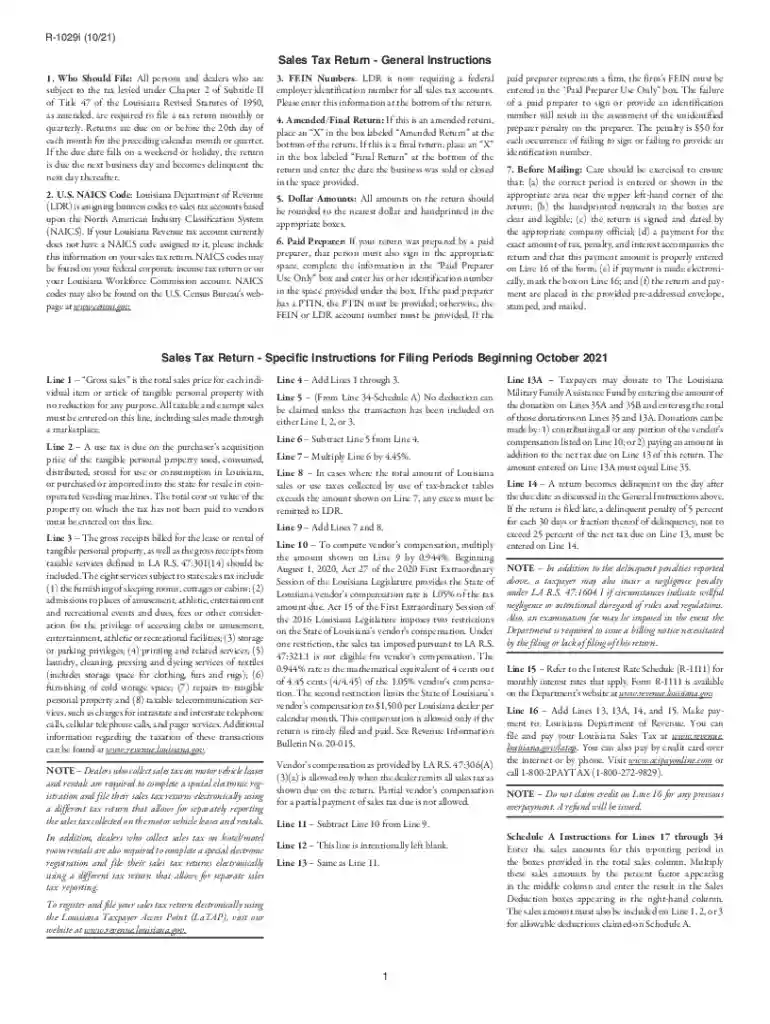
The Louisiana Sales Tax Return Instructions, often referred to by its form number R-1029i, serve as a comprehensive guide for businesses and individuals needing to report sales tax to the state. The instructions outline the specific details required to accurately complete and submit a sales tax return, helping taxpayers avoid errors that could result in penalties or fines. By following these detailed guidelines, filers ensure compliance with Louisiana's tax laws, reporting both gross sales and any applicable deductions.
Completing the Louisiana Sales Tax Return involves a sequence of methodical steps designed to be both thorough and efficient. By following these steps, filers ensure they are capturing all necessary information and meeting filing requirements.
Collect Required Information and Documents:
Calculate Gross Sales:
Account for Use Tax:
Determine Vendor’s Compensation:
Apply Deductions and Credits:
Review and Submit:
Adhering to filing deadlines is crucial for avoiding penalties. Louisiana provides specific deadlines based on whether the returns are filed monthly or quarterly.
Louisiana offers multiple methods for submitting sales tax returns, ensuring both convenience and accessibility for all taxpayers.
Understanding key terms associated with the Louisiana Sales Tax Return Instructions is vital for accurate reporting and compliance.
The R-1029i must be used legally and in accordance with Louisiana state law to ensure the proper reporting and calculation of sales tax liabilities.
Failing to comply with the requirements laid out in the R-1029i instructions can result in significant penalties. These can include financial penalties, interest on unpaid taxes, and in severe cases, legal action.
Louisiana may have tax filing rules that differ significantly from other states. It is important for businesses operating across multiple states to be aware of these unique regulations.
We've got more versions of the louisiana sales tax return instructions form. Select the right louisiana sales tax return instructions version from the list and start editing it straight away!
At DocHub, your data security is our priority. We follow HIPAA, SOC2, GDPR, and other standards, so you can work on your documents with confidence.
FORM 8070 INSTRUCTIONS. These are the instructions for completing your Multi-Rate Sales/Use and Parking Electronic Tax Return. Round off the amount to theRead more
May 2, 2017 Download, view, and order tax forms, instructions, and publications. Access commercial tax preparation and e-file services. Research yourRead more
State employees can make authorized, tax-free purchases from any Wal-Mart store using a P-Card and the University of Louisiana at Monroe Customer ID:Read more


