




01. Edit your m3 form pdf online
Type text, add images, blackout confidential details, add comments, highlights and more.

Type text, add images, blackout confidential details, add comments, highlights and more.

Draw your signature, type it, upload its image, or use your mobile device as a signature pad.

Send m 3 via email, link, or fax. You can also download it, export it or print it out.
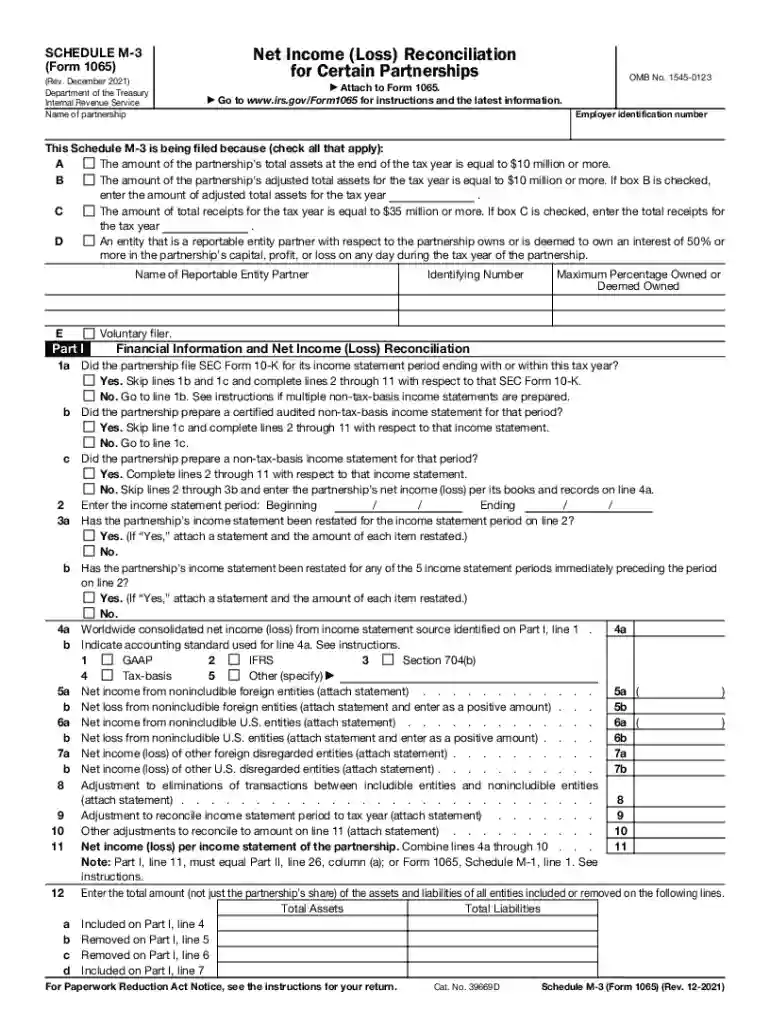
Schedule M-3 (Form 1065) is a critical document for certain partnerships, requiring these entities to reconcile the net income or loss reported in their financial statements with the income or loss recorded on their tax returns. This form is mandatory for partnerships with total assets of $10 million or more, total receipts of $35 million or more, or specific ownership structures.
Schedule M-3 plays a pivotal role in ensuring transparency and consistency between financial reporting and tax accounting for large partnerships. Its purpose is to help the IRS identify significant tax positions and discrepancies between book and taxable income, facilitating more effective oversight.
Schedule M-3 is primarily used by partnerships that meet certain financial thresholds. This includes:
The form includes various sections and requires meticulous attention to specific elements:
Completing Schedule M-3 involves several steps to ensure accuracy:
Failure to accurately complete and submit Schedule M-3 can lead to severe repercussions:
The IRS provides explicit guidelines to ensure uniformity and adherence:
Understanding filing timelines is crucial for compliance:
Applying theoretical knowledge to practical contexts enhances comprehension:
Schedule M-3 (Form 1065) is integral for partnerships meeting specific financial criteria, providing a framework for accurate financial and tax alignment. Proper adherence to IRS guidelines and thorough completion of the form mitigates risks and ensures compliance.
We've got more versions of the m3 form pdf form. Select the right m3 form pdf version from the list and start editing it straight away!
At DocHub, your data security is our priority. We follow HIPAA, SOC2, GDPR, and other standards, so you can work on your documents with confidence.
The National Board of Boiler and Pressure Vessel Inspectors Search. Ph.614.888.8320
M-3 filers on Form 1120 (Schedule B) and Form. 1065 (Schedule C). We use Schedule M-3 in this letter to refer generally and collectively to all these


