




01. Edit your 990 t instructions online
Type text, add images, blackout confidential details, add comments, highlights and more.

Type text, add images, blackout confidential details, add comments, highlights and more.

Draw your signature, type it, upload its image, or use your mobile device as a signature pad.

Send it via email, link, or fax. You can also download it, export it or print it out.
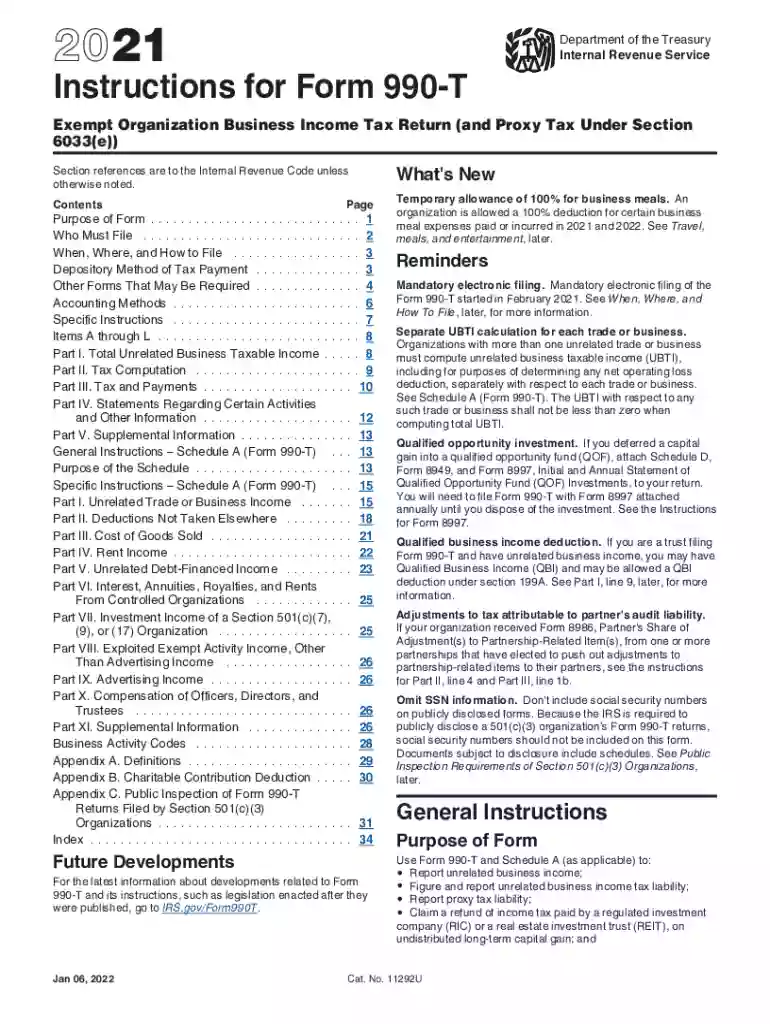
Form 990-T, officially known as the Exempt Organization Business Income Tax Return, is used by tax-exempt organizations to report any unrelated business taxable income (UBTI). This form ensures that organizations operating in the United States remain compliant with federal tax regulations by accurately declaring income that falls outside their tax-exempt activities. Compliance with Form 990-T helps maintain the tax-exempt status while managing tax liabilities from unrelated business operations.
Unrelated Business Taxable Income refers to income generated from activities not substantially related to an organization’s tax-exempt purpose. For example, if a charity operates a gift shop, the revenue generated may be considered UBTI. The form ensures that tax-exempt entities pay the appropriate amount of tax on such income, thus upholding fairly regulated competition with for-profit businesses.
Completing Form 990-T involves several important steps to ensure accuracy and compliance. Here’s a detailed breakdown:
Gather Required Information and Documents
Calculate Unrelated Business Income
Complete the Form Sections
Review and Attach Supporting Documents
Submit Form 990-T
Organizations required to file Form 990-T include various types of tax-exempt entities under section 501(c), such as charities, religious organizations, and educational institutions. Eligibility hinges on these entities having a minimum gross UBTI of $1,000 or more during the fiscal year. Meeting this requirement ensures that the organization complies with federal tax obligations while maintaining its tax-exempt status.


The Internal Revenue Service (IRS) provides detailed guidelines to assist organizations in accurately completing and submitting Form 990-T. These instructions include:
Failure to file Form 990-T accurately and on time may result in significant penalties from the IRS. These can include monetary fines calculated based on the tax owed and potentially jeopardizing the organization’s tax-exempt status. Understanding and adhering to form submission deadlines and requirements is crucial to avoiding these penalties.
Organizations can submit Form 990-T either electronically or through the mail. The IRS encourages electronic filing for accuracy and efficiency, though paper submissions via mail remain an option. It is essential to follow the IRS instructions regarding format and required attachments for the chosen submission method.
Consider a nonprofit university that runs a parking garage open to the public and generates significant revenue. This income qualifies as unrelated business income, making it necessary to file Form 990-T to declare this revenue. Similarly, a charity operating a seasonal farmer's market that sells produce from local farms must report earnings through this form.
Form 990-T can be completed using widely available tax preparation software such as TurboTax or QuickBooks. These programs offer robust support for accurately filing the form, automating calculations for UBTI, and ensuring adherence to IRS guidelines. Organizations that leverage these software solutions benefit from increased accuracy and reduced administrative burden.
We've got more versions of the 990 t instructions form. Select the right 990 t instructions version from the list and start editing it straight away!
At DocHub, your data security is our priority. We follow HIPAA, SOC2, GDPR, and other standards, so you can work on your documents with confidence.
All other organizations must file Form 990-T by the 15th day of the 5th month after the end of their tax years. If the regular due date falls on a Saturday,Read more
Sep 16, 2013 Instructions are pro- vided for computing foreign insurance companies liabilities for the estimated tax and installment payments of estimatedRead more


