Colorado estimated 2026

Get Form
colorado estimated Preview on Page 1

Here's how it works

01. Edit your form online
Type text, add images, blackout confidential details, add comments, highlights and more.

02. Sign it in a few clicks
Draw your signature, type it, upload its image, or use your mobile device as a signature pad.

03. Share your form with others
Send it via email, link, or fax. You can also download it, export it or print it out.

Definition & Meaning

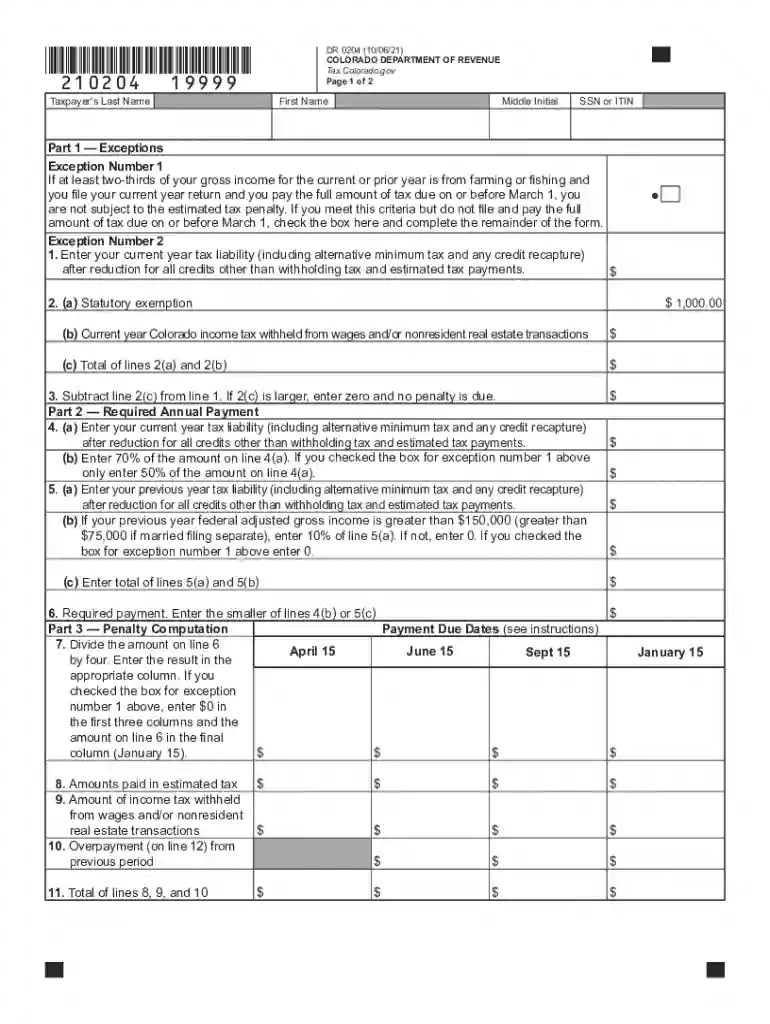
The "Colorado Estimated Tax" refers to the payments a taxpayer anticipates owing to the state of Colorado for their individual income tax. These payments are usually made quarterly to cover tax liabilities that are not withheld by an employer or other sources. This form is essential for individuals who expect to owe more than one thousand dollars in Colorado state tax beyond what is withheld. It ensures compliance with state tax laws and helps avoid penalties due to underpayment.

Real-World Application

  • Freelancers or Independent Contractors: These taxpayers often do not have taxes withheld from their income, making estimated tax payments necessary to avoid a large bill at tax time.
  • Self-Employed Individuals: Owners of small businesses or sole proprietors use this form to manage their tax obligations throughout the year.
  • Investors: Those who make significant income from dividends or capital gains may need to estimate taxes to ensure accuracy and compliance.

How to Use the Colorado Estimated Tax

To effectively utilize the "Colorado Estimated Tax" form, understanding the payment schedule and calculation methods is crucial.

Payment Schedule

Taxpayers typically make four payments per year, corresponding to quarterly deadlines. Each installment should reflect one-fourth of the estimated tax liability, unless the taxpayer chooses to use the annualized income installment method.

Steps to Calculate Payments

  1. Estimate Annual Income: Determine the total income expected for the year from self-employment, dividends, or other non-wage sources.
  2. Calculate Tax Liability: Use Colorado's individual income tax rate to estimate the total tax owed.
  3. Adjust for Credits and Deductions: Subtract any applicable tax credits and deductions to arrive at the net estimated tax.

Steps to Complete the Colorado Estimated Tax Form

Filling out the form precisely can prevent costly errors and penalties.

Detailed Instructions

  1. Download the Form DR 0204: The form is available on the Colorado Department of Revenue's website.
  2. Personal Information: Enter full legal name, address, and social security number.
  3. Income Verification: Report gross income, then adjust for any tax credits or deductions.
  4. Compute Installment Amounts: Calculate the installment payments based on the annual estimated tax.
  5. Submit Payments: Use provided methods to make quarterly payments.

Example

If a freelancer anticipates earning ninety thousand dollars annually, with no taxes withheld, they would calculate the tax at the Colorado rate, apply any known deductions, and divide by four.

Filing Deadlines / Important Dates

Understanding key dates for tax submissions helps maintain compliance and avoid late fees.

Quarterly Deadlines

  • April 15: Payment for the first quarter.
  • June 15: Payment for the second quarter.
  • September 15: Payment for the third quarter.
  • January 15 of the following year: Payment for the fourth quarter.

It's essential to note that if a taxpayer files their annual return and pays in full by January 31, they may skip the January estimated payment.

State-Specific Rules for the Colorado Estimated Tax

Each state carries unique regulations that impact how estimated taxes are calculated and reported.

Colorado-Specific Considerations

  • Tax Rates: Colorado uses a flat tax rate for individual income which taxpayers must apply when estimating their liabilities.
  • Credits: Certain state-specific credits can affect the calculation, such as credits for renewable energy use.

Adjustment Opportunities

Taxpayers experiencing significant economic shifts can adjust their estimated payments. For example, if an unexpected decrease in income occurs, reckoning for the adjusted total could avoid overpayments.

Penalties for Non-Compliance

Failing to properly estimate and pay the Colorado tax can result in penalties and interest.

Types of Penalties

  • Late Payment Penalty: Imposed if taxes are not paid by the deadline.
  • Underpayment Penalty: Applied if less than ninety percent of the actual tax liability is paid by the due date.

Mitigation Strategies

Taxpayers can potentially reduce penalties by demonstrating reasonable cause or using the annualized income installment method, which accommodates fluctuating income patterns.

Software Compatibility

Taxpayers can leverage software tools for efficient tax management.

Supported Software Platforms

  • TurboTax: Guides users through estimated tax forms with step-by-step instructions.
  • QuickBooks: Offers features targeted at self-employed users to track income and estimate taxes effectively.

Integration Benefits

These tools can sync financial data, calculate tax estimates, and establish alerts for payment deadlines, streamlining the tax management process.

Taxpayer Scenarios (e.g., Self-Employed, Retired, Students)

Different taxpayer categories necessitate tailored approaches to estimated tax.

decoration image ratings of Dochub

Specific Use Cases

  • Self-Employed: Must manage estimated payments due to the absence of employer withholding.
  • Retirees: May need to estimate taxes on retirement income not subject to withholding.
  • Students: Who earn above a certain threshold may also have to consider estimated payments if they have freelance or investment income.

Understanding these distinct scenarios helps taxpayers file accurately and efficiently, minimizing the risk of surprises at year-end.

See more colorado estimated versions

We've got more versions of the colorado estimated form. Select the right colorado estimated version from the list and start editing it straight away!
Versions Form popularity Fillable & printable
2023 4.8 Satisfied (45 Votes)
2022 4.9 Satisfied (28 Votes)
2021 4.8 Satisfied (62 Votes)
2020 4.3 Satisfied (206 Votes)
2019 4.2 Satisfied (92 Votes)
2018 4.4 Satisfied (100 Votes)
2017 4.4 Satisfied (102 Votes)
2014 4.3 Satisfied (28 Votes)
be ready to get more

Complete this form in 5 minutes or less

Get form

Got questions?

We have answers to the most popular questions from our customers. If you can't find an answer to your question, please contact us.
Contact us
Colorado is known for its picturesque scenery, diverse terrain, and welcoming atmosphere, and these factors all contribute to the growing cost of living within the state. Unsurprisingly, this leads to higher costs when it comes to housing whether it be buying or renting a property.
Fastest Growing States in the US The ten fastest growing states are Utah, Idaho, Texas, North Dakota, Nevada, Colorado, Washington, Florida, Arizona, and South Carolina. Utah is the fastest growing state with a population growth rate of 15%.
Average Cost of Living in Colorado: $63,781 per year Take a closer look at your budget before you decide to move to Colorado. MERIC data gathered in 2024 found that Colorado tied with Idaho and Puerto Rico for the 32nd best cost-of-living in the country. The neighboring state of Nebraska (No.
In the fiscal year of 2024, Colorados state debt stood at about 24.79 billion U.S. dollars. Comparatively, the states debt was approximately 4.43 billion U.S. dollars in 2000.
Colorado The cost of living in Colorado is nearly 6% higher than the national average in the United States.

Security and compliance

At DocHub, your data security is our priority. We follow HIPAA, SOC2, GDPR, and other standards, so you can work on your documents with confidence.

Learn more
ccpa2
pci-dss
gdpr-compliance
hipaa
soc-compliance
be ready to get more

Complete this form in 5 minutes or less

Get form

People also ask

A state with a 183-day residency rule will consider you a full-year resident for tax purposes if you spent more than half the year there.
Average Home Prices: The median home price in Colorado is $592,900. But, it is expected to decrease due to a rise in inventory in the latter half of 2025. The sale-to-list price ratio is 98.7%, down by 0.62 pt YoY.
Key factors affecting Colorados cost of living include a dynamic job market with a tight labor ratio, a slowing population growth rate with an anticipated rebound, and the states focus on developing under-developed areas to balance the cost of living with lifestyle quality.

Related links