M8379 form 2026

Get Form
m8379 Preview on Page 1

Here's how it works

01. Edit your m8379 online
Type text, add images, blackout confidential details, add comments, highlights and more.

02. Sign it in a few clicks
Draw your signature, type it, upload its image, or use your mobile device as a signature pad.

03. Share your form with others
Send it via email, link, or fax. You can also download it, export it or print it out.

Definition & Meaning

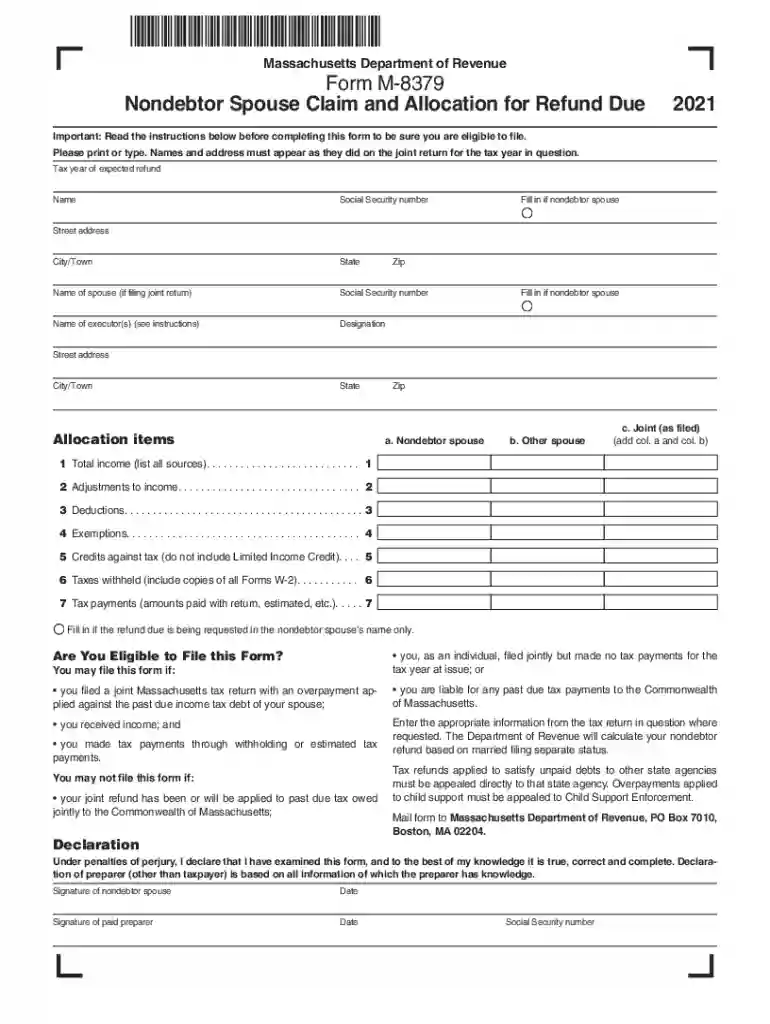
The M-8379 form is specifically designed by the Massachusetts Department of Revenue. It serves as a tool for non-debtor spouses seeking to claim and allocate tax refunds due from a joint tax return. This form is crucial when one spouse is not liable for the other's tax debts, ensuring that the innocent spouse's portion of the refund is not unfairly seized.

  • Purpose: Allows for equitable distribution of tax refunds, protecting non-responsible spouses from the tax liabilities of their partners.
  • Target Users: Non-debtor spouses involved in joint tax return filings where tax debts of one partner result in the withholding of refunds.

How to use the M-8379 Form

To use the M-8379 form effectively, non-debtor spouses must understand the sequential steps involved in its completion and submission. This involves providing accurate personal and tax information to ensure proper processing.

  1. Gather Required Information: Collect all necessary personal and financial information related to previous tax returns.
  2. Complete Personal Information: Fill out personal information including names, social security numbers, and tax year.
  3. Specify Debts and Refund Allocation: Clearly indicate the debts and how the refund should be allocated between spouses.
  4. Signature and Date: Ensure both signatures and the date are included where required.
  5. File the Form: Decide on the method of submission, either online or via mail, adhering to specified filing methods.

Common Mistakes

  • Incomplete Information: Failing to complete all sections correctly can delay processing.
  • Incorrect Allocation of Refunds: Misallocation may result in disputes or rejections.

How to Obtain the M-8379 Form

The M-8379 form is accessible through various channels, allowing users to obtain it according to their convenience.

  • Online: Download the form directly from the official Massachusetts Department of Revenue website.
  • In-Person: Visit local tax offices where forms can be collected in hard copy.
  • Mail: Request a form to be sent via postal services, especially for those without internet access.

Important Considerations

  • Availability: Ensure accessibility well before filing deadlines to allow sufficient time for completion and submission.

Steps to Complete the M-8379 Form

Proper completion of the M-8379 form is essential for accurate processing and refund allocation. A step-by-step approach ensures all sections are addressed comprehensively.

  1. Begin with Personal Details: Include full names, addresses, and social security numbers.
  2. Detail Income and Debts: Accurately report all income and any existing tax debts.
  3. Allocation Section: Designate how refunds should be split, applying any relevant calculations.
  4. Review for Errors: Double-check all details for accuracy before submission.
  5. Signatures: Obtain both applicable signatures to validate the form.
  6. Submit via Preferred Method: Opt between mail or electronic filing based on personal preference.

Who Typically Uses the M-8379 Form

The form is primarily used by non-debtor spouses involved in joint tax filings where one spouse has pre-existing tax obligations. Understanding typical use cases provides context for its necessity.


  • Eligible Spouses: Individuals married to partners with separate tax liabilities not involving them.
  • Joint Filers: Married couples who file joint returns but require separation of tax responsibilities.
decoration image ratings of Dochub

Key Elements of the M-8379 Form

Understanding the essential components of the M-8379 form is crucial for correct and effective use.

  • Personal Information: Spouses must provide accurate personal data to ensure identification.
  • Tax Debts and Liabilities: Specify all debts influencing the joint return.
  • Refund Distribution: Detailed section allocation for proper refund split based on individual liability.
  • Signatures: Both parties must verify the provided information through signatures.

Required Documents

To ensure a successful filing of the M-8379 form, certain documents must be prepared and submitted alongside the form.

  • Previous Tax Returns: Copies of past returns where applicable.
  • Identification Proofs: Valid IDs and social security confirmations.
  • Debt Documentation: Clear evidence of debts or obligations related to the return.

Eligibility Criteria

Eligibility to file the M-8379 form involves meeting specific criteria related to spousal tax obligations and refund entitlements.

  • Marital Status: Must be legally recognized as spouses or former spouses.
  • Refund Entitlement: Must have a share of the refund that should not be used against the other spouse's tax debts.
  • Non-liability Proof: Demonstrate no responsibility for the tax debts claimed against the refund.
decoration image

Filing Deadlines / Important Dates

Timely submission of the M-8379 form ensures that the process is not delayed and refunds are allocated appropriately.

  • Deadline Alignment: Align with general tax return submission deadlines to avoid complications.
  • Penalty-Free Windows: File within deadlines to avoid penalties or lost refund opportunities.

In-depth understanding of the M-8379 form and its complexities ensures non-debtor spouses can efficiently protect their rightful tax returns against unwarranted liabilities. Providing detailed information and following outlined procedures guarantees effective and accurate refund allocation.

See more m8379 form versions

We've got more versions of the m8379 form form. Select the right m8379 form version from the list and start editing it straight away!
Versions Form popularity Fillable & printable
2022 4.6 Satisfied (44 Votes)
2021 4.8 Satisfied (104 Votes)
2020 4.4 Satisfied (125 Votes)
2018 4.2 Satisfied (74 Votes)
2017 4.4 Satisfied (180 Votes)
2003 4.4 Satisfied (175 Votes)
be ready to get more

Complete this form in 5 minutes or less

Get form

Got questions?

We have answers to the most popular questions from our customers. If you can't find an answer to your question, please contact us.
Contact us
You may be eligible for injured spouse relief if: You filed a joint return with your spouse. Your tax refund was applied to your spouses overdue debts. You werent responsible for the debt.
Yes. The IRS can apply all or part of your joint refund to your spouses legally enforceable past-due debt.
This makes you both legally responsible for each others tax liability. If youre lying awake at night wondering, can the IRS come after me for my spouses taxes? the answer is yes. This is true even if you didnt do anything wrong. In this case, the IRS will use your refund to offset your spouses liability.
The injured spouse on a jointly filed tax return files Form 8379 to get back their share of the joint refund when the joint overpayment is applied to a past-due obligation of the other spouse.
There are nine community property states where married couples need Form 8958 if they file separate returns. Domestic partnerships in community property states like California, Nevada, Washington, and Wisconsin typically need to use Form 8958 to allocate their income.

Security and compliance

At DocHub, your data security is our priority. We follow HIPAA, SOC2, GDPR, and other standards, so you can work on your documents with confidence.

Learn more
ccpa2
pci-dss
gdpr-compliance
hipaa
soc-compliance
be ready to get more

Complete this form in 5 minutes or less

Get form

People also ask

Related Separation of Liability Relief. Equitable Relief. Injured Spouse Relief. Tax Relief for Spouses.
Can the IRS Deny an Injured Spouse Claim? Yes, the IRS may determine that someone filing Form 8379 is ineligible for an injured spouse allocation, or that they are not entitled to as much as they believe.

Related links