




01. Edit your ca590 online
Type text, add images, blackout confidential details, add comments, highlights and more.

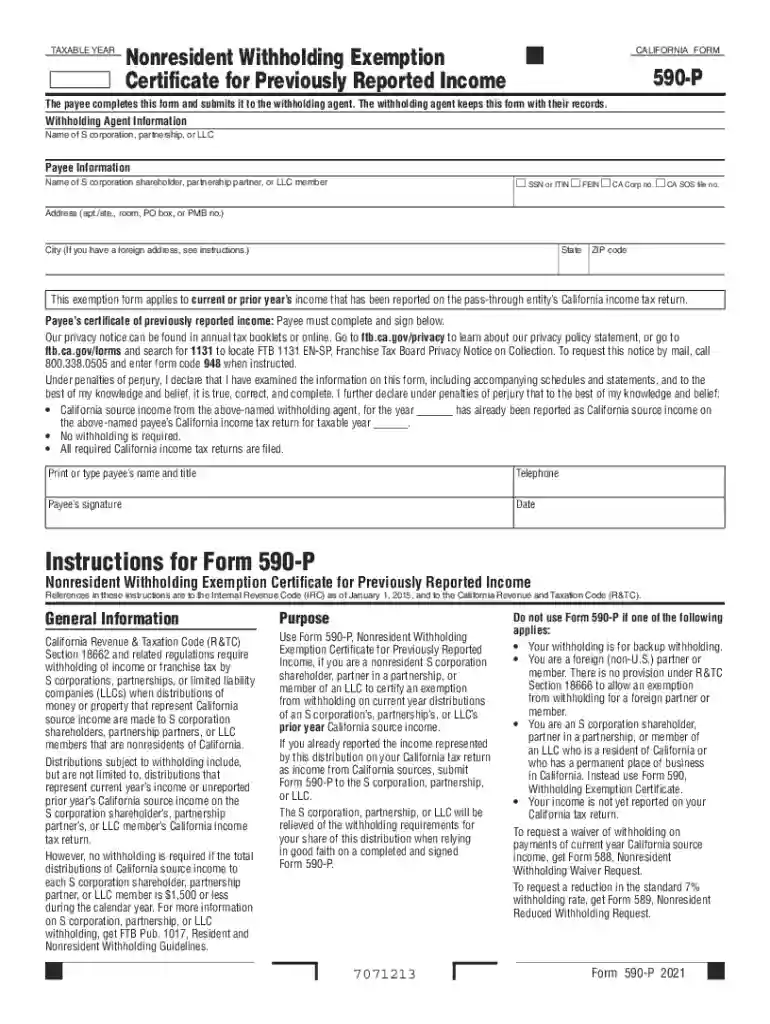
Type text, add images, blackout confidential details, add comments, highlights and more.

Draw your signature, type it, upload its image, or use your mobile device as a signature pad.

Send 590 form via email, link, or fax. You can also download it, export it or print it out.
California Form 590-P, also known as the Nonresident Withholding Exemption Certificate for Previously Reported Income, is a tax form utilized by nonresident shareholders, partners, or members associated with S corporations, partnerships, or LLCs in California. This certificate serves as a formal declaration that the income in question has already been reported on a California individual tax return, thereby exempting the current year’s distributions of prior year California source income from withholding.
The form is a crucial document for stakeholders who have already fulfilled their tax obligations on certain income streams. By submitting CA Form 590-P, these entities can avoid redundant withholding processes on the same income. Understanding this form is essential for accurately navigating the complexities of California's tax regulations and ensuring compliance with state tax laws.
To effectively use CA Form 590-P, individuals or entities should first confirm their eligibility. The form is intended for nonresident taxpayers who can demonstrate that the income from which they seek exemption has been previously reported. Once eligibility is verified, the following steps should be followed:
Obtain the Form: Acquire the latest version of CA Form 590-P from the California Franchise Tax Board’s website or a reliable source.
Complete the Form: Fill out the necessary fields including your personal and entity information, as well as detailed data regarding the previously reported income.
Submit to Withholding Agent: Forward the completed form to the withholding agent responsible for your income distributions. This agent retains the form for their records, validating your exemption claim.
Maintain a Copy: Keep a copy of the completed form for your own records, in case of future audits or verification requests.
Completing CA Form 590-P involves several precise steps to ensure the form is filled out accurately. Below is a detailed breakdown:
Part I - Withholding Agent Information:
Part II - Nonresident Entity Information:
Part III - Certification of Previously Reported Income:
Signature and Date:
Utilize these step-by-step instructions to navigate the form effectively, ensuring no essential detail is overlooked.
Several critical elements define CA Form 590-P, each serving a unique role in validating a taxpayer’s withholding exemption:
Personal and Agent Information: Accurate identification details are necessary to establish a legitimate link between the taxpayer and the withholding agent.
Income Reporting: Detailed insight into the nature and amount of previously reported income.
Certification: Asserts that the declared income has already been addressed in prior tax filings, thus validating the exemption claim.
These elements collectively ensure the form's effectiveness in streamlining tax processes for nonresident stakeholders.
The legal use of CA Form 590-P is governed by state tax regulations. Its primary purpose is to facilitate the exemption from withholding income tax for distributions derived from previously reported Californian income. Users must adhere to legal criteria, such as the timely and accurate reporting of income on individual California tax returns.
Noncompliance or misrepresentation on CA Form 590-P can lead to penalties or additional tax burdens. Therefore, it's vital to understand the legal requirements and ensure the document strictly aligns with California tax laws.
CA Form 590-P is commonly used by:
These entities utilize the form to certify that relevant incomes have been correctly reported, allowing for seamless financial operations without excess withholding.


California imposes specific rules and criteria regarding the use of Form 590-P:
An in-depth understanding of these state-specific stipulations is necessary to qualify for the withholding exemption and avoid compliance issues.
While CA Form 590-P itself does not have an explicit filing deadline, timely submission to the withholding agent is crucial to avoid unnecessary withholding on distributions. Ideally, the form should be submitted before the distributor processes payments.
Proactive tracking of filing and submission timelines significantly aids in adhering to compliance protocols, enhancing fiscal efficiency and accuracy.
Supporting documentation is pivotal for the submission of CA Form 590-P, to validate claims of previously reported income:
Organize and maintain these documents meticulously to substantiate your withholding exemption certificate.
We've got more versions of the ca590 form. Select the right ca590 version from the list and start editing it straight away!
| Versions | Form popularity | Fillable & printable |
|---|---|---|
| 2025 | 4.4 Satisfied (33 Votes) | |
| 2024 | 4.4 Satisfied (57 Votes) | |
| 2023 | 4.6 Satisfied (20 Votes) | |
| 2022 | 4.2 Satisfied (37 Votes) | |
| 2021 | 4.8 Satisfied (91 Votes) | |
| 2020 | 4.2 Satisfied (96 Votes) | |
| 2019 | 4.4 Satisfied (171 Votes) | |
| 2018 | 4.3 Satisfied (111 Votes) | |
| 2016 | 4.4 Satisfied (424 Votes) | |
| 2015 | 4.1 Satisfied (51 Votes) | |
| 2014 | 4.1 Satisfied (47 Votes) | |
| 2013 | 4 Satisfied (52 Votes) | |
| 2011 | 4.3 Satisfied (68 Votes) |
At DocHub, your data security is our priority. We follow HIPAA, SOC2, GDPR, and other standards, so you can work on your documents with confidence.
Introduction. Benign prostatic hyperplasia (BPH) is a histologic diagnosis that refers to the proliferation of smooth muscle and epithelial cells within theRead more
This exemption form applies to current or prior years income that has been reported on the pass-through entitys California income tax return.Read more
By checking the appropriate box below, the payee certifies the reason for the exemption from the California income tax withholding requirements on payment(s)Read more


