




01. Edit your form online
Type text, add images, blackout confidential details, add comments, highlights and more.

Type text, add images, blackout confidential details, add comments, highlights and more.

Draw your signature, type it, upload its image, or use your mobile device as a signature pad.

Send it via email, link, or fax. You can also download it, export it or print it out.
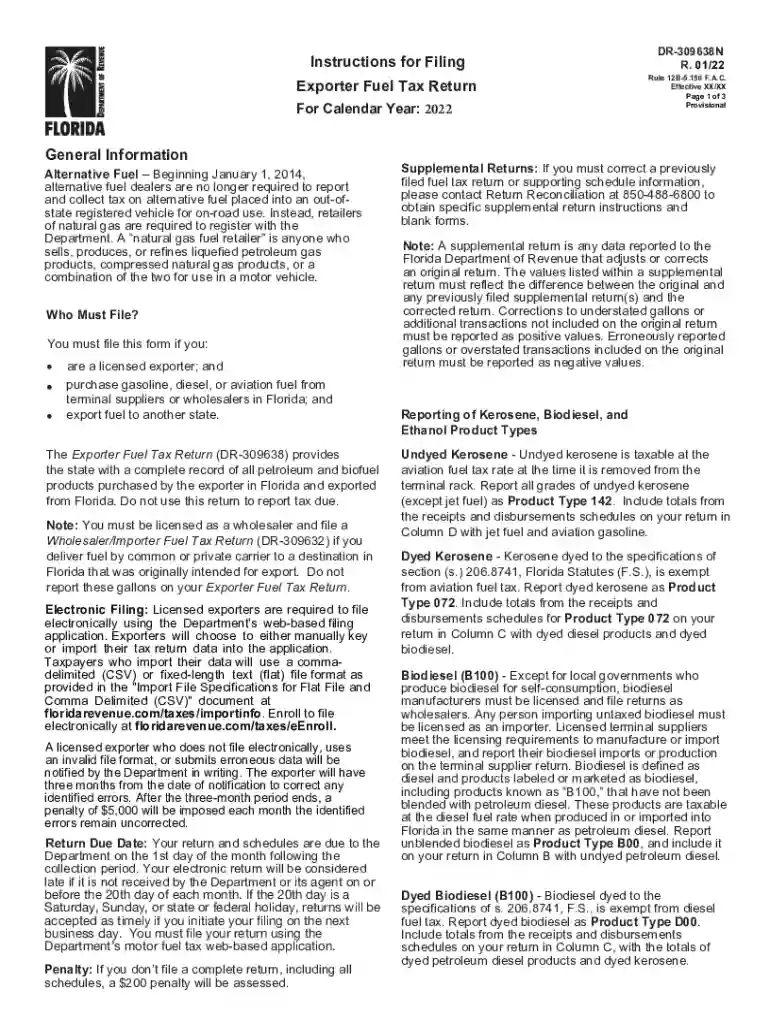
The Exporter Fuel Tax Return, known formally as the DR-309638, is a mandatory form required for licensed exporters dealing with the transportation of fuel across state lines in the United States. This document ensures that fuel taxes are appropriately reported and paid to the relevant authorities for the calendar year 2022. By filing this document, exporters provide detailed information about the types and volumes of fuel exported, ensuring compliance with state and federal tax regulations. This form plays a key role in maintaining transparency within the fuel industry, impacting various stakeholders, including government agencies and businesses.
Gather Necessary Information: Begin by collecting all the required data, including details about the types of fuel exported, quantities, and destinations. Ensure that all figures are accurate and well-documented to avoid delays or penalties.
Complete Supporting Schedules: Fill out the supporting schedules that detail the specific transactions of each fuel type, such as alternative fuels, biodiesel, and ethanol blends. This step is critical for summarizing total exports and ensuring precise reporting.
Finalize Export Totals: After compiling the data and completing the schedules, summarize the total amounts of each fuel type exported. Double-check all calculations to ensure that all exports are accurately recorded.
Submit the Form: Submit the completed Exporter Fuel Tax Return and any accompanying schedules electronically, if electronic filing is available and applicable, or through traditional mailing methods. Ensure submission by the specified deadline to avoid penalties.
Filing the Exporter Fuel Tax Return is essential for compliance with state and federal regulations. Completing the form ensures that the appropriate fuel taxes are remitted, which supports public infrastructure and community services funded through these taxes. Additionally, filing prevents the risk of legal penalties, interest charges, and disruptions to business operations that might result from tax non-compliance. Filing this return strengthens a company's reputation for reliability and transparency in its dealings with regulatory authorities, customers, and partners.
Licensed Exporter: Any individual or entity registered to transport fuel across state boundaries, holding the necessary licenses to do so legally.
Alternative Fuels: Fuels that serve as substitutes for conventional fossil fuel sources, including biodiesel and ethanol blends.
Supporting Schedules: Detailed documents accompanying the main form, which present in-depth data about fuel types, quantities, and transactions.
Compliance: Adherence to all laws and regulations governing fuel exportation, including accurate filing and timely submission of tax returns.
Timely filing of the Exporter Fuel Tax Return is crucial to avoid penalties. Typically, the return is due annually, with specific deadlines set by the relevant state authority. For the calendar year 2022, the exact submission deadline will need to be confirmed with the taxing authority or relevant state publications. Exporters must plan their filing process to account for any potential delays, ensuring all documentation is submitted by the stipulated deadline.
Failing to file the Exporter Fuel Tax Return or submitting inaccurate information can result in significant penalties. These may include financial fines, accrued interest on unpaid taxes, and even legal action. Stringent enforcement by state tax authorities underscores the importance of thorough and accurate tax return filing. License suspension or revocation could also occur, impacting an exporter’s operational capabilities.
To successfully complete the Exporter Fuel Tax Return, specific documents are required:
Having these documents prepared in advance greatly facilitates an efficient and smooth filing process.
While the Exporter Fuel Tax Return generally follows a standard format, specific state-based regulations may dictate additional requirements. Certain states may have unique guidelines concerning the types of fuels subject to tax, the rates applied, or additional documentation required. Exporters should thoroughly review the regulations of all states involved in their transactions to ensure full compliance. Consulting with legal or tax professionals can provide clarity on complex state-specific rules and avoid potential pitfalls.
The Exporter Fuel Tax Return is available in both digital and paper formats. Digital filing is often preferred due to its convenience, speed, and reduced risk of errors. The electronic submission process provides immediate confirmation of receipt and can streamline the overall filing process, while paper filing may be necessary in areas where electronic options are unavailable. Exporters should weigh the advantages and limitations of each method based on their specific circumstances.
Utilizing tax preparation software like TurboTax or QuickBooks can simplify the filing of the Exporter Fuel Tax Return. These programs often include features that automatically calculate tax liabilities and update tax codes based on the latest regulations. Users can import data directly into the software, reducing the risk of errors and saving time during the filing process. This compatibility facilitates more efficient tax management and adherence to changing tax laws.
We've got more versions of the filing exporter fuel tax form. Select the right filing exporter fuel tax version from the list and start editing it straight away!
At DocHub, your data security is our priority. We follow HIPAA, SOC2, GDPR, and other standards, so you can work on your documents with confidence.
Purpose: This Announcement identifies persons licensed as motor fuels distributors by the Department of Revenue Service (DRS) as of January 1, 2012. Background:Read more
1. To obtain an annual license as an exporter, a person must file a Florida Fuel Tax Application (Form DR-156, incorporated by reference in RuleRead more
General information regarding iowa fuel tax, filing, processes, reports, and more Includes fuel used to power vehicles used in racing. Export of Tax Paid FuelRead more


