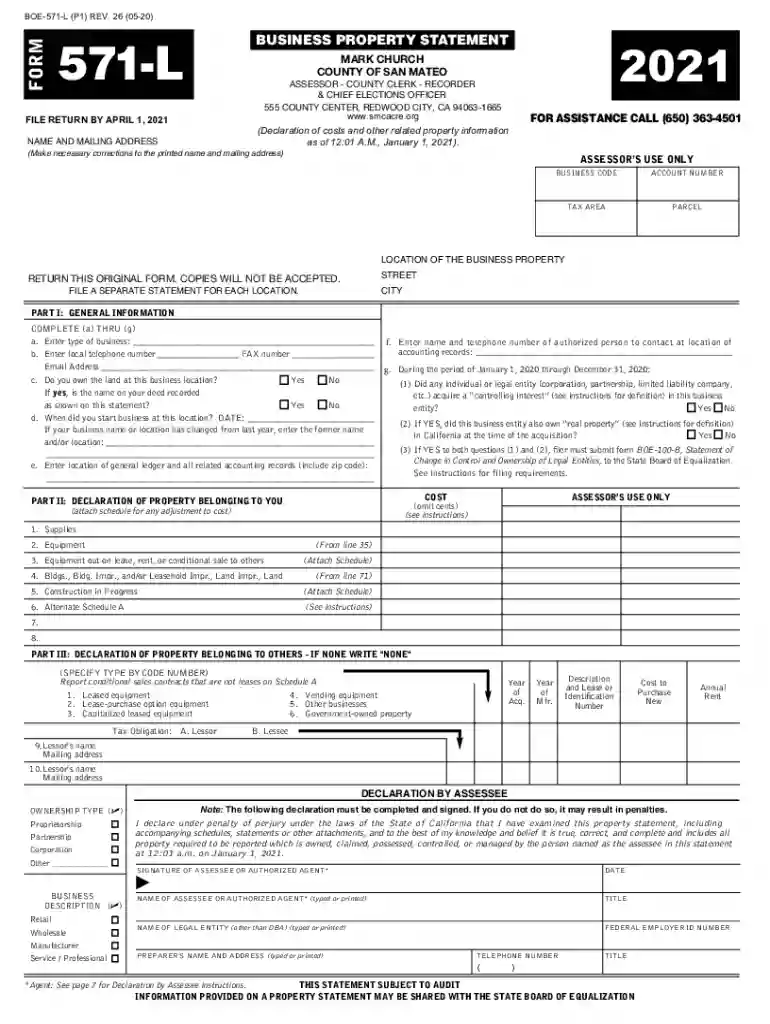
California boe 571 l form 2026

Get Form
boe 571 l Preview on Page 1

Here's how it works

01. Edit your boe 571 l online
Type text, add images, blackout confidential details, add comments, highlights and more.

02. Sign it in a few clicks
Draw your signature, type it, upload its image, or use your mobile device as a signature pad.

03. Share your form with others
Send boe 571 l alameda county via email, link, or fax. You can also download it, export it or print it out.

How to use or fill out California BOE 571 L form with our platform

Form edit decoration
9.5
Ease of Setup
DocHub User Ratings on G2
9.0
Ease of Use
DocHub User Ratings on G2
  1. Click ‘Get Form’ to open the California BOE 571 L form in the editor.
  2. Begin by entering your name and mailing address in the designated fields. Ensure that any preprinted information is corrected as necessary.
  3. In Part I, provide general information about your business, including type, contact details, and ownership of the land. Make sure to answer all questions accurately.
  4. Proceed to Part II where you will declare property belonging to you. Report costs for supplies, equipment, and buildings as instructed. Attach additional schedules if needed.
  5. In Part III, declare any property belonging to others located on your premises. Fill in the required details about leased equipment or other businesses.
  6. Complete the declaration by signing and dating the form at the end. This step is crucial as unsigned forms may incur penalties.

Start filling out your California BOE 571 L form online for free today!

See more california boe 571 l form versions

We've got more versions of the california boe 571 l form form. Select the right california boe 571 l form version from the list and start editing it straight away!
Versions Form popularity Fillable & printable
2021 4.8 Satisfied (59 Votes)
2017 4.2 Satisfied (135 Votes)
2012 4.1 Satisfied (49 Votes)
2011 4.1 Satisfied (67 Votes)
be ready to get more

Complete this form in 5 minutes or less

Get form

Got questions?

We have answers to the most popular questions from our customers. If you can't find an answer to your question, please contact us.
Contact us
To apply for tax exemptions, organizations have to apply for recognition of exemption. This results in the formal recognition of the organizations status by the IRS. Usually, organizations that dont operate for profit and provide valuable service to the communities can apply for tax exemption.
Tax Exemptions If you own and live in your home on January 1, you may qualify for a homeowners exemption. This exemption removes $7,000 from your homes assessed value, which may lower your property tax by about $70 each year.
The Form 571L or 571A constitutes an official request that you declare all assessable business property situated in this county which you owned, claimed, possessed, controlled or managed on the tax lien date. The form is approved by the State Board of Equalization (BOE) but forms are administered by the county.
You must occupy the dwelling as your principal residence as of January 1 of each year to qualify for the Homeowners Exemption for that year.
As long as no one person owns more than 50% of the LLC, there will be no property tax reassessment. The second way to use an LLC to avoid California property tax reassessment is to purchase your home with an LLC in the first place.
be ready to get more

Complete this form in 5 minutes or less

Get form

People also ask

You may qualify for the Homeowners Exemption if: You own the property. It was your principal residence on January 1st at 12:01 a.m. You dont already have a Homeowners Exemption on any other property. And you submit a completed application for Homeowners Exemption .
Prop. 19 also raises taxes on certain inherited and gifted family properties by closing a Prop. 13. That loophole allowed children and grandchildren who inherited property to also inherit the old property tax base, even if the current market value had increased docHubly.
The homeowners exemption is available to anyone who owns and occupies the property as their primary residence. Homestead exemption protections apply to a primary domicile but have varying levels of protection based on factors such as age, income, and marital status.

571l form