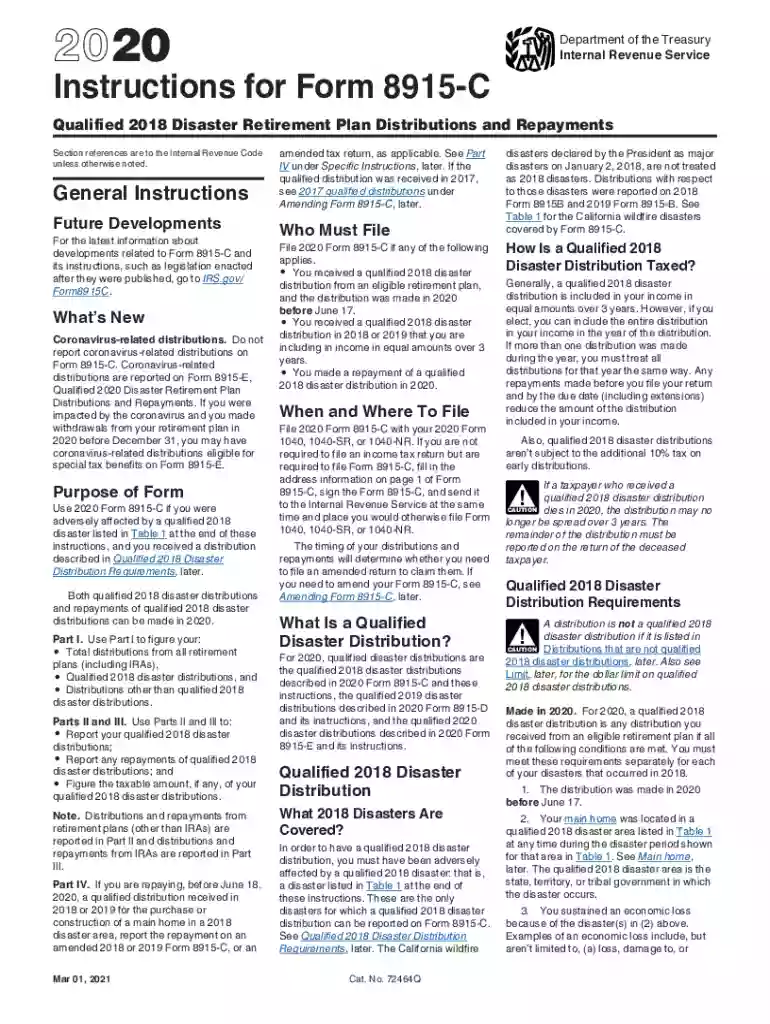
Irs instructions 8915c qualified retirement form 2026

Get Form
form 8915 c Preview on Page 1

Here's how it works

01. Edit your form 8915 c online
Type text, add images, blackout confidential details, add comments, highlights and more.

02. Sign it in a few clicks
Draw your signature, type it, upload its image, or use your mobile device as a signature pad.

03. Share your form with others
Send it via email, link, or fax. You can also download it, export it or print it out.

How to use or fill out IRS Instructions 8915-C Qualified Retirement Form with Our Platform

Form edit decoration
9.5
Ease of Setup
DocHub User Ratings on G2
9.0
Ease of Use
DocHub User Ratings on G2
  1. Click ‘Get Form’ to open it in the editor.
  2. Begin by entering your personal information at the top of the form, including your name and Social Security number.
  3. In Part I, report total distributions from all retirement plans. Use Form 1099-R to find the amounts for each distribution.
  4. Proceed to Parts II and III to report qualified disaster distributions and any repayments. Ensure you categorize distributions correctly based on whether they are from IRAs or other retirement plans.
  5. For Part IV, if applicable, indicate any repayments made for qualified distributions received in previous years.
  6. Review all entries for accuracy before saving or exporting your completed form directly from our platform.

Start using our platform today to simplify your form completion process for free!

See more irs instructions 8915c qualified retirement form versions

We've got more versions of the irs instructions 8915c qualified retirement form form. Select the right irs instructions 8915c qualified retirement form version from the list and start editing it straight away!
Versions Form popularity Fillable & printable
2023 4.1 Satisfied (51 Votes)
2022 4.3 Satisfied (52 Votes)
2021 4.7 Satisfied (52 Votes)
2020 4.8 Satisfied (30 Votes)
2019 4.4 Satisfied (93 Votes)
be ready to get more

Complete this form in 5 minutes or less

Get form

Got questions?

We have answers to the most popular questions from our customers. If you can't find an answer to your question, please contact us.
Contact us
In general, an employee must be allowed to participate in a qualified retirement plan if he or she meets both of the following requirements: Has docHubed age 21. Has at least 1 year of service.
Non-qualified retirement plans do not require IRS approval, which allows for greater flexibility in plan design and administration.
A qualified retirement plan does not have to favor shareholders, this statement is not a requirement by the IRS. On the contrary, the IRS rules state that a qualified retirement plan must not discriminate in favor of highly compensated employees, which often includes shareholders and higher-ups within the company.
Basic elective deferral limit The elective deferral limit for SIMPLE plans is 100% of compensation or $16,000 in 2024, $15,500 in 2023, $14,000 in 2022, and $13,500 in 2020 and 2021. Catch-up contributions may also be allowed if the employee is age 50 or older.
In order to satisfy this Code section, a plan must meet one of the following tests: The plan benefits at least 70 percent of employees who are not highly compensated employees (percentage test). (ii) the percentage of highly compensated employees benefiting under the plan (ratio test).

Security and compliance

At DocHub, your data security is our priority. We follow HIPAA, SOC2, GDPR, and other standards, so you can work on your documents with confidence.

Learn more
ccpa2
pci-dss
gdpr-compliance
hipaa
soc-compliance
be ready to get more

Complete this form in 5 minutes or less

Get form

People also ask

Proof of plan qualification status is typically documented in a copy of the plans IRS Letter of Determination, a signed letter from your employer or prior Plan Administrator and/or your rollover distribution statement. Proof of taxability is typically documented in your rollover distribution statement.
A qualified distribution from a 401(k) is a withdrawal made when the account holder is at least 59 years old. Any withdrawal taken prior to that age will face income taxes on the withdrawn amount as well as a 10% tax penalty.

Related links