




01. Edit your 1065 mailing address online
Type text, add images, blackout confidential details, add comments, highlights and more.

Type text, add images, blackout confidential details, add comments, highlights and more.

Draw your signature, type it, upload its image, or use your mobile device as a signature pad.

Send 1065 x via email, link, or fax. You can also download it, export it or print it out.
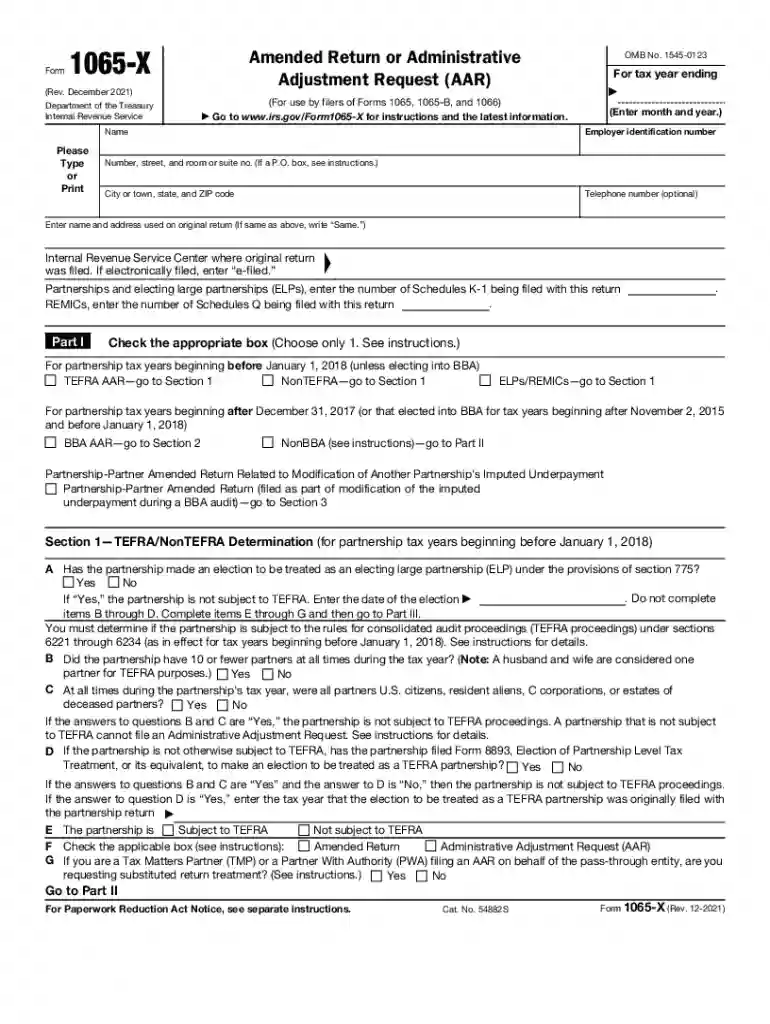
The Amended Return or Administrative Adjustment Request, commonly referred to as Form 1065-X, is a critical document for partnerships wishing to correct or adjust information from previously filed Forms 1065. This form ensures that partnerships remain in compliance with federal tax obligations by updating financial information such as income, deductions, and credits. Typically, this form is essential when new information emerges that significantly affects the partnership's initial return or when previous errors are discovered. The 1065-X also aids in determining the Tax Equity and Fiscal Responsibility Act of 1982 (TEFRA) and Bipartisan Budget Act of 2015 (BBA) applicability.
Using Form 1065-X involves several critical steps to ensure accurate and compliant amendments. Begin by gathering all necessary documentation from the original Form 1065 filing. This includes income statements, expense reports, and any supporting documents that justify the need for amendments. Next, review each section of the 1065-X to determine where changes are required, whether in reporting income, deductions, or credits. After identifying these areas, input the corrected figures alongside the original numbers to show the nature and effect of changes. Finally, submit the revised form to the IRS, either electronically or via mail, depending on filing preferences and submission requirements.
Review Original Filing: Start by examining the initially filed Form 1065 to locate discrepancies or areas that require adjustment. Ensure you have all correlated documents.
Annotate Changes: Mark which figures or information need altering and note down reasons for these amendments. Clearly differentiate between original and revised figures.
Adjust Sections: Carefully alter the necessary sections in Form 1065-X, making sure any change impacts other fiscally related parts of the form.
Complete Partner Information: Ensure that new information is communicated to all partners, as changes can affect their individual tax liabilities.
Sign and Authenticate: The amended return must be signed by an authorized partner, affirming the information’s accuracy under possible penalties of perjury.
Submit to IRS: File the completed 1065-X with the IRS, ensuring compliance with the corresponding deadlines to avoid penalties.
Amending Form 1065 is essential for multiple reasons. It ensures tax compliance by correcting inaccuracies or omissions from the original filing, which can prevent IRS penalties. Furthermore, this amendment could uncover rightful deductions or credits previously overlooked, potentially reducing the tax liability for the partnership. Additionally, maintaining accurate tax records supports informed financial decision-making and transparent business operations. Ensuring an amended form aligns with regulatory frameworks like TEFRA and BBA further fortifies the partnership's credibility and legal standing.
Understanding specific terminologies is pivotal when dealing with the 1065-X. Key terms include:
The IRS provides explicit instructions for filing Form 1065-X. It includes detailed line-by-line guidance on making corrections and specifies how partnerships should represent global changes. The agency also outlines whether the amendment requires additional partner consent and the documentation needed to support changes. IRS guidelines stress submitting supporting evidence for amendments to avoid unnecessary audits. Moreover, guidelines explain the relationship between Form 1065-X and other tax forms, detailing compliance aspects for integrated reporting.
Form 1065-X should be filed within three years from the original due date of the partnership return, including extensions. Adhering to this timeline ensures the partnership's claim to potential tax benefits resulting from the amendments remains valid. Note that specific deadlines may vary depending on the partnerships' fiscal calendar. It is vital to mark these dates prominently in tax preparation timelines to ensure compliance and leverage opportunities for corrections.
The amended 1065 form is primarily used by partnerships and large partnerships electing under IRS regulations to report necessary financial adjustments post-filing. This form is crucial for business types such as LLCs operating as partnerships and electing large partnerships, especially when reconciling economic events like capital investments, operational changes, or partnership dissolutions. Additionally, it serves tax consultants managing multi-member entity returns, providing them a procedural basis to make essential post-filing corrections without starting from scratch.


Failing to file an accurate 1065-X when errors are detected in initial filings may result in IRS-imposed fines and interest penalties. Partnerships that neglect to amend errors found in the original 1065 can face more serious repercussions, including audits or more substantial penalizations. It’s imperative that partnerships understand their compliance duty, promptly addressing discrepancies by filing the 1065-X to prevent potential financial and reputational damage.
We've got more versions of the 1065 mailing address form. Select the right 1065 mailing address version from the list and start editing it straight away!
At DocHub, your data security is our priority. We follow HIPAA, SOC2, GDPR, and other standards, so you can work on your documents with confidence.
Mar 30, 2026 Use Form 1065-X, if you are not filing electronically, to: Correct items on a previously filed Form 1065, Form 1065-B, or Form 1066.Read more
by C Cruz 2024 A partnership needing to amend a previously filed Form 1065 must consider the modifications as impacted by the BBA. This is because BBARead more
G Check applicable boxes: (1). Initial return (2). Final return (3). Name change (4). Address change (5). Amended return.Read more


