




01. Edit your form 8858 online
Type text, add images, blackout confidential details, add comments, highlights and more.

Type text, add images, blackout confidential details, add comments, highlights and more.

Draw your signature, type it, upload its image, or use your mobile device as a signature pad.

Send 8858 via email, link, or fax. You can also download it, export it or print it out.
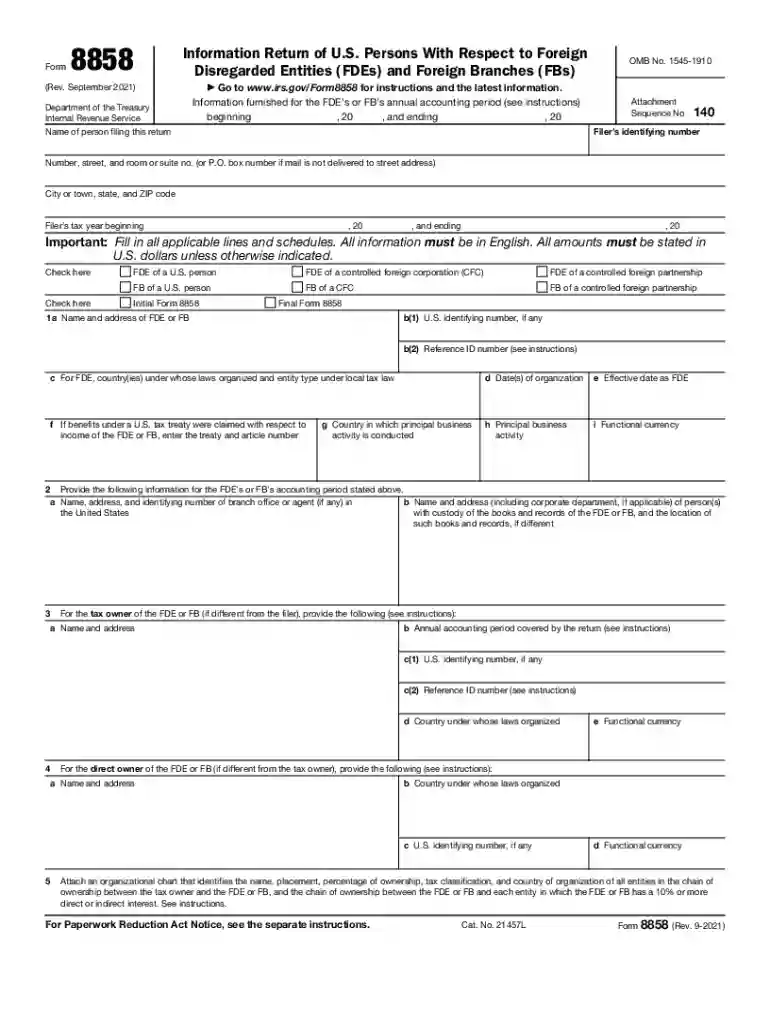
Form 8858, titled "Information Return of U.S. Persons With Respect to Foreign Disregarded Entities," is a mandatory tax documentation required by the U.S. Internal Revenue Service (IRS). Its purpose is to ensure that U.S. persons, including citizens and residents, properly report their financial interest in foreign disregarded entities (FDEs) and foreign branches (FBs). This form is crucial for maintaining transparency in global financial operations and compliance with U.S. tax laws.
Foreign Disregarded Entities: These are entities that the IRS ignores for tax purposes, meaning the income and transactions are directly considered for tax on an entity's owner.
Foreign Branches: Portions of a company that conduct business in a foreign country, but do not constitute a separate legal entity.
Providing accurate information on Form 8858 assists in evaluating a taxpayer's global income, which is essential for determining correct tax liabilities and ensuring adherence to international tax regulations.
Completing Form 8858 requires careful attention to detail and an understanding of your foreign operations. Below is a step-by-step guide to help you through this process.
Gather Required Information: Collect all necessary financial statements, ownership documents, and compliance-related materials linked to your FDEs or FBs.
Fill Out Basic Information: Start with entering your name, taxpayer identification number, and relevant details about the FDE or FB.
Complete Financial Information: Address all sections pertaining to income, deductions, and financial position of the foreign entity for the tax year in question.
Ownership and Transactions: Detail information on ownership structure and intercompany transactions, ensuring accurate representation of relationships and financial flows.
Compliance and Disclosure: Include compliance checks to ensure all required disclosures, such as reporting of foreign assets, are completed accurately.
Review and Submit: Double-check all the entries for accuracy and completeness before filing. Typically, it’s best to consult with a tax professional to avoid errors.
Understanding key terms is crucial for correctly completing Form 8858. Below are definitions and insights into several important terms.
U.S. Person: An individual or corporation subject to U.S. taxation on worldwide income.
Disregarded Entity: An entity that is not considered separate from its owner for tax purposes.
Controlled Foreign Corporation (CFC): A foreign corporation with U.S. shareholders that own, directly or indirectly, over 50% of the corporation’s stock.
Knowledge of these terms assists filers in navigating the complexities of Form 8858 with clarity and accuracy. It ensures adherence to all legal and procedural prerequisites set by the IRS.
Timeliness is critical for tax compliance related to Form 8858. Missing deadlines can lead to penalties.
Generally Attached to Other Returns: Form 8858 is typically filed with the main tax return (e.g., Form 1065, 1120, or 1040) and follows the same deadline.
Extension Opportunities: Taxpayers can request an extension to file this form, which aligns with the extension of their main return.
Penalties: Late filing or non-filing can result in substantial penalties, including monetary fines and interest accruals.
Adhering to these deadlines ensures compliance, reduces risks of penalties, and maintains good tax standing with the IRS.
The IRS provides explicit guidelines on how to fill and submit Form 8858. Familiarizing yourself with these guidelines is essential for accurate filing.
Documentation Requirements: Keep comprehensive records of all related financial transactions, ownership documentation, and relevant tax forms.
Specific Instructions: Follow IRS's specific instructions on reporting income, expenses, and ownership detail to ensure full compliance.
Amendments: Guidance is available on how to correct or amend a previously filed Form 8858 to rectify errors or update information.
Consulting the IRS guidelines or a tax professional can greatly assist in navigating this process and ensure adherence to all requirements.
Form 8858 is aimed at a specific category of taxpayers. Understanding who uses this form can help in assessing whether it applies to your situation.
U.S. Individuals and Corporations: Especially those with significant foreign business operations or interests in FDEs and FBs.
U.S. Multinational Corporations: Enterprises with a global footprint needing to report their global operations for U.S. tax purposes.
Foreign Partnerships and Trusts: In some configurations, may need to address parts of this form if they involve U.S. person investments or management.
These groups are most involved in international transactions, making Form 8858 relevant for detailed reporting and compliance.
Real-world scenarios can illuminate how Form 8858 is used in practice. The following are examples of situations necessitating this form.
A U.S. Tech Company: Expands operations into Asia with foreign branches to manage local sales activities, requiring detailed reporting on Form 8858.
An American Entrepreneur: Owns a foreign disregarded entity involved in producing goods outside the U.S., thus needing to disclose all financial transactions related to this FDE.
Large Manufacturer: Operates through subsidiaries worldwide with revenue flows back to U.S. headquarters, making Form 8858's detailed disclosures crucial for accurate tax reporting.
These examples illustrate the application of Form 8858 in different corporate and personal settings, emphasizing its role in comprehensive international reporting requirements.
Non-compliance with Form 8858's filing requirements can result in serious consequences. Understanding these penalties can underscore the importance of timely and accurate filing.
Monetary Fines: Failure to file, or late filing, could lead to fines up to $10,000 per foreign entity per year.
Additional Penalties: Continued noncompliance can result in further assessments of penalties or interests.
Impact on Tax Returns: Incorrect filings may also lead to inaccuracies in your overall tax return, potentially escalating disputes with the IRS.
Maintaining precise compliance with Form 8858 helps mitigate these risks and ensures adherence to U.S. tax obligations related to foreign operations.
We've got more versions of the form 8858 form. Select the right form 8858 version from the list and start editing it straight away!
At DocHub, your data security is our priority. We follow HIPAA, SOC2, GDPR, and other standards, so you can work on your documents with confidence.
5 Attach an organizational chart that identifies the name, placement, percentage of ownership, tax classification, and country of organization of all entitiesRead more
If the partnership is required to file Form 8858, Information Return of U.S. Persons With Respect To Foreign. Disregarded Entities, enter the number of FormsRead more
Instructions for Form 8858, information return of U.S. persons with respect to foreign disregarded entities [electronic resource]. Format: Journal, PeriodicalRead more


