
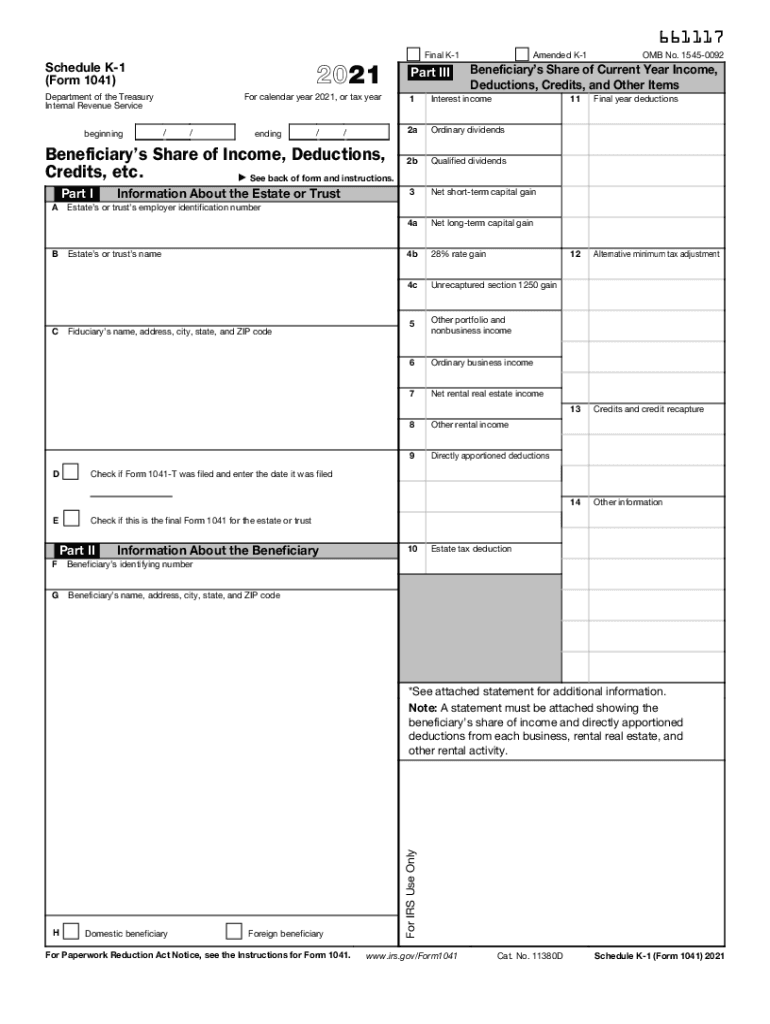







Definition and Purpose of Schedule K-1
Schedule K-1 (Form 1041) is a crucial tax document used in the U.S. for tax reporting purposes. It details a beneficiary's share of income, deductions, credits, and other items distributed from an estate or trust. This form serves as a communication tool between the estate or trust and the beneficiary, providing necessary information to complete the beneficiary's individual tax return. The document includes different sections to report various income types, such as interest, dividends, capital gains, and rental income.
Key Elements of the Schedule K-1
- Beneficiary Information: Includes personal details such as the beneficiary's name, address, and taxpayer identification number.
- Income Details: Enumerates different income types like ordinary dividends, interest income, and capital gains.
- Deductions and Credits: Lists applicable deductions and credits which can be claimed by the beneficiary.
- Estate or Trust Information: Provides essential information about the trust or estate including its name, address, and taxpayer identification number.
How to Use the Schedule K-1
Beneficiaries should use the information provided in Schedule K-1 to fill out their individual income tax returns. Typically attached to Form 1040, taxpayers input data from the K-1 to accurately report income and calculate tax liabilities.
- Review for Accuracy: Ensure all information, particularly financial figures, is correct.
- Input on Tax Return: Transfer the necessary numbers to corresponding sections on personal tax forms.
- Retain Records: Keep a copy for personal records and future reference.
Steps to Complete Schedule K-1
- Gather Information: Collect all necessary financial records and communication from the estate or trust.
- Fill Details: Complete identification sections with the beneficiary's and estate/trust's relevant details.
- List Income and Deductions: Enter all distributed income, applicable deductions, and credits in designated areas.
- Review and Double-Check: Verify that all entries are accurate and comply with IRS guidelines.
IRS Guidelines and Filing Instructions
The IRS has specific instructions for completing and filing Schedule K-1 to ensure beneficiaries accurately report distributed income:
- Follow Official Instructions: Reference the IRS instructions for Form 1041 and Schedule K-1 to avoid errors.
- Recordkeeping: Maintain copies of the Schedule K-1 and supporting documents for three years from the date of filing.
- Avoid Common Mistakes: Double-check entries for accuracy, especially regarding income allocation and type classifications.
Important Filing Deadlines
Understanding and adhering to the filing deadlines for Schedule K-1 is crucial for compliance:
- Regular Deadline: Generally due by April 15, coinciding with personal income tax filing.
- Extensions: If the estate or trust files an extension, beneficiaries should be aware of new deadlines, typically October 15.
- Penalties for Late Filing: Missing deadlines can result in penalties for inaccurate or late tax filing, emphasizing the need for timely submissions.
Required Documents for Completing Schedule K-1
Completing Schedule K-1 requires several supporting documents to provide accurate information:
- Previous Tax Returns: Helps ensure consistency and verification.
- Distribution Statements: Documentation of income distributions from the estate or trust.
- Estate or Trust Records: Includes any statements or records provided by the trust or estate fiduciary detailing financial transactions.
Legal Use and Compliance
Schedule K-1 carries legal implications as it is used for tax reporting and compliance. Beneficiaries and fiduciaries must ensure all reported information is accurate and truthful, as submissions are subject to audit by the IRS. Non-compliance or fraudulent reporting can result in severe legal penalties, including fines or other legal actions.
Software Compatibility
Schedule K-1 preparation and filing can be simplified using various tax preparation software solutions:
- TurboTax, H&R Block: Recognized software that can assist in importing and populating K-1 information directly into individual tax returns.
- QuickBooks: While more focused on accounting, it can track and report financial data relevant for K-1 calculations.
Beneficiary Scenarios and Considerations
Schedule K-1 is pivotal for numerous taxpayer scenarios:
- Self-Employed: Beneficiaries with additional business income need to ensure all income types are accurately reported.
- Retirees: Includes managing mixed income streams like pensions and dividends.
- Students: Those who are beneficiaries of an education-related trust must correctly account for any distributed income.
Beneficiaries and their tax advisors must diligently review and apply the information contained within their Schedule K-1 to ensure compliance, accurate reporting, and proper tax liabilities are met.




