




01. Edit your 2021 form 8582 online
Type text, add images, blackout confidential details, add comments, highlights and more.

Type text, add images, blackout confidential details, add comments, highlights and more.

Draw your signature, type it, upload its image, or use your mobile device as a signature pad.

Send 8582 form 2021 via email, link, or fax. You can also download it, export it or print it out.
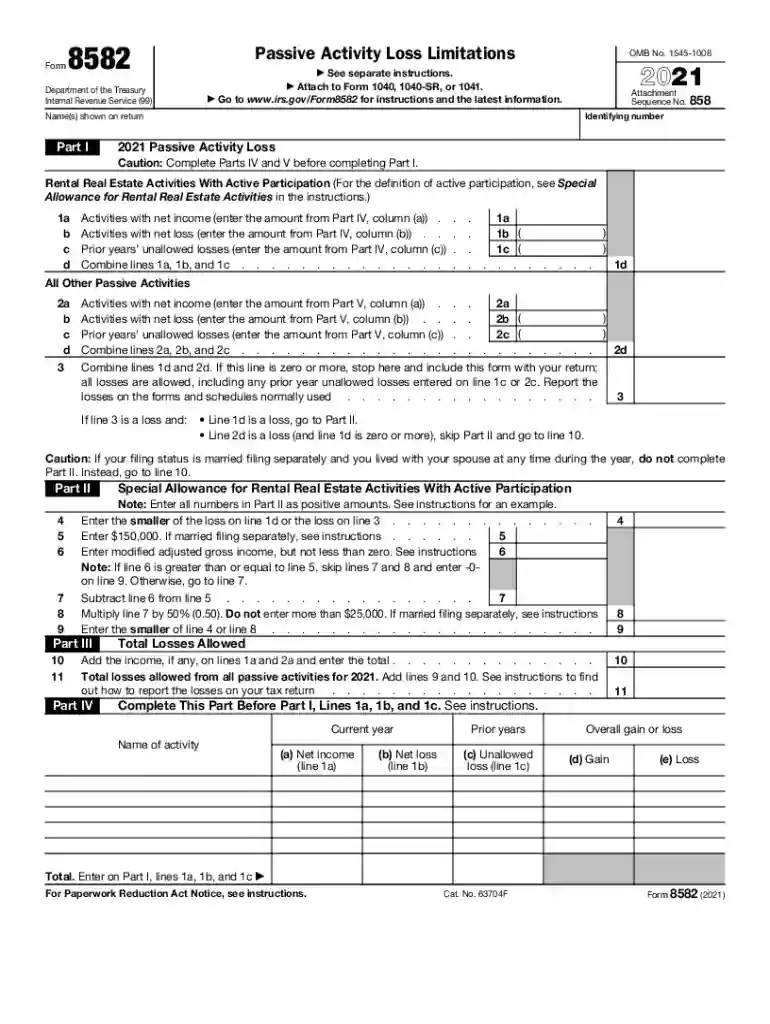
Form 8582, or the Passive Activity Loss Limitations form, is utilized by taxpayers in the United States to report their passive activity losses. The primary purpose of this form is to calculate and disclose any losses derived from passive activities, particularly rental real estate activities where the taxpayer actively participates. Passive activity losses typically cannot offset non-passive income, making Form 8582 essential for properly accounting for those losses within the confines set by the Internal Revenue Service (IRS). Understanding the specific nuances of how passive losses are limited under IRS regulations is crucial for accurate tax reporting.
Form 8582 is structured to ensure a detailed calculation of passive activity losses. It includes several key elements:
A comprehensive understanding of Form 8582 requires familiarity with specific terms:
Form 8582 is employed by taxpayers for detailed accounting of passive losses. To maximize the utility of this form, taxpayers should begin by listing each passive activity along with the corresponding income or loss. Subsequently, apply the passive activity loss rules to determine the allowable deductions for the tax year, ensuring that unallowed losses are appropriately carried over to future years for potential deduction.
Completing Form 8582 involves a series of calculated steps:
The IRS provides specific guidelines governing the submission of Form 8582 to ensure compliance with tax regulations. Instructions emphasize the taxpayer's need to accurately report the total amount of passive activity income and losses each year. The guidance also elucidates calculation methods and criteria for passive versus active participation in activities, necessary to properly claim and limit losses.
Failing to properly complete Form 8582 can result in significant penalties from the IRS. Non-compliance may lead to fines, audits, and further scrutiny of the taxpayer's returns. Taxpayers must ensure that all passive activity loss calculations are consistently accurate to avoid these repercussions.
Form 8582 is compatible with various tax preparation software, such as TurboTax and QuickBooks, which help streamline the filing process. These software solutions often include modules for passive activity calculations, automatically capping losses according to IRS rules and facilitating electronic filing.
Taxpayers have multiple submission methods for Form 8582:
Eligibility to utilize Form 8582 extends to individuals, estates, and trusts engaged in passive activities but restricted by certain thresholds for active participants. Specifically, taxpayers who own rental properties or limited partnerships may find themselves required to file this form to justify their passive activity losses against any income.


While Form 8582 is a federal requirement, different states may have unique regulations and treatments for passive activity losses. Taxpayers should verify their state-specific obligations to ensure comprehensive compliance.
By providing detailed explanations, multiple examples, and structured guidance, this content ensures taxpayers are well-informed about Form 8582, its criteria, and processes.
We've got more versions of the 2021 form 8582 form. Select the right 2021 form 8582 version from the list and start editing it straight away!
| Versions | Form popularity | Fillable & printable |
|---|---|---|
| 2025 | 4.3 Satisfied (23 Votes) | |
| 2024 | 4.4 Satisfied (55 Votes) | |
| 2023 | 3.8 Satisfied (31 Votes) | |
| 2022 | 4.9 Satisfied (27 Votes) | |
| 2021 | 4.8 Satisfied (135 Votes) | |
| 2020 | 4.4 Satisfied (190 Votes) | |
| 2019 | 4.3 Satisfied (203 Votes) | |
| 2018 | 4.2 Satisfied (72 Votes) | |
| 2017 | 4.2 Satisfied (115 Votes) | |
| 2016 | 4.4 Satisfied (185 Votes) | |
| 2015 | 4.3 Satisfied (53 Votes) | |
| 2014 | 4 Satisfied (32 Votes) | |
| 2013 | 4.2 Satisfied (52 Votes) | |
| 2012 | 4.3 Satisfied (49 Votes) | |
| 2011 | 4.2 Satisfied (35 Votes) |
At DocHub, your data security is our priority. We follow HIPAA, SOC2, GDPR, and other standards, so you can work on your documents with confidence.
1995 Passive Activity Credits. Caution: If you have credits from a publicly traded partnership, see Publicly Traded Partnerships (PTPs) on page 14.Read more
Mar 30, 2026 Noncorporate taxpayers use Form 8582 to: Figure the amount of any passive activity loss (PAL) for the current tax year. Report the applicationRead more


