




01. Edit your 1997 1040 online
Type text, add images, blackout confidential details, add comments, highlights and more.

Type text, add images, blackout confidential details, add comments, highlights and more.

Draw your signature, type it, upload its image, or use your mobile device as a signature pad.

Send it via email, link, or fax. You can also download it, export it or print it out.
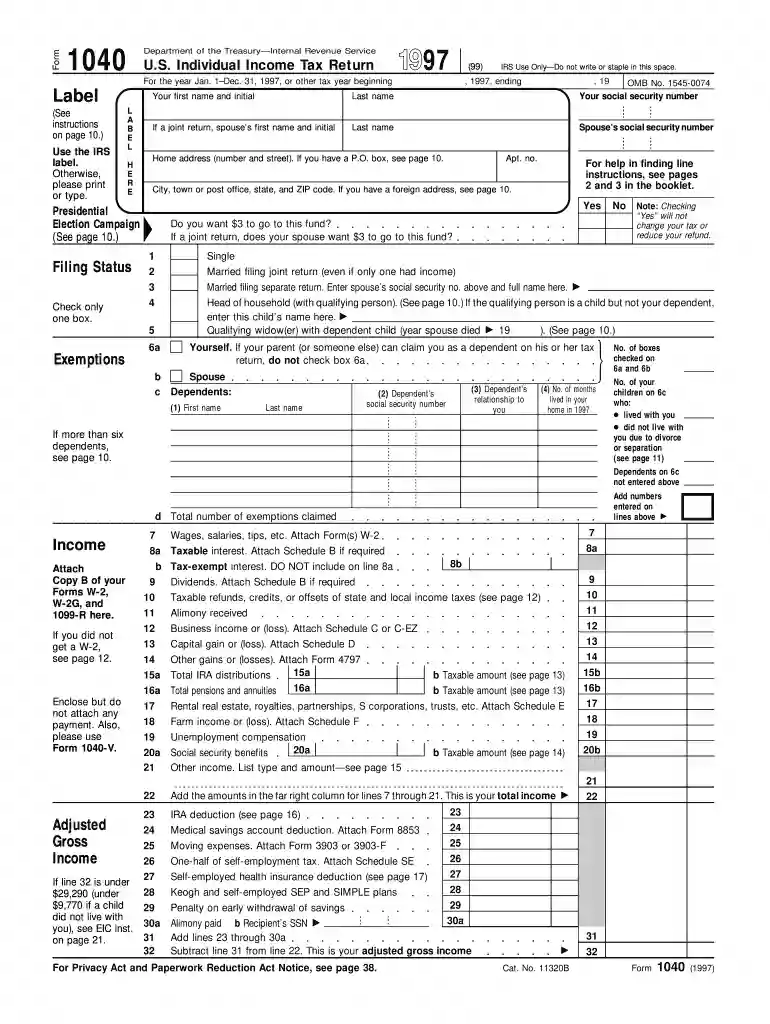
The 1997 IRS Form 1040 is the official document used by U.S. taxpayers to file their annual federal income tax returns. This form enables individuals to report their income, claim deductions and credits, and calculate their tax obligations or potential refunds for the tax year 1997. It is a comprehensive form that includes sections for various types of income, allowed deductions, and credits, making it essential for ensuring compliance with federal tax laws.
The 1040 form for 1997 includes several critical sections:
Understanding these components is vital for accurate completion and compliance.
To obtain the 1997 IRS Form 1040, taxpayers could order a copy from the IRS by mail or download it from the IRS website if available in the archives. Alternatively, some tax preparation software and services may offer access to prior-year forms, ensuring historical compliance.
The 1997 IRS Form 1040 is legally required for any individual who earned above a certain threshold in 1997 and needs to report their income to the IRS. It ensures that taxpayers fulfill their legal obligations by accurately reporting and paying their federal taxes.
The IRS provides extensive guidelines which include:
These guidelines are crucial for preventing errors and ensuring compliance.
Typically, the deadline for filing the 1997 IRS Form was April 15, 1998. If you were unable to meet this deadline, the IRS offered extensions; however, these required timely application. Missing the deadlines could lead to penalties and interest charges on any taxes owed.
Failure to file the 1997 IRS Form 1040 or pay the due taxes can result in various penalties:
Understanding these penalties emphasizes the importance of timely and accurate filing.
Different taxpayer scenarios affected how one might interact with the 1997 IRS Form:
Knowing these differences can aid in precise completion and maximize tax benefits.


We've got more versions of the 1997 1040 form. Select the right 1997 1040 version from the list and start editing it straight away!
| Versions | Form popularity | Fillable & printable |
|---|---|---|
| 2025 | 4.9 Satisfied (56 Votes) | |
| 2024 | 4.5 Satisfied (50 Votes) | |
| 2023 | 4.9 Satisfied (56 Votes) | |
| 2022 | 4.3 Satisfied (60 Votes) | |
| 2021 | 4.8 Satisfied (50 Votes) | |
| 2020 | 4.4 Satisfied (257 Votes) | |
| 2019 | 4.2 Satisfied (85 Votes) | |
| 2018 | 4.4 Satisfied (346 Votes) | |
| 2017 | 4 Satisfied (21 Votes) | |
| 2017 | 4.4 Satisfied (458 Votes) | |
| 2016 | 4.4 Satisfied (657 Votes) | |
| 2015 | 4.3 Satisfied (174 Votes) | |
| 2014 | 4 Satisfied (48 Votes) | |
| 2013 | 4 Satisfied (70 Votes) | |
| 2012 | 4 Satisfied (28 Votes) |
At DocHub, your data security is our priority. We follow HIPAA, SOC2, GDPR, and other standards, so you can work on your documents with confidence.
May 2, 2017 You may use an acceptable substitute form instead of an official IRS form. Revenue Bulletin 1997-2 at IRS.gov/pub/irs-irbs/. CAUTION ! CAUTION.Read more
Form. Married filing separate return. Enter spouses social security no. above and full name here. . Cat. No. 11320B. . %. Label. Form 1040 (1997). IRS UseRead more
If this form shows Federal income tax withheld in box 2, attach this copy to your return. This information is being furnished to the Internal Revenue. Service.Read more


