




01. Edit your 709 form online
Type text, add images, blackout confidential details, add comments, highlights and more.

Type text, add images, blackout confidential details, add comments, highlights and more.

Draw your signature, type it, upload its image, or use your mobile device as a signature pad.

Send form 709 via email, link, or fax. You can also download it, export it or print it out.
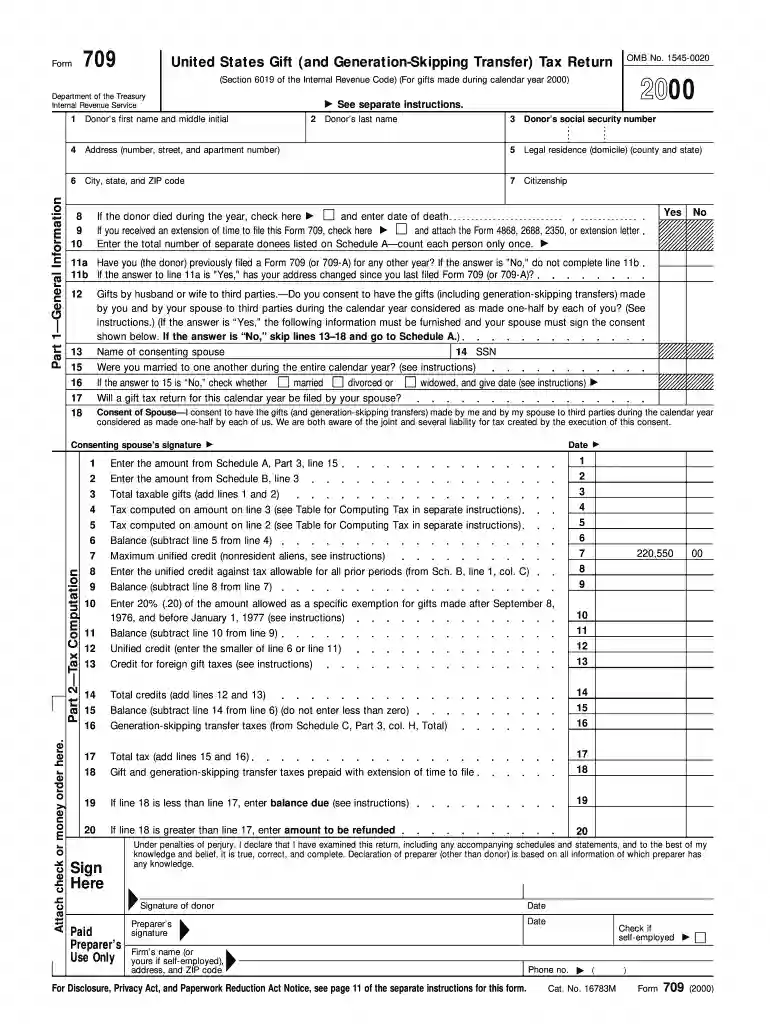
The 2000 Form 709 is the United States Gift (and Generation-Skipping Transfer) Tax Return. It is used to report gifts given by an individual during the year to others, whether they are individuals or trusts. This form allows donors to specify the value of these gifts and compute relevant taxes. Gift-splitting between spouses can also be detailed here, offering couples a way to manage their collective gift taxes effectively.
Form 709 is essential for individuals who have gifted amounts exceeding the annual exclusion limit. It provides a comprehensive record to the IRS about the nature and value of the gifts, serving as a crucial component in the administration of gift taxes. The form is also pivotal in tracking lifetime exclusion usage for taxes.
Acquiring the 2000 Form 709 can be done through several channels. The IRS provides this form on its official website, allowing users to download and complete it digitally or as a printed document. Alternatively, those using tax software might find the form integrated within the program, offering a more guided experience.
Completing Form 709 requires attention to detail and comprehensive knowledge of the gifts made during the year. Below is a step-by-step guide to ensure the form is filled out correctly:
Understanding specific terminology associated with Form 709 is crucial to accurately completing it:
Form 709 consists of multiple sections that need to be accurately completed:
The due date for submitting Form 709 aligns with the federal income tax deadline, typically April 15 of the year following the gift. Extensions can be requested if necessary, providing additional time to gather details or consult tax professionals.
Form 709 ensures taxpayers comply with federal gift tax laws. Failure to file or incorrect reporting can result in penalties, making it essential to understand legal obligations.
Various taxpayer scenarios involve the use of Form 709. Examples include individuals making substantial gifts, and grandparents investing in grandchildren's education via trust funds, or couples utilizing gift splitting to maximize tax advantages.
Non-compliance with Form 709 requirements can lead to penalties and interest on unpaid taxes. Accurate filing and timely submission are crucial to avoid these repercussions, emphasizing the importance of understanding the guidelines and deadlines.
Consider hypothetical scenarios where Form 709 comes into play:
Tax preparation software like TurboTax and QuickBooks can aid in filing Form 709. They provide guided steps and automated calculations, ensuring accuracy and compliance.
When filing Form 709, individuals have the option to submit digitally or on paper. Digital submissions offer quicker processing and can often integrate directly with tax software tools for added convenience and error checking.
The 2000 Form 709 is an essential document for reporting and taxing gifts beyond certain limits. Careful completion, understanding of applicable laws, and timely submission are critical to maintaining compliance with IRS regulations. By leveraging appropriate resources and tools, taxpayers can effectively manage their gift tax obligations.
We've got more versions of the 709 form form. Select the right 709 form version from the list and start editing it straight away!
| Versions | Form popularity | Fillable & printable |
|---|---|---|
| 2025 | 4.3 Satisfied (24 Votes) | |
| 2024 | 4.2 Satisfied (58 Votes) | |
| 2023 | 4.4 Satisfied (50 Votes) | |
| 2022 | 4.9 Satisfied (46 Votes) | |
| 2021 | 4.9 Satisfied (24 Votes) | |
| 2020 | 4.3 Satisfied (180 Votes) | |
| 2019 | 4.3 Satisfied (183 Votes) | |
| 2018 | 4.3 Satisfied (183 Votes) | |
| 2017 | 4.2 Satisfied (54 Votes) | |
| 2016 | 4.4 Satisfied (60 Votes) | |
| 2015 | 4 Satisfied (25 Votes) | |
| 2014 | 4 Satisfied (38 Votes) | |
| 2013 | 4.3 Satisfied (55 Votes) | |
| 2012 | 4.1 Satisfied (59 Votes) | |
| 2011 | 4 Satisfied (41 Votes) |
At DocHub, your data security is our priority. We follow HIPAA, SOC2, GDPR, and other standards, so you can work on your documents with confidence.
Declaration of preparer (other than donor) is based on all information of which preparer has any knowledge. Attach check or money order here. Form 709 (2000).Read more
Her preparer filed a Form 709 on June 20, 2000, showing the $700,000 gift and a $1,850 gift tax due. There is no delinquency penalty for the late filed gift taxRead more
The American Association of Clinical Endocrinologists and American Association of Endocrine Surgeons. Medical Guidelines for the Management of AdrenalRead more


