Form ct3 4 2026

Get Form
form ct3 4 Preview on Page 1

Here's how it works

01. Edit your form online
Type text, add images, blackout confidential details, add comments, highlights and more.

02. Sign it in a few clicks
Draw your signature, type it, upload its image, or use your mobile device as a signature pad.

03. Share your form with others
Send it via email, link, or fax. You can also download it, export it or print it out.

How to use or fill out form ct3 4 with our platform

Form edit decoration
9.5
Ease of Setup
DocHub User Ratings on G2
9.0
Ease of Use
DocHub User Ratings on G2
  1. Click ‘Get Form’ to open it in the editor.
  2. Begin by entering the tax year for which you are completing Form CT-3.4 in the first row of Schedule A. For subsequent years, move the previous year's information down and enter the new tax year at the top.
  3. If you have a loss from Form CT-3 or CT-3-A, mark an X in the box to elect to waive the carryback of this loss.
  4. Complete lines 1 through 4 based on your business income. If your income is zero or less, enter 0 and proceed to complete lines 5a through 5.
  5. For lines 5a through 7, ensure all amounts are entered as positive values. Calculate your NOLs available for use and follow the instructions for each line carefully.

Start using our platform today to streamline your form completion process for free!

See more form ct3 4 versions

We've got more versions of the form ct3 4 form. Select the right form ct3 4 version from the list and start editing it straight away!
Versions Form popularity Fillable & printable
2023 4.3 Satisfied (57 Votes)
2022 4.3 Satisfied (22 Votes)
2021 4.8 Satisfied (186 Votes)
2020 4.3 Satisfied (173 Votes)
2019 4.2 Satisfied (78 Votes)
2018 4.4 Satisfied (221 Votes)
2017 3.6 Satisfied (29 Votes)
2016 4.4 Satisfied (462 Votes)
2015 4.3 Satisfied (104 Votes)
2014 4 Satisfied (42 Votes)
2013 4 Satisfied (58 Votes)
2012 4 Satisfied (22 Votes)
2010 4.4 Satisfied (136 Votes)
be ready to get more

Complete this form in 5 minutes or less

Get form

Got questions?

We have answers to the most popular questions from our customers. If you can't find an answer to your question, please contact us.
Contact us
At the federal level, businesses can carry forward their net operating losses indefinitely, but the deductions are limited to 80 percent of taxable income. Prior to the Tax Cuts and Jobs Act (TCJA) of 2017, businesses could carry losses forward for 20 years (without a deductibility limit).
A net operating loss (NOL) occurs when a companys deductions exceed its taxable income. NOLs can be carried forward indefinitely but are limited to offsetting 80% of taxable income.
NOL 80% carryover limitation 80% of the excess of (1) taxable income (computed without regard to the NOL deduction, QBI deduction, or the foreign-derived intangible income), over (2) the aggregate amount of NOL arising in taxable years beginning before 2018, carried to the taxable year.
For tax years ending on or after Dec. 31, 2024, and prior to Dec. 31, 2027, the maximum amount of an NOL that a C corporation may deduct is limited to $500,000. Prior to amendment, the limitation was $100,000 for tax years ending on or after Dec.
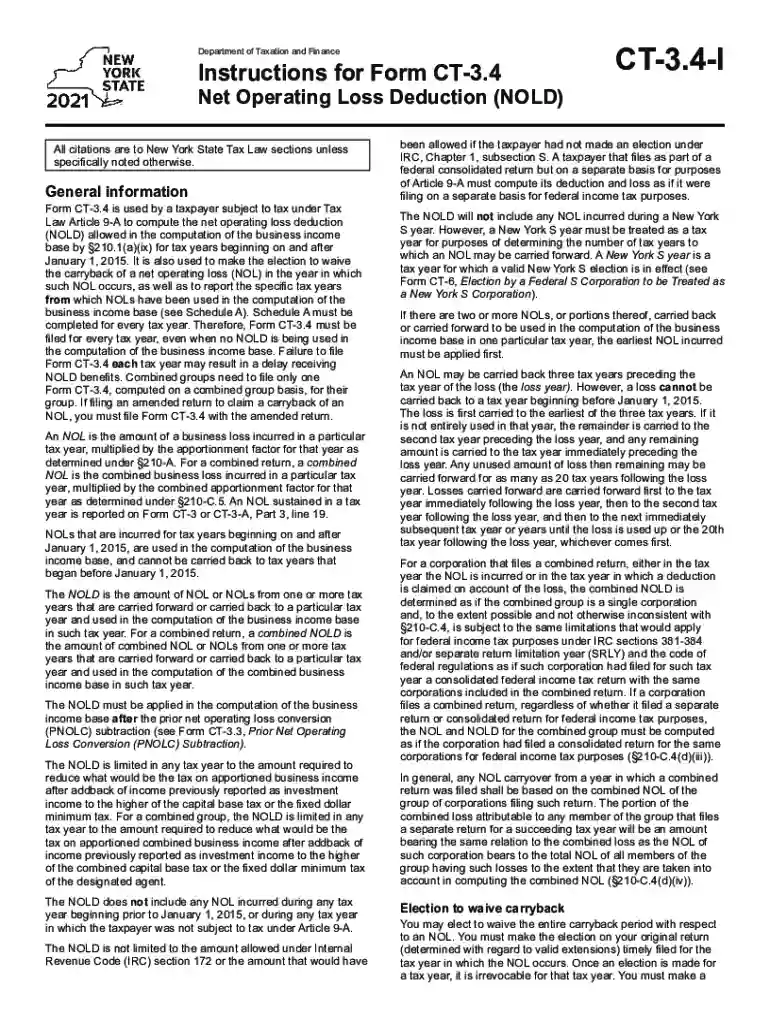
Form CT-3.4 is used by a taxpayer subject to tax under Tax Law Article 9-A to compute the net operating loss deduction (NOLD) allowed in the computation of the business income base and to make the election to waive the carryback of a net operating loss (NOL) in the year in which such NOL occurs, as well as to report

Security and compliance

At DocHub, your data security is our priority. We follow HIPAA, SOC2, GDPR, and other standards, so you can work on your documents with confidence.

Learn more
ccpa2
pci-dss
gdpr-compliance
hipaa
soc-compliance

People also ask

Nonbusiness income, such as interest, dividends, and Social Security is not adjusted when calculating net operating losses. The exception would be recomputed capital gains, discussed above.
The Internal Revenue Code allows taxpayers to claim a capital loss deduction from their annual capital gains. Capital loss deductions from regular income are limited to $3,000 a year. Losses over this limit can be carried forward and claimed in future tax years if you make use of a capital loss carryover.

Related links