




01. Edit your form online
Type text, add images, blackout confidential details, add comments, highlights and more.

Type text, add images, blackout confidential details, add comments, highlights and more.

Draw your signature, type it, upload its image, or use your mobile device as a signature pad.

Send it via email, link, or fax. You can also download it, export it or print it out.
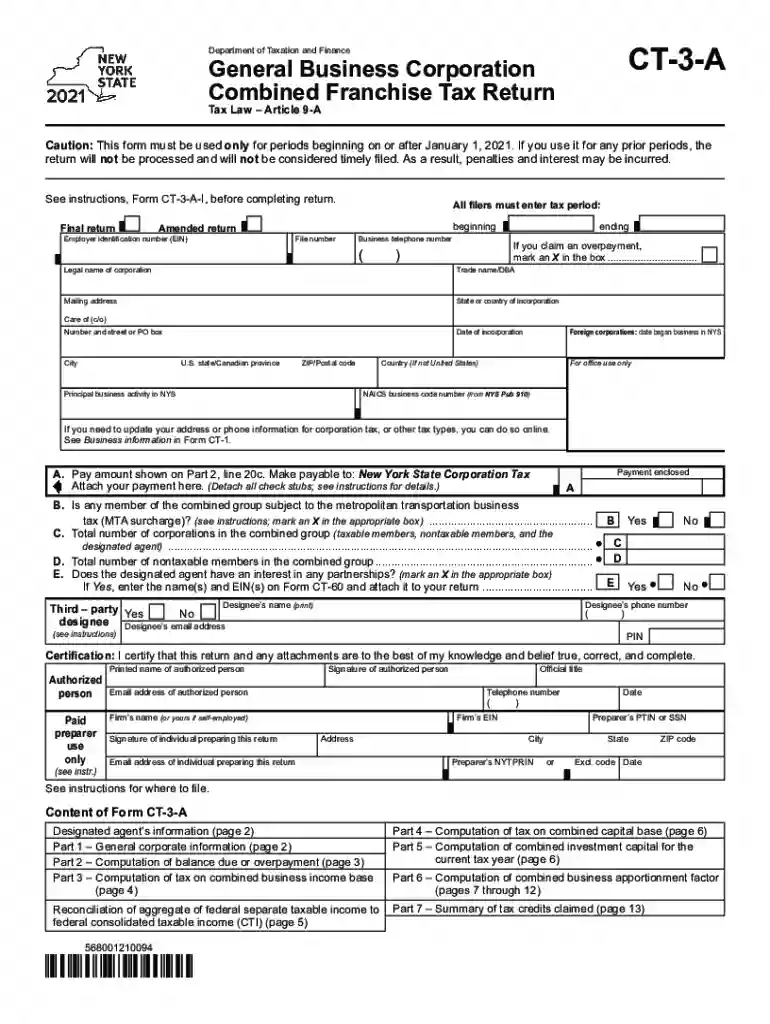
The CT-3-A form is a Combined Franchise Tax Return used by general business corporations in New York State. This form is designed for corporations that need to file a consolidated tax return for various member corporations under common ownership. It captures detailed financial information, including corporate income and capital bases, to accurately calculate the tax obligations of these businesses.
Completing the CT-3-A form involves several detailed steps to ensure accurate financial reporting.
Gather Required Documentation: Ensure that you have all necessary records, such as financial statements and prior tax returns, readily available.
Enter Corporate Details: Begin with basic information, including names and identification numbers for all corporations in the group.
Calculate Business Income and Capital Bases:
Compute Apportionment Factors: Use state-prescribed formulas to determine the proportion of income attributable to New York State.
Claim Available Tax Credits: Identify and apply any eligible credits that can reduce tax liability.
Review and Validate Entries: Double-check all figures and calculations to prevent errors.
Prepare for Submission: Ensure completed forms are ready for submission by the due date.
Corporations that are required to file the CT-3-A form typically fit into specific business categories.



The key components of the CT-3-A form address various tax calculation needs.
Understanding the legal requirements and compliance associated with the CT-3-A form is crucial for corporations.
The CT-3-A is governed by rules specific to New York State, which may vary from other states.
Meeting filing deadlines is essential to avoid penalties.
Timely submissions are crucial in maintaining compliance and avoiding state-imposed penalties.
There are various methods available for submitting the CT-3-A form, each offering different advantages.
Understanding which business types benefit most from the CT-3-A form can help tailor its use.
We've got more versions of the ct 3 a form. Select the right ct 3 a version from the list and start editing it straight away!
At DocHub, your data security is our priority. We follow HIPAA, SOC2, GDPR, and other standards, so you can work on your documents with confidence.
Dec 29, 2025 Form CT-3-A/BC provides individual group member detail concerning each members: general information, fixed dollar minimum tax, prepayments,Read more
CT 3 The purpose of the rotation is to focus on learning genitourinary imaging. Third Rotation for Radiology. The kidney and retroperitoneum anatomy and
The. CT3 has a vast number of audio connectors on it as well as RJ45 (CAT5 and. CAT6) RJ11 (Telephone). 2. THE DESIGN CONCEPT. 2.1 High quality components andRead more


