







Definition and Meaning
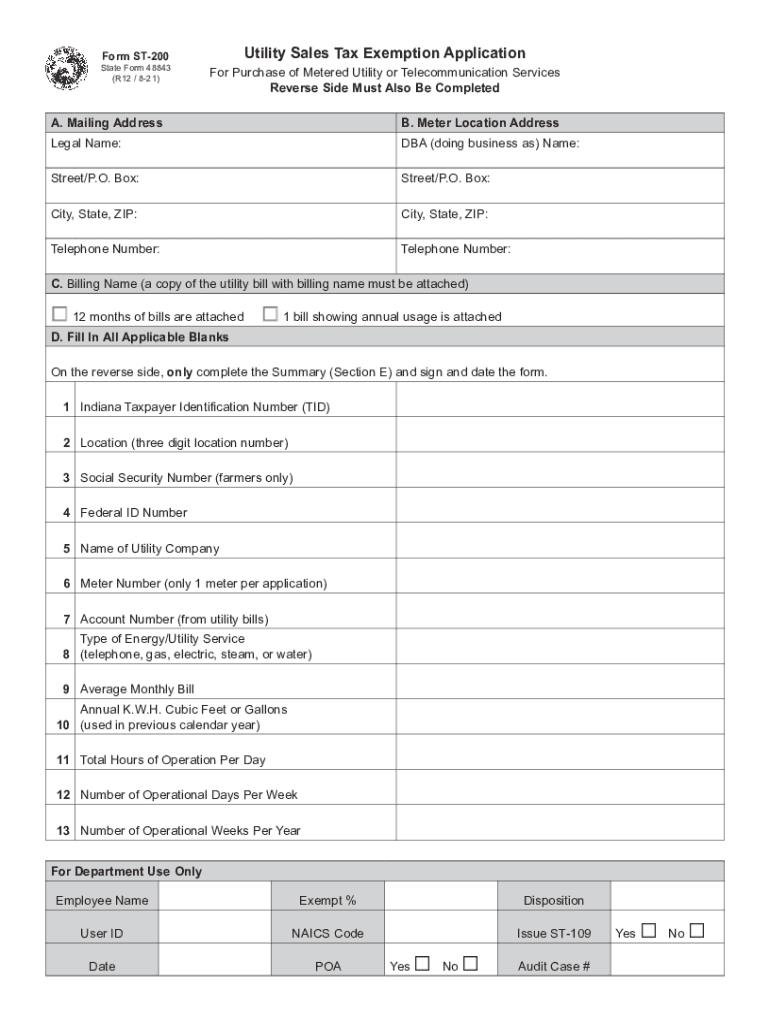
The Indiana ST-200 form is the Utility Sales Tax Exemption Application used by businesses to apply for an exemption from sales tax on metered utility or telecommunication services in the state of Indiana. This form is essential for businesses seeking relief from sales tax, allowing them to mitigate costs associated with essential utility expenses. It requires detailed information concerning the nature of the business, the utility usage patterns, and the specific equipment associated with the metered services.
Steps to Complete the Indiana ST-200
-
Gather Necessary Information: Collect all detailed business information, including the legal name, address, and the nature of the business activity. Make sure to have precise data about the utility usage and the equipment connected to each meter.
-
Complete the Form: Carefully fill out the sections of the Indiana ST-200, ensuring that there are no errors. Sections typically require specifics about the usage type—for example, whether used for manufacturing or processing.
-
Attach Supporting Documentation: Gather relevant documents that support the application, such as previous utility bills, contracts, or invoices. These documents are crucial in demonstrating the legitimacy of the claimed exemption.
-
Review for Accuracy: Double-check all entries in the form and attached documents to ensure compliance with guidelines. Any discrepancies may result in delays or denials.
-
Submit the Application: Once completed, submit the form along with supporting documentation to the Indiana Department of Revenue (DOR) for processing. Follow submission instructions carefully to avoid any processing issues.
Eligibility Criteria
To qualify for the utility sales tax exemption, a business must meet specific eligibility criteria set by the Indiana Department of Revenue. Typically, businesses that utilize utilities in certain processes like manufacturing, agriculture, or telecommunications may be eligible. Understanding these criteria is vital for determining applicability:
- Type of Business: Primarily manufacturing or processing entities, but may include agricultural or communication-focused businesses depending on specific circumstances.
- Usage Requirements: The utility usage must directly relate to the production of goods or services that align with exempt categories.


Key Elements of the Indiana ST-200
- Business Information: Filling out comprehensive business details ensures that the DOR can verify the entity’s eligibility and tax status.
- Utility Details: Provide in-depth descriptions of how utilities are employed within business operations, highlighting their essential nature.
- Attached Proofs: Supporting documentation helps substantiate the claim for exemption, confirming the stated utility usage and business activity.
Required Documents
Submissions for the Indiana ST-200 must include a series of supporting documents that bolster the exemption claim. Essential documents include:
- Utility Bills: Recent utility bills demonstrating current charges and service types.
- Contracts or Agreements: Any formal agreements with utility providers that highlight terms and usage specifics.
- Operational Documentation: Product inventories, manufacturing records, or process flowcharts, which demonstrate how utilities integrate into business functions.
Form Submission Methods
- Online Submission: The Indiana DOR website provides online forms submission facilities. This method ensures swift processing and traceable application status updates.
- Mail Submission: Physical copies of the form and accompanying documents can be sent through traditional mail to the designated IRS address.
- In-Person Drop-Off: For those seeking confirmation of receipt, dropping off the form in person at the DOR office may provide peace of mind.
Who Typically Uses the Indiana ST-200
- Manufacturers: Produce goods using intensive production equipment and processes.
- Agricultural Enterprises: Farms or agribusinesses that use significant utilities for production or storage.
- Telecommunications Companies: Entities that rely heavily on communication technologies needing tax relief on related utilities.

Filing Deadlines and Important Dates
The Indiana ST-200 does not have an explicitly stated annual filing deadline as it’s typically event-driven. However, for optimal timeline management:
- Regular Review: Annually review utility expenses and tax obligations to ascertain potential savings.
- Proactive Submission: Submit the form promptly when businesses undergo significant operations changes or expansion that may alter utility needs.
Penalties for Non-Compliance
Failure to submit the Indiana ST-200 accurately or submitting fraudulent information can incur penalties:
- Fines and Interest: Businesses may face financial penalties for underreported utilities or misuse of tax exemptions.
- Revocation of Exemption: Immediate suspension or permanent revocation of tax-exempt status, increasing future financial burdens on operating expenses.
Examples of Using the Indiana ST-200
- Small Manufacturer: A small appliance manufacturer filing this form to exempt electricity used in operating production lines.
- Agricultural Business: A large farm applying for the exemption of electricity used in greenhouse operations.
- Telecommunications Firm: A service provider submitting the form for exempting electricity required for server farms.
Ensuring precise and comprehensive filing of the Indiana ST-200 form can result in substantial tax savings and enhance business operational efficiency. Each of these headings covers available utilities and scenarios aligned with its purpose, offering detailed insights into usage, processing, and compliance.




