Taxable calculation 2026

Get Form
postal id Preview on Page 1

Here's how it works

01. Edit your postal id online
Type text, add images, blackout confidential details, add comments, highlights and more.
02. Sign it in a few clicks
Draw your signature, type it, upload its image, or use your mobile device as a signature pad.
03. Share your form with others
Send pt 172 via email, link, or fax. You can also download it, export it or print it out.

How to use or fill out taxable calculation with our platform

Form edit decoration
9.5
Ease of Setup
DocHub User Ratings on G2
9.0
Ease of Use
DocHub User Ratings on G2
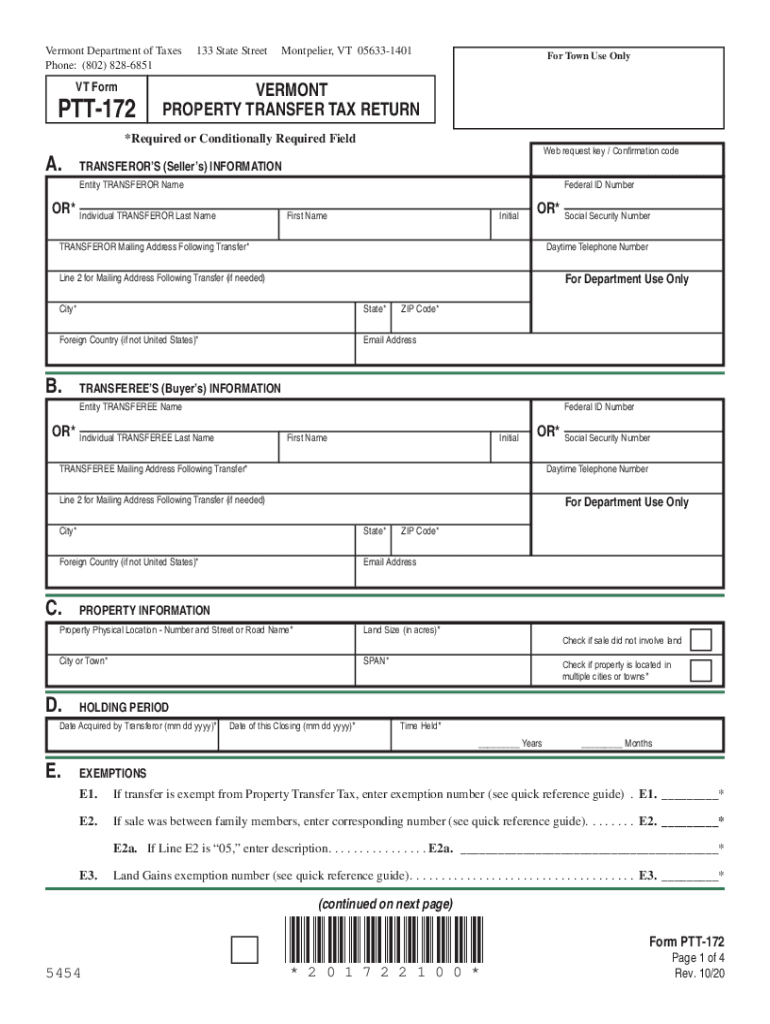
  1. Click ‘Get Form’ to open the Vermont Property Transfer Tax Return (PTT-172) in the editor.
  2. Begin by entering the Transferor’s information, including name, Federal ID or Social Security Number, and mailing address. Ensure all required fields marked with an asterisk are filled out.
  3. Next, provide the Transferee’s information in a similar manner. This includes their name, identification number, and contact details.
  4. Fill in the Property Information section with the physical location and land size. If applicable, check any boxes regarding property specifics.
  5. In the Holding Period section, input the dates of acquisition and closing along with how long the property was held.
  6. Proceed to Exemptions if applicable; enter exemption numbers as needed based on your situation.
  7. For Tax Calculation, carefully complete each line from J1 to J15 based on your property's value and applicable rates. This will determine your total tax due.

Start filling out your taxable calculation form for free today!

See more taxable calculation versions

We've got more versions of the taxable calculation form. Select the right taxable calculation version from the list and start editing it straight away!
Versions Form popularity Fillable & printable
2023 4.5 Satisfied (51 Votes)
2020 4.8 Satisfied (160 Votes)
2017 4.4 Satisfied (62 Votes)
2015 4.8 Satisfied (22 Votes)
2008 4 Satisfied (54 Votes)
be ready to get more

Complete this form in 5 minutes or less

Get form

Got questions?

We have answers to the most popular questions from our customers. If you can't find an answer to your question, please contact us.
Contact us

Of course, it is possible with DocHub. This reliable and compliant online solution features a phone-based signing option. When you log in to your DocHub account and add your ptt 172 to our editor, complete all blank areas and utilize the Sign feature on the top barf. Click on Create your signature and select Phone from the available options. Here, you scan a QR code using your smartphone and draw your signature on your phone screen, as you usually do when approving hard copies. If you access DocHub right from your mobile device, you can electronically sign your document by drawing your electronic signature, adding its image, or simply with a typed name.

You can find the latest and most relevant version of the vermont pttr in our DocHub forms collection. Search it by categories or use the search field to find the exact template that suits your situation. You may open this form for editing after you find it.

For example, in 2024, a single filer with taxable income of $100,000 will pay $17,053 in tax, or an average tax rate of 17%. But your marginal tax rate or tax bracket is actually 22%.
Your taxable income is your gross income minus deductions youre eligible for. Its used to determine your tax bracket and marginal tax rate, so its important to know this amount as you file your income tax return.
In short, taxable income is equal to adjusted gross income (AGI) minus standard or itemized deductions.

Security and compliance

At DocHub, your data security is our priority. We follow HIPAA, SOC2, GDPR, and other standards, so you can work on your documents with confidence.

Learn more
ccpa2
pci-dss
gdpr-compliance
hipaa
soc-compliance

People also ask

Lets say you have a product with a price of ₹1,000, and the applicable GST rate is 18%. GST Amount = (18/100) x ₹1,000 = ₹180. Total Amount (including GST) = ₹1,000 + ₹180 = ₹1,180.
How to Calculate Taxable Income Step 1: Determine Your Filing Status. Step 2: Gather Documents for all Sources of Income. Step 3: Calculate Your Adjusted Gross Income (AGI) Step 4: Calculate Your Deductions (Standard or Itemized) Step 5: Calculate Taxable Income.
Income from salary = Basic salary + HRA + Special Allowance + Transport Allowance + any other allowance. Some components of your salary are exempt from tax, such as telephone bill reimbursement and leave travel allowance. If you receive HRA and live on rent, you can claim an exemption on HRA.
Taxable income represents the portion of your total income that is subject to tax, once youve subtracted any eligible deductions. This includes your salaries, wages, investment earnings, and any other income streams minus allowable deductions like work-related expenses and certain investment costs.

Related links