




01. Edit your nj w9 online
Type text, add images, blackout confidential details, add comments, highlights and more.

Type text, add images, blackout confidential details, add comments, highlights and more.

Draw your signature, type it, upload its image, or use your mobile device as a signature pad.

Send w9 state form via email, link, or fax. You can also download it, export it or print it out.
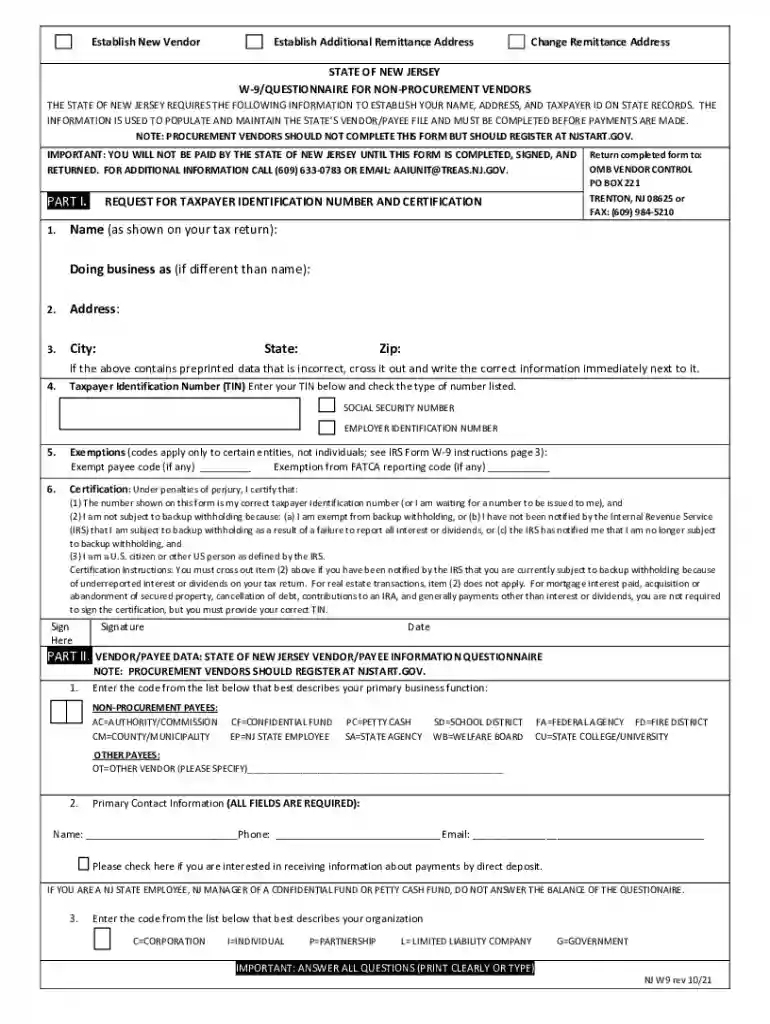
The "NJ State W" form, commonly known as the New Jersey Substitute Form W-9, is an essential document for vendors and employees associated with the State of New Jersey. Its primary function is to collect taxpayer information that verifies identification and addresses for financial and legal purposes. This substitute W-9 form ensures compliance with the Internal Revenue Service's (IRS) regulations by capturing precise data required for tax reporting and other official records.
For the successful execution of financial operations, submitting accurate details on the NJ State W is critical. This includes taxpayer identification numbers (TINs), which can be a social security number (SSN) or employer identification number (EIN), contact information, and business addresses. Ensuring the accuracy of this data helps avoid processing delays and guarantees correct tax and financial records, which can prevent potential audits and penalties from the IRS.
The New Jersey Substitute Form W-9 can be acquired through several accessible channels. Generally, it is distributed by New Jersey state departments seeking the information necessary for payment processing or verification purposes. You can find a downloadable version of the form on the official New Jersey state website or through a direct request via the department handling your business transactions with the state.
Many find it most convenient to access the NJ State W online, enabling quick download and printing at their convenience. Once downloaded, vendors and employees can fill out the form electronically or print it for manual completion.
Filling out the NJ State W form accurately is crucial for proper tax compliance and financial dealings. Here is a step-by-step guide to ensure all sections are completed correctly:
The NJ State W form serves legal purposes primarily related to taxation. This document is utilized to ensure that all payments are reported correctly under IRS guidelines. The NJ State W form also establishes proof of taxpayer status and the responsibility of both the state and the payee to report income comprehensively.
Completing the NJ State W form aligns with IRS guidelines, assisting in preventing financial discrepancies and legal issues relating to tax evasion or misreporting. This compliance ultimately leads to a smoother business relationship with state entities and adheres to legal mandates.
Several key elements must be provided accurately on the NJ State W to ensure its validity:
These elements form the backbone of the form's functionality, underpinning tax compliance and legal credibility.
While the NJ State W parallels the federal W-9 form, certain specific rules apply to New Jersey:
The consequences for failing to comply with NJ State W regulations can be significant:
Understanding and adhering strictly to the form's requirements can prevent these penalties. By providing complete and accurate information, entities not only maintain a positive relationship with the New Jersey state departments but also safeguard against broader tax discrepancies.
We've got more versions of the nj w9 form. Select the right nj w9 version from the list and start editing it straight away!
At DocHub, your data security is our priority. We follow HIPAA, SOC2, GDPR, and other standards, so you can work on your documents with confidence.
Your filing status is MARRIED/CIVIL UNION COUPLE JOINT, and your wages combined with your spouses/civil union partners wages plus your taxable nonwage incomeRead more
Your filing status is MARRIED/CIVIL UNION COUPLE JOINT, and your wages combined with your spouses/civil union partners wages plus your taxable non wage incomeRead more


