




01. Edit your et 133 online
Type text, add images, blackout confidential details, add comments, highlights and more.

Type text, add images, blackout confidential details, add comments, highlights and more.

Draw your signature, type it, upload its image, or use your mobile device as a signature pad.

Send et133 via email, link, or fax. You can also download it, export it or print it out.
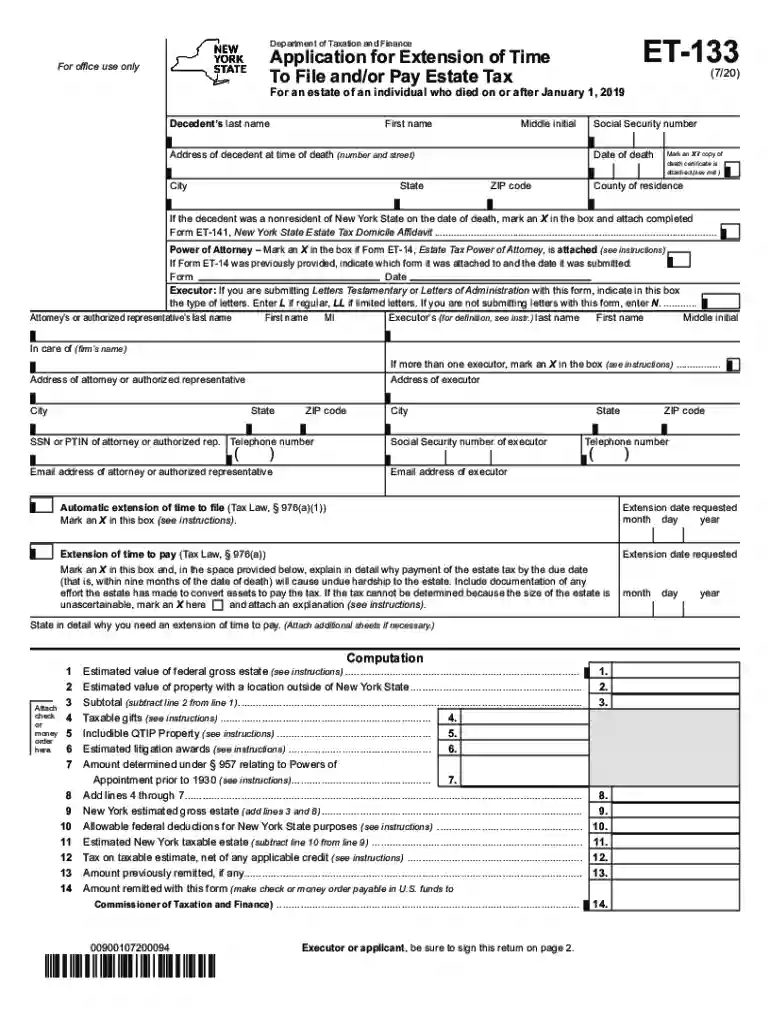
The ET-133 form is an application for requesting an extension of time to file and/or pay estate tax in the United States. This form is essential for estates of individuals who passed away on or after January 1, 2019, allowing for additional time to organize and submit the necessary financial documentation. The primary function of the ET-133 is to bridge the gap for executors who need a reprieve in gathering required estate data or amassing the funds to pay the estate tax owed.
Executors might find themselves in scenarios necessitating the ET-133 form. For instance, if an estate has considerable non-liquid assets such as art or real estate, finding quick liquidity to pay taxes might be challenging, similarly when there's a need to resolve complex will instructions or disputes among heirs.
Utilizing the ET-133 within legal confines is crucial for exemption eligibility and to avoid potential penalties. Ensure compliance by:
Failure to submit the ET-133 correctly or on time can result in significant consequences:
The rise in digital solutions offers enhanced convenience for executors managing estates:
Estate management often requires software for seamless processing:
Each state in the U.S. might impose additional or varying regulations affecting how the ET-133 form is used:
In conclusion, while the ET-133 form presents a structured means to request tax filing extensions, understanding its complexities across state lines, abiding by submission protocols, and leveraging digital tools can significantly ease the process for executors managing intricate estates.
We've got more versions of the et 133 form. Select the right et 133 version from the list and start editing it straight away!
eSignatures are a perfect replacement for traditional signing, as they save time, effort, and costs people spend on printing, scanning, and paper delivery. You can eSign your 133 form utilizing a reliable and robust online document processing tool like DocHub. It complies with main eSignature policies (ESIGN and UETA), so all forms approved there are legally binding and have the same validity as manually signed ones.
If you edit your 133 form download with DocHub, you merely require a stable internet connection and virtually any browser installed on your device. No need to install any third-party applications or study tutorials. Just open a tab with DocHub, drag and drop your file, and modify it immediately.
At DocHub, your data security is our priority. We follow HIPAA, SOC2, GDPR, and other standards, so you can work on your documents with confidence.
If you need an extension of time to file the estate tax return, pay the estate tax, or both, file Form ET-133, Application for Extension of. Time to File andRead more
If the decedent was a nonresident of New York State on the date of death, mark an X in the box and attach completed. Form ET‑141, New York State Estate TaxRead more
Article 33: TRADE substances under the New York State Controlled Substances Act by complying with the following: (1) Obtain a class 3b license


