




01. Edit your bmj case report consent form online
Type text, add images, blackout confidential details, add comments, highlights and more.

Type text, add images, blackout confidential details, add comments, highlights and more.

Draw your signature, type it, upload its image, or use your mobile device as a signature pad.

Send bmj consent form via email, link, or fax. You can also download it, export it or print it out.
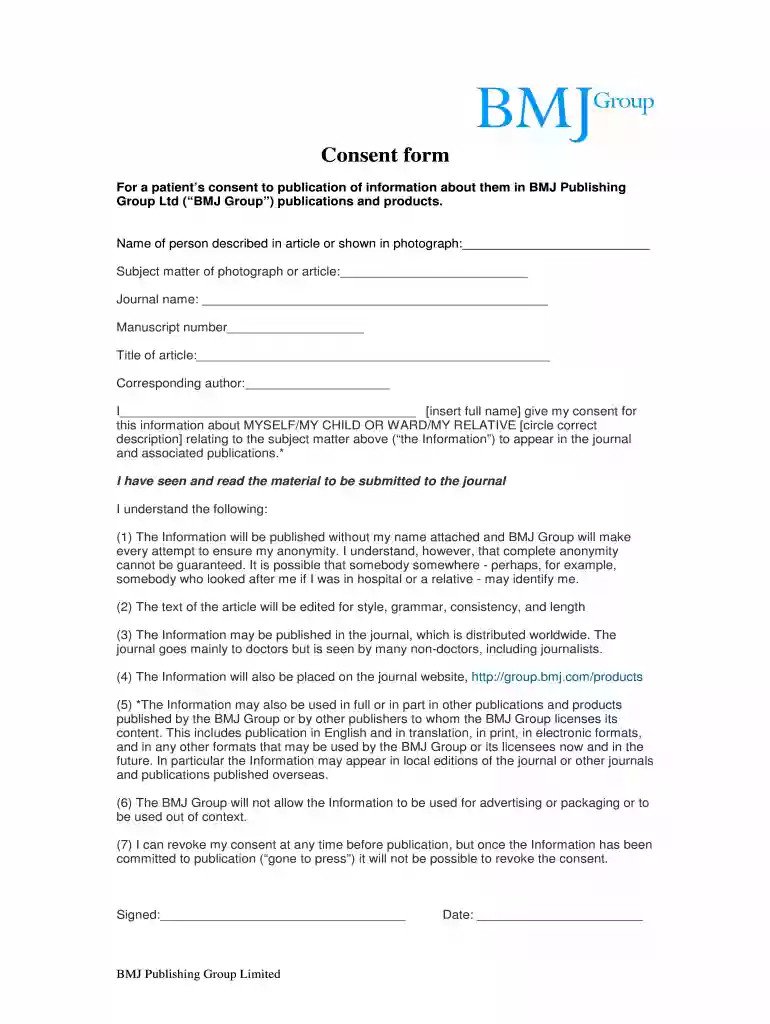
The BMJ consent form for case reports is an essential document used to secure permission from patients to publish their health information in a medical journal. It ensures that patients are aware of how their data will be used and provides guidelines for confidentiality and data handling.
The consent form consists of several vital sections, including:
Patient Information: Information about the patient, including name, contact details, and relevant health history. This section is crucial as it establishes the identity of the individual whose case report is being published.
Anonymity Assurance: This guarantees that the patient's identity will not be disclosed. The form outlines measures taken to ensure anonymity, emphasizing the importance of privacy in the publication process.
Publication Consent: The patient must explicitly acknowledge that they consent to the publication of their case report. This section often includes a statement confirming that the patient understands their rights regarding the use of their information.
Right to Withdraw Consent: The form states that patients can withdraw their consent before the document is finalized for publication. However, once published, it cannot be retracted, highlighting the need for informed consent.
To facilitate the documentation process, following these steps can be beneficial:
Review the Document: Patients should read through the entire consent form carefully to understand its content.
Seek Clarification: Patients are encouraged to ask questions about any terms or conditions they do not comprehend.
Sign the Document: After a thorough understanding, patients must sign and date the consent form to affirm their agreement.
Provide Additional Information: If required, the patient may need to supply supplementary details about their medical history relevant to the case report.
Submission Process: Once completed, the form should be submitted according to the outlined procedures, either electronically or via physical delivery, depending on the publication's requirements.
The BMJ consent form plays a critical role in several aspects:
Ethical Considerations: It ensures that the patient's autonomy is respected and that they fully understand how their information will be used.
Legal Protection: By obtaining documented consent, authors and the publication protect themselves against potential legal issues related to confidentiality breaches.
Quality of Research: Ensuring that all participants provide informed consent enhances the integrity and quality of medical research published in BMJ case reports.
While the BMJ consent form has a standard structure, variations may exist depending on specific case requirements or updates in policy. Templates can usually be found in medical institutions or through professional organizations associated with medical publishing.
PDF Versions: The BMJ consent form is often available in PDF form to facilitate easy printing and distribution.
Editable Formats: For institutions that require modifications, editable versions may also be provided, allowing for tailored usage according to institutional policies.
In practice, the BMJ consent form is utilized in various scenarios:
Clinical Studies: When reporting on unique cases arising from clinical practice, obtaining consent is critical to share potentially groundbreaking or informative results.
Educational Content: Healthcare professionals may seek to share insightful cases that can facilitate learning and discussion among medical peers.
Publication of Case Reports: The form is necessary for any case report intended for submission to the BMJ or similar journals, ensuring compliance with ethical standards.
By meticulously following these guidelines and utilizing the BMJ consent form appropriately, healthcare providers uphold the integrity of medical research while ensuring patients' rights and confidentiality are safeguarded.
At DocHub, your data security is our priority. We follow HIPAA, SOC2, GDPR, and other standards, so you can work on your documents with confidence.
Jun 5, 2024 I [insert full name] give my consent for this information about MYSELF OR MY CHILD OR WARD/MYRead more
by M Neavyn 2014 Cited by 16 The editorial board of JMT agrees that obtaining consent on every case report is not always possible, and at this time feel this should not impede theRead more


