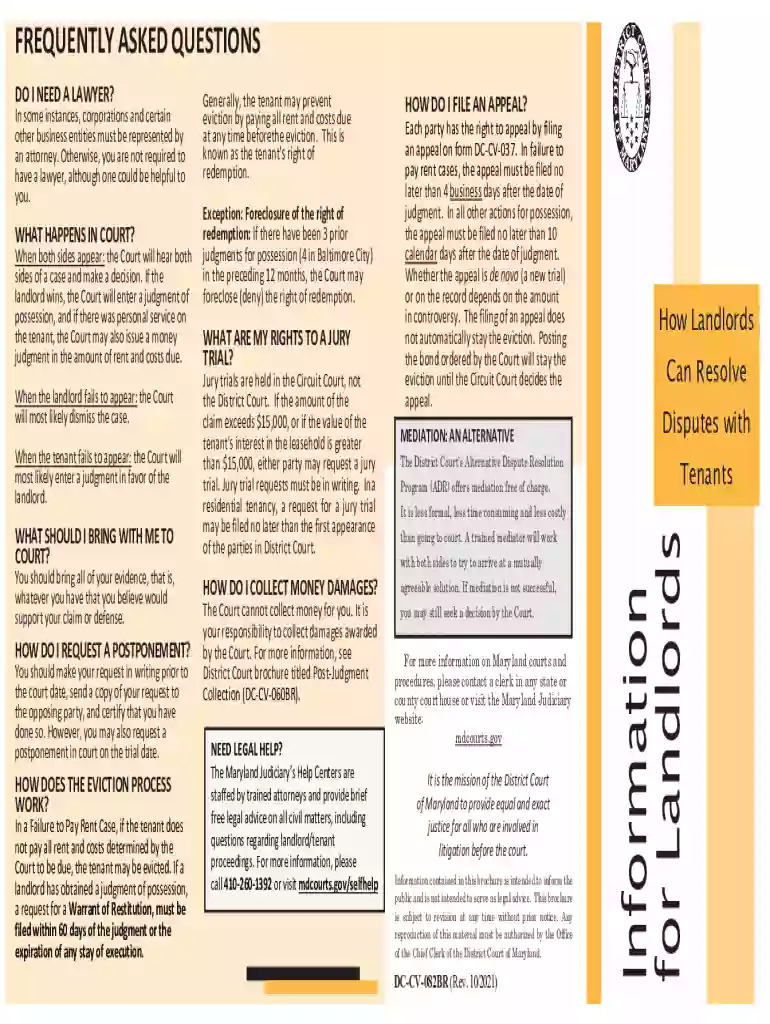
FREQUENTLY ASKED QUESTIONS - courts.state.md.us 2026

Get Form
FREQUENTLY ASKED QUESTIONS - courts.state.md.us Preview on Page 1

Here's how it works

01. Edit your form online
Type text, add images, blackout confidential details, add comments, highlights and more.

02. Sign it in a few clicks
Draw your signature, type it, upload its image, or use your mobile device as a signature pad.

03. Share your form with others
Send it via email, link, or fax. You can also download it, export it or print it out.

How to use or fill out FREQUENTLY ASKED QUESTIONS - courts.state.md.us with our platform

Form edit decoration
9.5
Ease of Setup
DocHub User Ratings on G2
9.0
Ease of Use
DocHub User Ratings on G2
  1. Click ‘Get Form’ to open it in the editor.
  2. Begin by reviewing the section titled 'What Happens in Court?' This will help you understand the court's procedures and what to expect during your hearing.
  3. In the 'What Should I Bring With Me to Court?' section, ensure you gather all necessary evidence that supports your case. You can annotate this section directly in the editor for easy reference.
  4. For requests regarding postponements, navigate to the relevant section and draft your request. Use our platform’s text tools to format your request clearly before saving.
  5. If you need to file an appeal, locate the instructions under 'How Do I File an Appeal?' and fill out form DC-CV-037 as directed. You can easily download and print this form from our platform.
  6. Finally, review all sections thoroughly before finalizing your document. Utilize our platform’s features for signing and sharing your completed form securely.

Start using our platform today for free to streamline your document editing and completion process!

See more FREQUENTLY ASKED QUESTIONS - courts.state.md.us versions

We've got more versions of the FREQUENTLY ASKED QUESTIONS - courts.state.md.us form. Select the right FREQUENTLY ASKED QUESTIONS - courts.state.md.us version from the list and start editing it straight away!
Versions Form popularity Fillable & printable
2021 4.8 Satisfied (95 Votes)
2019 4.2 Satisfied (48 Votes)
2016 3.9 Satisfied (51 Votes)
be ready to get more

Complete this form in 5 minutes or less

Get form

Got questions?

We have answers to the most popular questions from our customers. If you can't find an answer to your question, please contact us.
Contact us
The District Court hears criminal cases, including motor vehicle/ boating violations and other misdemeanors and limited felonies, although the Circuit courts share jurisdiction if the penalties authorized are three years or more in prison, a fine of $2,500 or more, or both.
Circuit Courts are grouped in 8 judicial circuits. More information for each Maryland court can be found by hovering over and clicking on each county on the map below or using the links in the left menu column.
PROOF OF SERVICE. The clerk shall not accept for filing any pleading or other paper requiring service, other than an original pleading, unless it is accompanied by an admission or waiver of service or a signed certificate showing the date and manner of making service.
The Maryland court system has four levels: two trial courts and two appellate courts. The trial courts consider evidence presented in a case and make judgments based on the facts, the law and legal precedent (prior legal decisions from a higher court).
Maryland has a four-tiered court system consisting of the District Court of Maryland, Circuit Courts, the Court of Special Appeals, and the Court of Appeals. District Court of Maryland. The District Court of Maryland was created in 1971 on a statewide basis in each county and Baltimore City.

Security and compliance

At DocHub, your data security is our priority. We follow HIPAA, SOC2, GDPR, and other standards, so you can work on your documents with confidence.

Learn more
ccpa2
pci-dss
gdpr-compliance
hipaa
soc-compliance
be ready to get more

Complete this form in 5 minutes or less

Get form

People also ask

Supreme Court of Maryland highest court of State. The Supreme Court of Maryland, established by Article IV, 1 and 14 of the Maryland Constitution, is the highest court of the State.
Maryland Rule 19-503 requires Maryland attorneys to report on any pro bono activities they engaged in during the prior fiscal year (July 1 June 30). The Administrative Office of the Courts is required to email all attorneys no later than July 10 of the year following the fiscal year for which reporting is required.

Related links