




01. Edit your form online
Type text, add images, blackout confidential details, add comments, highlights and more.

Type text, add images, blackout confidential details, add comments, highlights and more.

Draw your signature, type it, upload its image, or use your mobile device as a signature pad.

Send it via email, link, or fax. You can also download it, export it or print it out.
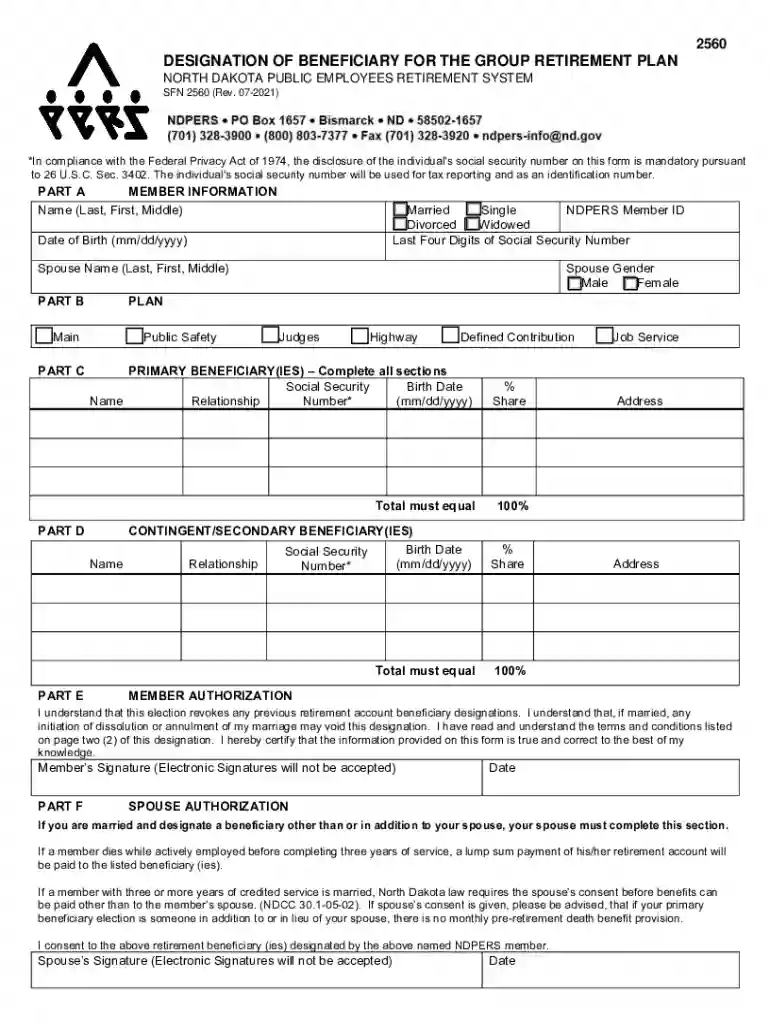
The "nd beneficiary form" refers to the beneficiary designation form for the North Dakota Public Employees Retirement System (NDPERS) group retirement plan. This form is a crucial document that allows members to specify both primary and contingent beneficiaries who will receive benefits from the retirement plan upon the member's death. It outlines essential details such as personal information, beneficiary eligibility, and any requirements for spousal consent. This form ensures that your retirement benefits are distributed according to your wishes and helps avoid potential legal issues or disputes among surviving family members.
The NDPERS beneficiary designation form holds significant importance as it determines how assets and benefits are allocated. Without a properly completed form, the distribution of benefits may default to a state-mandated method, which might not align with the member's desires. Thus, understanding and accurately completing this form is vital for securing financial assurance for selected beneficiaries.
To use the NDPERS beneficiary form effectively, follow these steps:
Complete Personal Information: Begin by filling out your personal details, such as your name, address, and social security number. This section ensures that the form is linked to your account accurately.
Designate Beneficiaries: Clearly specify both primary and contingent beneficiaries. A primary beneficiary is the first in line to receive benefits, while a contingent beneficiary will only receive benefits if the primary is unable or unwilling to do so.
Obtain Spousal Consent: If you're married, your spouse may need to agree with your beneficiary choices. This consent is often documented in the form of a signature, ensuring that there is mutual agreement on the disposition of retirement benefits.
Sign and Date: Ensure that you sign and date the form to validate its authenticity.
Submit the Form: Submit the completed form as directed, which can often be done online, by mail, or in-person, depending on NDPERS guidelines.
Using the form properly ensures your wishes for benefit distribution are clear and legally binding, providing peace of mind that your selected beneficiaries will be cared for.
Filling out the NDPERS beneficiary form involves several steps, each of which is crucial for ensuring its effectiveness:
Gather Necessary Information: Before you start, collect all essential information such as social security numbers for both you and your beneficiaries, as well as contact details.
Primary Beneficiary Designation:
Contingent Beneficiary Designation:
Review Regulatory Details: Read any explanatory notes on eligibility, effective date, and legal implications to ensure compliance with guidelines.
Verify Completion: Double-check each section for completeness and accuracy. Errors or missing information can invalidate the form or delay processing.
Submit the Form: Choose the submission method that best suits you, ensuring that all stipulated guidelines are followed.
Completing these steps accurately ensures a smooth processing experience and guarantees that your directives are legally recognized and acted upon accordingly.
The form comprises several essential elements that require careful consideration:
Understanding these elements helps you accurately prepare and submit a comprehensively filled form, ensuring intended beneficiaries receive benefits per your preferences.
Understanding relevant terms enhances the comprehension of the form:
Familiarity with these terms ensures accurate communication of preferences and avoids potential misunderstandings or misinterpretations.
While completing the NDPERS form, it is vital to consider state-specific rules:
Awareness of these rules helps in navigating the legal landscape associated with benefit designation, ensuring that your submissions align with both state and federal regulations.
Practical examples illustrate diverse scenarios for using the form:
Understanding and applying real-world examples with clarity ensure practical application in personalized scenarios, improving decision-making for your form submission.
The beneficiary form carries significant legal weight:
Legal diligence in completing this form safeguards your intent, reducing the potential for conflict or misunderstanding in the future.
We've got more versions of the nd beneficiary form form. Select the right nd beneficiary form version from the list and start editing it straight away!
At DocHub, your data security is our priority. We follow HIPAA, SOC2, GDPR, and other standards, so you can work on your documents with confidence.
Please use the attached form to request a change in beneficiary. form applies to the HealthChoice Life Insurance Plan replace and cancel all prior life
Designating a Beneficiary Overview Who is my Beneficiary? Designation of Beneficiary Forms for Designations.Read more


