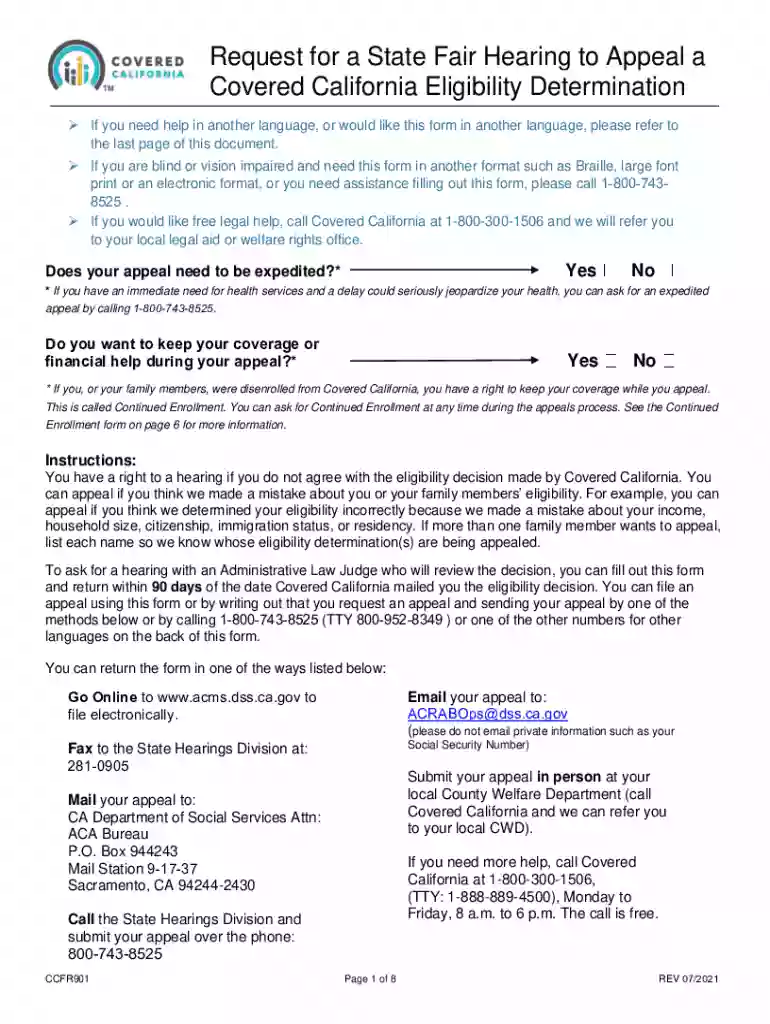
California hearing appeal 2026

Get Form
how long does it take for edd appeal decision Preview on Page 1

Here's how it works

01. Edit your how long does it take for edd appeal decision online
Type text, add images, blackout confidential details, add comments, highlights and more.

02. Sign it in a few clicks
Draw your signature, type it, upload its image, or use your mobile device as a signature pad.

03. Share your form with others
Send ca state fair hearing via email, link, or fax. You can also download it, export it or print it out.

Definition and Purpose of the California Hearing Appeal

The California hearing appeal process is a formal procedure that individuals can utilize to contest decisions made by state agencies, particularly concerning eligibility determinations. This process offers citizens the opportunity to have their grievances heard when they disagree with administrative rulings, especially in contexts involving health coverage, social services, or eligibility for state-funded programs. A state fair hearing is designed to ensure transparency and justice, providing an equitable platform for individuals to present their cases against state decisions. Its primary function is to uphold citizens' rights by providing a systematic avenue for redressal.

How to Use the California Hearing Appeal Process

To use the California hearing appeal process effectively, individuals must first identify the specific decision they wish to contest. Upon determination, the next step involves filing an official appeal, which requires completing and submitting the necessary forms provided by the state. The appeal form must include a clear statement of the disagreement, supporting documentation, and personal information. After submission, applicants will receive a notice of a scheduled hearing, where they can present their arguments before an administrative law judge. This hearing is an opportunity to provide additional evidence, witness testimonies, or any pertinent information that substantiates their claim.

Important Considerations for Filing

  • Timeliness: Appeals must be filed within specific timeframes, often 30 to 90 days from the decision date.
  • Documentation: Gather all relevant documents that support your appeal.
  • Representation: Consider legal representation for complex cases to navigate the procedural intricacies.

Steps to Complete the California Hearing Appeal

The completion of the California hearing appeal involves several methodical steps:

  1. Review the Decision Letter: Understand the reasons for the state’s decision and identify the specific points of contention.
  2. Complete the Appeal Form: Fill out the state fair hearing request with accurate and thorough information.
  3. Gather Evidence: Assemble documents, medical records, or other evidentiary material that supports your position.
  4. Submit the Appeal: Follow the instructions provided in your decision letter to submit your appeal through mail, fax, or online, where applicable.
  5. Prepare for the Hearing: Prepare a statement outlining your case, organize your evidence, and decide if you need witnesses.

Preparation for the Hearing

  • Statement: Draft a clear, concise opening statement that succinctly outlines your case.
  • Evidence Compilation: Organize all documents chronologically or thematically for ease of presentation.
  • Witnesses: Coordinate with individuals who can testify on your behalf if necessary.

Reasons to Utilize the California Hearing Appeal

Utilizing the California hearing appeal process can be crucial for individuals who believe an error was made in their case evaluation, affecting their eligibility for benefits or services. Common reasons for filing include:

  • Incorrect Determination of Benefits: Disputes over the level or type of benefits awarded.
  • Eligibility Disputes: Clarification or correction of eligibility status for state-administered programs.
  • Disputed Termination: Addressing the termination of benefits or services that the applicant believes is unjustified.

Benefits of Appealing

  • Right to be Heard: Ensures that your perspective and evidence are formally considered.
  • Potential for Reversal: Success in appeal could lead to overturning or modifying the initial decision.
  • Sets Precedent: Successful appeals can affect future cases with similar circumstances.

Important Terms Related to the California Hearing Appeal

Successfully navigating the California hearing appeal encompasses understanding several key terminologies:

  • Administrative Law Judge (ALJ): The official who presides over the hearing and makes decisions on appeals.
  • State Fair Hearing: The formal name of the process wherein individuals can appeal state decisions.
  • Eligibility Determination: A decision made by a state agency regarding an individual's qualification for benefits or services.

Technical Terminology

  • Expedited Appeal: A faster review process for cases involving urgent circumstances.
  • Continued Enrollment: Maintaining benefits during the appeal process to prevent interruption of services.

State-Specific Guidelines for California Hearing Appeals

California, owing to its diverse socio-economic demographics, has established specific guidelines that shape the hearing appeal process:

  • Local Regulations: Variations may exist based on county-specific regulations impacting hearing details.
  • Language Services: Interpretation services are available for non-English speakers to ensure comprehensive understanding and participation in the process.
  • Documentation Requirements: California mandates specific documentation to accompany appeal submissions, tailored to the type of benefit or service contested.

Complying with State Regulations

  • Review Local Guidelines: Be aware of any county-specific rules or procedures that apply.
  • Seek Translation Services: Ensure you fully understand all appeal documents and hearing communications.

Examples of Successfully Using the California Hearing Appeal

Numerous individuals have successfully used the California hearing appeal process to secure rights, benefits, or corrections in administrative decisions. Case studies highlight scenarios such as:

  • Overturned Eligibility Denial: An applicant successfully demonstrated an error in income calculation leading to an incorrect determination.
  • Restoration of Terminated Services: An individual proved the unwarranted termination of health coverage, resulting in service restoration.

Real-World Scenarios

  • Income Reevaluation: Applicants have used providing additional income records to revise benefit calculations.
  • Documentation of Error: Presenting clerical error evidence has led to favorable hearings outcomes.

Legal and Regulatory Compliance in Filing Appeals

The California hearing appeal process is governed by specific legal frameworks ensuring compliance with state and federal laws:

  • ESIGN Act Compliance: Electronic submissions and signatures must adhere to established electronic record-keeping laws.
  • Confidentiality Laws: Upholding applicant confidentiality during the appeal process.

Key Legal Insights

  • Due Process: Ensures that individuals have the right to appeal decisions and present their cases fully.
  • Compliance Standards: Appeals must meet regulated standards for documentation and submission to be processed effectively.

By understanding and engaging with the mechanics of the California hearing appeal, individuals can effectively advocate for their rights and achieve equitable outcomes in disputes regarding state-administered programs and services.

See more california hearing appeal versions

We've got more versions of the california hearing appeal form. Select the right california hearing appeal version from the list and start editing it straight away!
Versions Form popularity Fillable & printable
2021 4.8 Satisfied (47 Votes)
2021 4.3 Satisfied (54 Votes)
2019 4.2 Satisfied (79 Votes)
2015 4 Satisfied (63 Votes)
be ready to get more

Complete this form in 5 minutes or less

Get form

Got questions?

We have answers to the most popular questions from our customers. If you can't find an answer to your question, please contact us.
Contact us
The Court of Appeal has 90 days from the submission date to make a decision. Note: The court can issue an order dismissing the appeal at any time while the case is pending. If this happens early in the appeal process, the court does not need to allow the parties to file a brief or present an oral argument.
Appeals Process California: 5 Proven Steps to Win in 2025 File Notice of Appeal 30-60 days depending on case type. Compile the Record Gather transcripts and court documents. Draft Appellate Briefs Present legal arguments (14,000 word limit) Oral Argument Present case to 3-judge panel (if requested)
Winning an appeal is difficult. In California, fewer than 20% of civil appeals succeed in changing the original decision. This is because the Court of Appeal assumes the trial courts decision was correct unless the person appealing (the appellant) can prove it was wrong.
After a Decision is Issued Step 1: File the Notice of Appeal. Step 2: Pay the filing fee. Step 3: Determine if/when additional information must be provided to the appeals court as part of opening your case. Step 4: Order the trial transcripts. Step 5: Confirm that the record has been transferred to the appellate court.
In California, fewer than 20% of civil appeals succeed in changing the original decision. This is because the Court of Appeal assumes the trial courts decision was correct unless the person appealing (the appellant) can prove it was wrong.

Security and compliance

At DocHub, your data security is our priority. We follow HIPAA, SOC2, GDPR, and other standards, so you can work on your documents with confidence.

Learn more
ccpa2
pci-dss
gdpr-compliance
hipaa
soc-compliance