




01. Edit your schedule e tax form online
Type text, add images, blackout confidential details, add comments, highlights and more.

Type text, add images, blackout confidential details, add comments, highlights and more.

Draw your signature, type it, upload its image, or use your mobile device as a signature pad.

Send 1040 e form via email, link, or fax. You can also download it, export it or print it out.
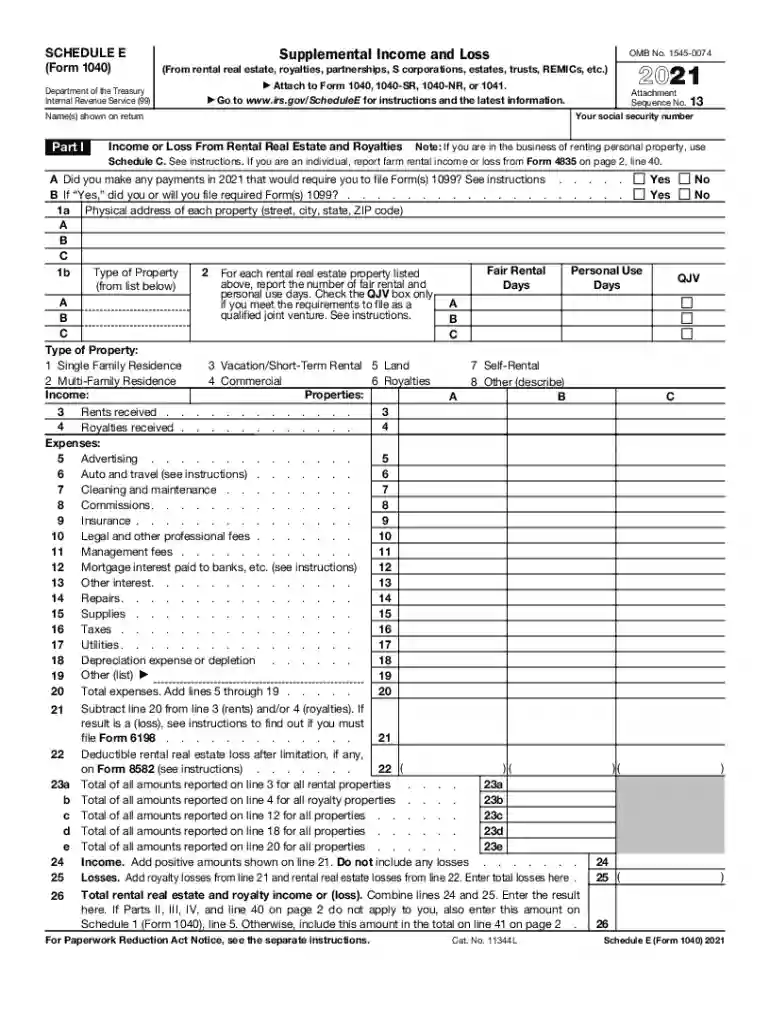
Schedule E (Form 1040) is a supplemental tax form used by individuals in the United States to report income or loss from various sources, such as rental real estate, royalties, partnerships, S corporations, estates, and trusts. This form is essential for individuals who earn income from multiple streams outside their regular salaried work. By detailing these earnings, taxpayers can ensure accurate reporting and compliance with IRS requirements.
The form is organized into multiple sections that cover different income types. Taxpayers must attach Schedule E to their main tax return forms, such as the 1040, 1040-SR, 1040-NR, or 1041, ensuring that any additional income or losses are correctly documented and reported. Proper completion of this form can impact total taxable income and, consequently, tax liability.
When dealing with Schedule E, it is crucial to understand its key components. The form comprises four main parts that categorize various income sources:
Understanding how to correctly fill out Schedule E is essential for accurate tax filing. Here are the general steps:
Accurate completion of each section and meticulous calculations are crucial to ensure compliance and avoid errors that can result in discrepancies or penalties.
Completing Schedule E involves navigating through different income types and ensuring precise entry. Here’s a detailed breakdown:
Verify all entries for consistency and correctness before proceeding to transfer total values onto Form 1040.
Understanding specific terminology used in Schedule E can simplify the filing process:
Grasping these terms is vital for accurately reporting income and understanding subsequent tax implications.
To avoid penalties, taxpayers must be aware of the deadlines for submitting Schedule E. Generally, it must be filed along with Form 1040 by the traditional April 15 tax filing deadline. This deadline extends if April 15 falls on a weekend or public holiday. Extensions for filing taxes can be requested using Form 4868, but note that this extension applies to filing the paperwork, not to paying owed taxes. Late submissions without an extension can incur penalties and interest on unpaid taxes.
The IRS provides specific rules and guidance for filing Schedule E, including but not limited to:
Adhering to IRS guidelines ensures proper filing and legal compliance.
Before filling out Schedule E, ensure you have collected all necessary documents:
Possessing these documents aids in accurate reporting and eases the completion of Schedule E.
Taxpayers have the option to file Schedule E either digitally or via paper. Each method has its advantages:
Choosing the right method depends on personal preference, technological access, and whether or not the individual wishes to utilize additional software compatibility options.
We've got more versions of the schedule e tax form form. Select the right schedule e tax form version from the list and start editing it straight away!
| Versions | Form popularity | Fillable & printable |
|---|---|---|
| 2025 | 4.6 Satisfied (25 Votes) | |
| 2024 | 4.9 Satisfied (60 Votes) | |
| 2023 | 4.3 Satisfied (56 Votes) | |
| 2022 | 4.5 Satisfied (34 Votes) | |
| 2021 | 4.8 Satisfied (109 Votes) | |
| 2020 | 4.3 Satisfied (99 Votes) | |
| 2019 | 4 Satisfied (73 Votes) | |
| 2018 | 4.3 Satisfied (109 Votes) | |
| 2017 | 4.3 Satisfied (239 Votes) | |
| 2016 | 4.4 Satisfied (694 Votes) | |
| 2015 | 4 Satisfied (45 Votes) | |
| 2014 | 4.2 Satisfied (43 Votes) | |
| 2013 | 4 Satisfied (50 Votes) | |
| 2012 | 4.4 Satisfied (53 Votes) | |
| 2011 | 4.2 Satisfied (63 Votes) |
At DocHub, your data security is our priority. We follow HIPAA, SOC2, GDPR, and other standards, so you can work on your documents with confidence.
Feb 8, 2018 Instead, you would get a de- duction on one of the following Form 1040 schedules: Schedule C, line 14; Schedule E, line 19 or 28; or Sched-.Read more
(E) Schedule E The term Schedule E means a form or information filed by a taxpayer to report income from rental properties, royalties, partnerships, SRead more
Jan 23, 2026 Use Schedule E (Form 1040) to report income or loss from rental real estate, royalties, partnerships, S corporations, estates, trusts, and residual interests.Read more


