Fl 625 s 2026

Get Form
fl 625 s Preview on Page 1

Here's how it works

01. Edit your form online
Type text, add images, blackout confidential details, add comments, highlights and more.

02. Sign it in a few clicks
Draw your signature, type it, upload its image, or use your mobile device as a signature pad.

03. Share your form with others
Send it via email, link, or fax. You can also download it, export it or print it out.

How to use or fill out FL-625 S with our platform

Form edit decoration
9.5
Ease of Setup
DocHub User Ratings on G2
9.0
Ease of Use
DocHub User Ratings on G2
  1. Click ‘Get Form’ to open FL-625 S in the editor.
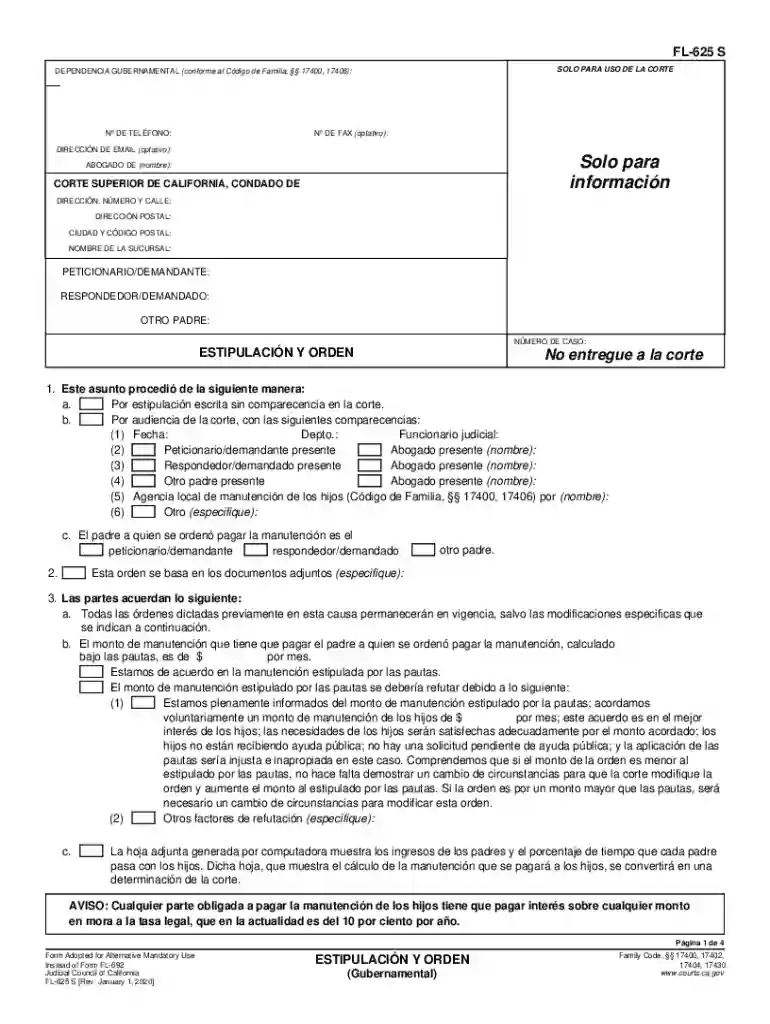
  2. Begin by entering the government agency information, including phone number, fax (optional), and email address (optional). This section is crucial for communication purposes.
  3. Fill in the petitioner and respondent details, including names and case number. Ensure accuracy as this information is vital for court records.
  4. In the stipulation section, indicate how the matter proceeded—either through written stipulation without court appearance or via a court hearing. Provide necessary dates and names of involved parties.
  5. Specify the agreed child support amount per month and any additional costs such as childcare or uninsured medical expenses. Clearly outline these amounts to avoid future disputes.
  6. Complete the signature section at the end of the form. Ensure all parties involved sign where indicated to validate the agreement.

Start using our platform today to fill out your FL-625 S form online for free!

See more fl 625 s versions

We've got more versions of the fl 625 s form. Select the right fl 625 s version from the list and start editing it straight away!
Versions Form popularity Fillable & printable
2020 4.8 Satisfied (200 Votes)
2017 4.2 Satisfied (115 Votes)
2011 4.4 Satisfied (1268 Votes)
be ready to get more

Complete this form in 5 minutes or less

Get form

Got questions?

We have answers to the most popular questions from our customers. If you can't find an answer to your question, please contact us.
Contact us
(1) In an action for possession, after entry of judgment in favor of the landlord, the clerk shall issue a writ to the sheriff describing the premises and commanding the sheriff to put the landlord in possession after 24 hours notice conspicuously posted on the premises.
(1) Administrative probation means a form of no contact, nonreporting supervision. A court may order administrative probation, or the Department of Corrections may transfer an offender to administrative probation, as provided in s. 948.013. (2) Child care facility has the same meaning as provided in s.
The Clerk will sign this Writ. After the Clerk signs this Writ, it must be delivered to the Sheriff to be served upon the Tenant and who, if necessary, will forcibly evict the Tenant after 24 hours from the time of service.
A writ of execution is one of the final steps in procuring compensation for debts owed. The sheriff or marshall will seek to seize property to fulfill the order. The property may then be sold in order to pay the debt specified. The seizure may also include money from a specific bank account that belongs to the debtor.
A court shall take judicial notice of any matter in s. 90.202 when a party requests it and: (1) Gives each adverse party timely written notice of the request, proof of which is filed with the court, to enable the adverse party to prepare to meet the request.

Security and compliance

At DocHub, your data security is our priority. We follow HIPAA, SOC2, GDPR, and other standards, so you can work on your documents with confidence.

Learn more
ccpa2
pci-dss
gdpr-compliance
hipaa
soc-compliance

People also ask

ItemFee Summons and Complaint $40.00 Subpoena $40.00 Writ of Garnishment $40.00 Writ of Possession $90.009 more rows
The only thing you can do at this point is file a Motion to Stay Execution of Writ of Possession. This motion will put the execution of the eviction order on hold for up to 10 days.
Florida Statute 790.23 criminalizes the possession of firearms, ammunition, or other deadly weapons by individuals who have previously been convicted of a felony. The intent behind this statute is to prevent those with a history of serious criminal behavior from accessing weapons that could lead to further offenses.

Related links