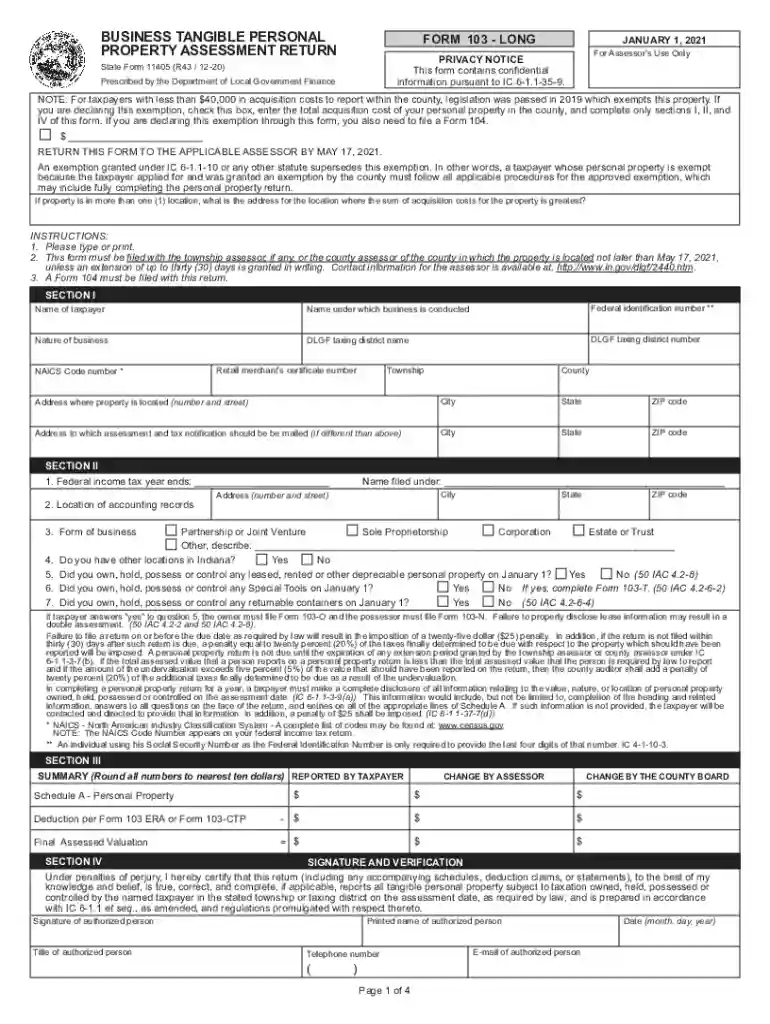
Indiana personal property assessment return 2026

Get Form
indiana personal property assessment return Preview on Page 1

Here's how it works

01. Edit your form online
Type text, add images, blackout confidential details, add comments, highlights and more.

02. Sign it in a few clicks
Draw your signature, type it, upload its image, or use your mobile device as a signature pad.

03. Share your form with others
Send it via email, link, or fax. You can also download it, export it or print it out.

How to use or fill out Indiana Personal Property Assessment Return with our platform

Form edit decoration
9.5
Ease of Setup
DocHub User Ratings on G2
9.0
Ease of Use
DocHub User Ratings on G2
  1. Click ‘Get Form’ to open the Indiana Personal Property Assessment Return in the editor.
  2. Begin by filling out the heading section, including your name, business name, and address. Ensure all information is accurate to avoid penalties.
  3. Answer all questions on the form, particularly regarding ownership and control of personal property as of January 1. Be thorough; incomplete disclosures may lead to additional penalties.
  4. Complete Schedule A by reporting all assessable personal property. Round all figures to the nearest dollar and ensure you include any applicable exemptions.
  5. Review your entries for accuracy. Once satisfied, sign and date the form under penalties of perjury, certifying that all information is true and complete.
  6. Submit your completed return to the appropriate township or county assessor by May 17, ensuring you meet any deadlines for extensions if necessary.

Start using our platform today for free to streamline your document editing and submission process!

See more indiana personal property assessment return versions

We've got more versions of the indiana personal property assessment return form. Select the right indiana personal property assessment return version from the list and start editing it straight away!
Versions Form popularity Fillable & printable
2022 4.9 Satisfied (57 Votes)
2021 4.8 Satisfied (45 Votes)
2020 4.3 Satisfied (125 Votes)
2019 4.3 Satisfied (273 Votes)
2018 4.2 Satisfied (128 Votes)
2017 4.2 Satisfied (53 Votes)
2015 4.4 Satisfied (201 Votes)
2014 4.2 Satisfied (73 Votes)
2007 4.3 Satisfied (72 Votes)
be ready to get more

Complete this form in 5 minutes or less

Get form

Got questions?

We have answers to the most popular questions from our customers. If you can't find an answer to your question, please contact us.
Contact us
Sadly for investors, the answer is no, there are no states without property tax.
1. Over 65 Deduction Breaker Credit. For retirees, its worth looking into the Over 65 Deduction Indiana property tax exemption. The Over 65 Circuit Breaker Credit helps limit how much your property taxes can increase annually.
You will receive notice of your propertys value in one of two ways: the county assessor may send you a notice of assessment, known as a Form 11. Otherwise, the assessed value of your property can be found on your tax bill. This document is known as the TS-1 tax comparison statement.
Two types of property are taxed in Indiana: real and personal. Real property consists of land, buildings, and other major permanent structures. Personal property is almost exclusively that of businesses and includes equipment for farming, manufacturing, and product inventories.
Business Personal Property Tax Exemption for 2025 If the cost of all of your business personal property is less than $80,000 and you filed in 2024 you are NOT REQUIRED TO FILE FOR 2025.

Security and compliance

At DocHub, your data security is our priority. We follow HIPAA, SOC2, GDPR, and other standards, so you can work on your documents with confidence.

Learn more
ccpa2
pci-dss
gdpr-compliance
hipaa
soc-compliance

People also ask

Indiana does not tax personal property, such as cars, boats and airplanes.
Most states tax. business personal property (machinery, equipment, fixtures, electronics, etc.), but of the 36 states that tax it, 10 states and the District of Columbia provide an exemption for small businesses with little tangible personal property.
State and local governments collect personal property taxes on tangible income-producing property, like business computers, office furniture, and fixtures. You typically have to report your property annually, providing both the fair market value and cost of the property.

Related links