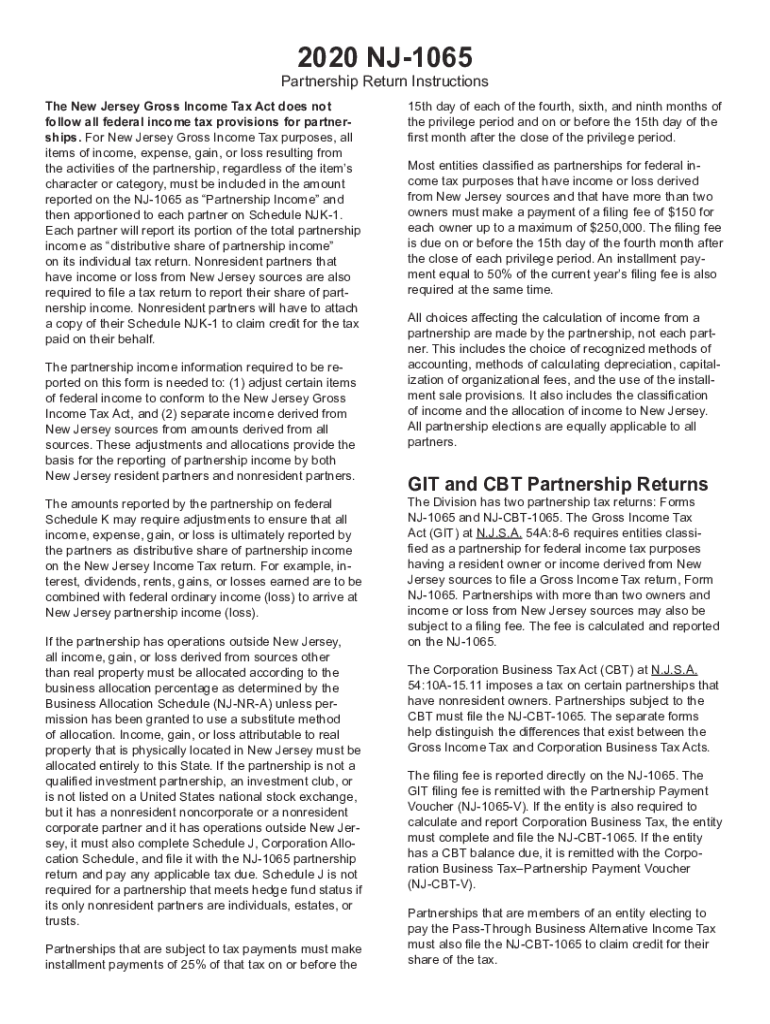
Form nj instructions 2026

Get Form
form nj instructions Preview on Page 1

Here's how it works

01. Edit your form online
Type text, add images, blackout confidential details, add comments, highlights and more.
02. Sign it in a few clicks
Draw your signature, type it, upload its image, or use your mobile device as a signature pad.
03. Share your form with others
Send it via email, link, or fax. You can also download it, export it or print it out.

How to use or fill out form nj instructions with our platform

Form edit decoration
9.5
Ease of Setup
DocHub User Ratings on G2
9.0
Ease of Use
DocHub User Ratings on G2
  1. Click ‘Get Form’ to open the NJ-1065 in the editor.
  2. Begin by entering the partnership's legal name, trade name, and address in the designated fields. Ensure you also input the federal employer identification number (FEIN) and the date the business started.
  3. Complete the sections for federal partnership income by entering amounts for ordinary income, rental activities, guaranteed payments, and other income as specified on lines 1 through 11.
  4. Proceed to report New Jersey additions and subtractions on lines 13a through 15g. Be sure to specify any items that are not included or are excludable under New Jersey Gross Income Tax Act.
  5. If applicable, complete Schedule NJK-1 for each partner detailing their share of partnership income. This is crucial for both resident and nonresident partners.
  6. Review all entries for accuracy before submitting your completed form electronically or via mail as per filing requirements.

Start using our platform today to streamline your form completion process for free!

See more form nj instructions versions

We've got more versions of the form nj instructions form. Select the right form nj instructions version from the list and start editing it straight away!
Versions Form popularity Fillable & printable
2023 4.5 Satisfied (35 Votes)
2022 4.7 Satisfied (44 Votes)
2021 4.8 Satisfied (192 Votes)
2020 4.3 Satisfied (163 Votes)
2019 4.4 Satisfied (153 Votes)
2018 4.4 Satisfied (99 Votes)
2017 4.3 Satisfied (70 Votes)
be ready to get more

Complete this form in 5 minutes or less

Get form

Got questions?

We have answers to the most popular questions from our customers. If you can't find an answer to your question, please contact us.
Contact us
The Stay NJ program offers property tax benefits to eligible homeowners aged 65 and older. It reimburses applicants for 50% of their property tax bills, up to a maximum of $13,000, with a 2024 benefit cap of $6,500.
Download and view most tax publications and instructions including the Instructions for Form 1040 on mobile devices as eBooks at IRS.gov/eBooks.
Eligibility Active wartime service in the United States Armed Forces. Filing of an application for exemption with the local tax assessor. Honorable discharge. Legal or domiciliary New Jersey residence. New Jersey citizenship. Principal or permanent residence in the claimed dwelling. Property ownership.
Married couples in New Jersey with income below $150,000 and at least one dependent child qualify for a rebate check. Individuals with less than $75,000 in income and at least one dependent child qualify. 2. Do you really need a dependent child to qualify?
Federal taxes on Social Security benefits remain, but the rules have shifted in favor of retirees. Beginning in tax year 2025, individuals age 65 and over can claim an additional $6,000 senior deduction per person (or $12,000 for married couples where both spouses qualify).

Security and compliance

At DocHub, your data security is our priority. We follow HIPAA, SOC2, GDPR, and other standards, so you can work on your documents with confidence.

Learn more
ccpa2
pci-dss
gdpr-compliance
hipaa
soc-compliance

People also ask

This bill allows New Jersey seniors, 65 years of age and older, whose annual household income, for federal tax purposes, is under $50,000 to also qualify for an annual deferral of property tax payments.
In the United States, there is no specific age at which seniors automatically stop paying taxes. However, as you get older, your tax responsibilities can change. Seniors often have different tax rules than younger taxpayers.

Related links