




01. Edit your illinois schedule icr online
Type text, add images, blackout confidential details, add comments, highlights and more.

Type text, add images, blackout confidential details, add comments, highlights and more.

Draw your signature, type it, upload its image, or use your mobile device as a signature pad.

Send il schedule icr via email, link, or fax. You can also download it, export it or print it out.
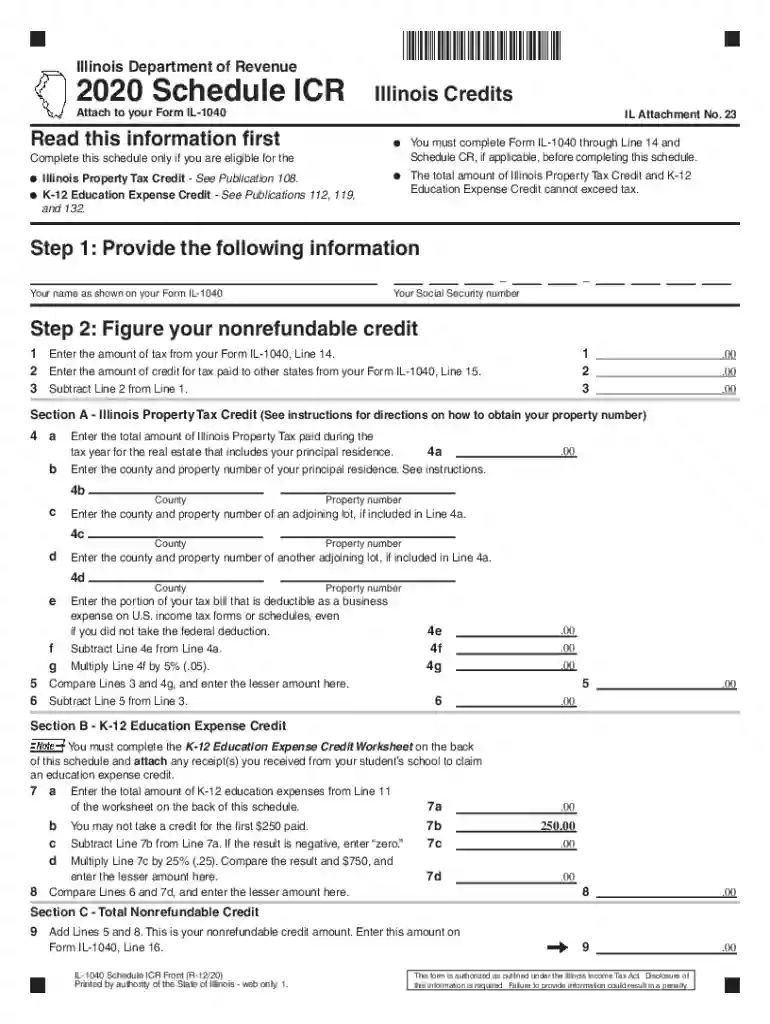
Illinois Schedule ICR is a form issued by the Illinois Department of Revenue, designed to help taxpayers claim credits like the Illinois Property Tax Credit and the K-12 Education Expense Credit. The form should be attached to the IL-1040, which is the individual income tax return. It primarily serves the purpose of calculating and reporting these credits to reduce taxable income based on qualifying expenses.
The Illinois Property Tax Credit allows taxpayers to claim a percentage of property taxes paid on their principal residences, while the K-12 Education Expense Credit covers a portion of eligible education expenses for dependent children. Understanding these credits and how they apply can lead to significant tax savings for eligible Illinois residents. Each section of the form corresponds to different elements of these credits, requiring precise information entries to ensure accurate calculations.
Securing a copy of the Illinois Schedule ICR is a straightforward process. The form is available on the Illinois Department of Revenue's official website, allowing taxpayers to download and print it directly. Additionally, individuals can access it through various tax software programs, making it easier to fill out and submit electronically.
For those who prefer physical copies, the form can be requested by mail from the Illinois Department of Revenue. It's crucial to obtain the correct version applicable to the tax year being filed, as forms may have slight variations each year due to legislative changes. Tax preparers and accounting professionals typically have access to these forms, providing another avenue for retrieval.
Completing the Illinois Schedule ICR involves several key steps, each requiring careful attention to detail:
Enter Personal Information: Include name, address, and Social Security Number at the top of the form.
Calculate the Illinois Property Tax Credit:
Determine the K-12 Education Expense Credit:
Attach Supporting Documentation: Include copies of property tax bills and eligible receipts for education expenses alongside the form.
Attach to IL-1040 Form: Finally, attach the completed Schedule ICR to your IL-1040 tax return, ensuring that all entries are correctly aligned to corresponding sections of IL-1040.
Tax software often simplifies this process by auto-filling sections based on user-provided data from other parts of the return, ensuring accuracy.
Eligibility for the Illinois Schedule ICR revolves around several critical criteria:
Residency: You must be an Illinois resident and have a primary residence in the state for which property taxes are paid.
Property Ownership: The taxpayer must either own or have an equitable interest in the property listed.
Income Restrictions: There may be income limits for claiming certain credits, though specifics can change yearly.
Education Expenses: For the K-12 Education Expense Credit, the expenses must be directly related to your dependents' schooling costs within Illinois.
Verification of eligibility typically involves reviewing guidelines provided on the Illinois Department of Revenue's website or consulting with tax professionals who can interpret nuanced rules or legislative changes.


Using the Illinois Schedule ICR correctly is paramount for compliance with state tax regulations. The form's purpose is to ensure that individuals accurately report and claim property tax and education expense credits. Failing to comply with reporting requirements or providing incorrect information can lead to fines and reassessments of taxes owed.
Accuracy: Ensure that all information provided is accurate and supported by verifiable documentation.
Timeliness: Submit the form with the IL-1040 by the specified filing deadline to avoid late penalties.
Record-Keeping: Maintain copies of the form and all supporting documents for a minimum of three years, the period during which the state can audit your tax return.
Understanding key terms associated with the Illinois Schedule ICR can clarify the form and its requirements:
Having a grasp of these terms helps ensure the form is filled out accurately and the taxpayer maximizes potential benefits.
Illinois imposes specific rules for claiming credits under the Schedule ICR, which differ from federal or other state guidelines:
Consulting the Illinois Department of Revenue’s annual updates is essential for adherence to these particular rules.
Illinois Schedule ICR can be completed using a variety of tax software programs, which provide user-friendly interfaces and automated calculations. Software such as TurboTax and QuickBooks are compatible with Illinois tax filings, making it easier to input necessary data and submit electronically.
These digital solutions offer an efficient alternative to manual submissions, especially beneficial for taxpayers with complex financial situations or multiple credits to claim.
We've got more versions of the illinois schedule icr form. Select the right illinois schedule icr version from the list and start editing it straight away!
At DocHub, your data security is our priority. We follow HIPAA, SOC2, GDPR, and other standards, so you can work on your documents with confidence.
Electronic only, one copy. You must complete Form IL-1040 through Line 14 and. Schedule CR, if applicable, before completing this schedule.Read more
This is your total income . Identify as ICR. Identify as IECR. Credit for employer-provided child care facilities


