California k 1 2026

Get Form
what is a k1 form Preview on Page 1

Here's how it works

01. Edit your what is a k1 form online
Type text, add images, blackout confidential details, add comments, highlights and more.

02. Sign it in a few clicks
Draw your signature, type it, upload its image, or use your mobile device as a signature pad.

03. Share your form with others
Send what is a k1 tax form via email, link, or fax. You can also download it, export it or print it out.

How to use or fill out California K-1 with our platform

Form edit decoration
9.5
Ease of Setup
DocHub User Ratings on G2
9.0
Ease of Use
DocHub User Ratings on G2
  1. Click ‘Get Form’ to open the California K-1 in the editor.
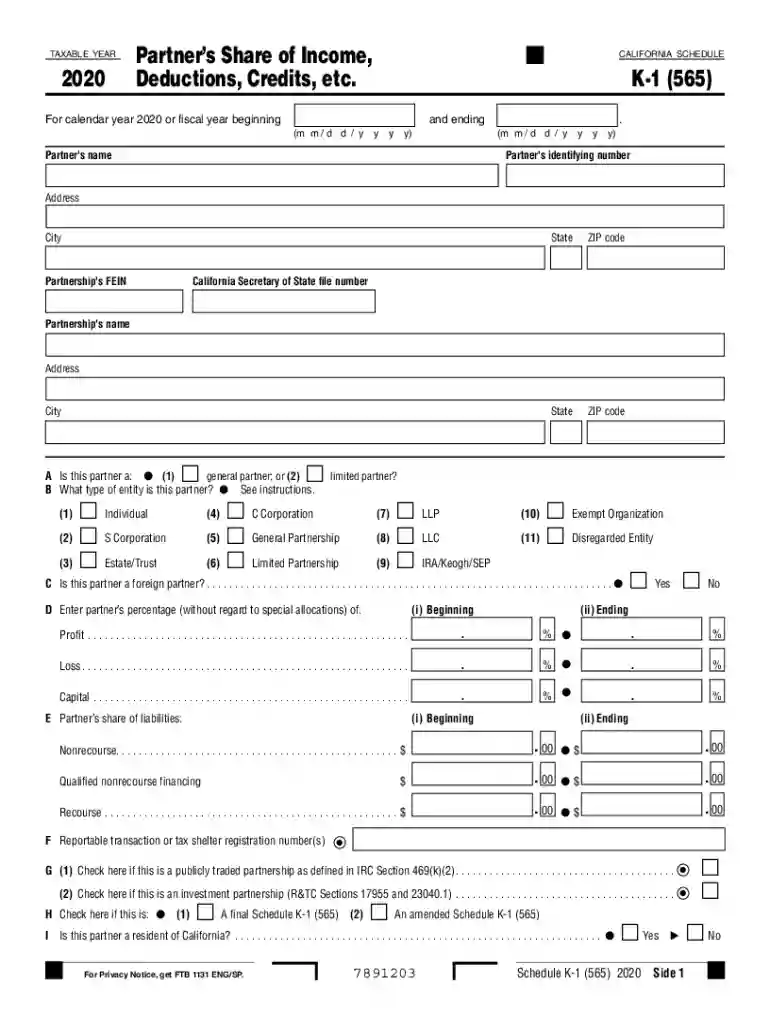
  2. Begin by entering the taxable year at the top of the form. Ensure you specify whether it’s for calendar year 2020 or a fiscal year.
  3. Fill in the partner's name, identifying number, and address details accurately. This information is crucial for proper identification.
  4. Indicate if the partner is a general or limited partner and select the type of entity from the provided options, such as Individual, S Corporation, or LLC.
  5. Complete sections A through I by providing necessary percentages for profit, loss, and capital shares. Be sure to check if this is a final or amended Schedule K-1.
  6. In the income section, report distributive share items like ordinary income and interest income. Adjust amounts based on California law where applicable.
  7. Review all entries for accuracy before saving your completed form. Utilize our platform’s features to easily modify any fields as needed.

Start using our platform today to fill out your California K-1 quickly and efficiently!

See more california k 1 versions

We've got more versions of the california k 1 form. Select the right california k 1 version from the list and start editing it straight away!
Versions Form popularity Fillable & printable
2022 4.5 Satisfied (40 Votes)
2021 4.8 Satisfied (83 Votes)
2020 4.4 Satisfied (238 Votes)
2019 4.3 Satisfied (80 Votes)
2018 4.4 Satisfied (52 Votes)
2017 4.4 Satisfied (58 Votes)
2016 4.3 Satisfied (247 Votes)
2015 4.4 Satisfied (44 Votes)
2012 4.2 Satisfied (60 Votes)
2011 4 Satisfied (38 Votes)
be ready to get more

Complete this form in 5 minutes or less

Get form

Got questions?

We have answers to the most popular questions from our customers. If you can't find an answer to your question, please contact us.
Contact us
The partnership files a copy of Schedule K-1 (Form 1065) with the IRS. For your protection, Schedule K-1 may show only the last four digits of your identifying number (social security number (SSN), etc.). However, the partnership has reported your complete identifying number to the IRS.
You are subject to tax on your share of the estates or trusts income, and you must include your share on your individual tax return. Schedule K-1 (541), column (b) shows amounts from your federal Schedule K-1 (Form 1041), Beneficiarys Share of Income, Deductions, Credits, etc.
Taxpayers should not consider the instructions as authoritative law. The California Schedule K-1 (100S), Shareholders Share of Income, Deductions, Credits, etc. line items are formatted similar to the federal Schedule K-1 (Form 1120-S), Shareholders Share of Income, Deductions, Credits, etc.
The K-1 isnt filed with your tax return, unless backup withholding was reported in box 13, code B.10 Keep it with your records. The trust or estate files a copy of Schedule K-1/Form 1041 with the IRS.
The Schedule K-1 is the form that reports the amounts passed to each party with an interest in an entity, like a business partnership or an S corporation. The parties use the information on the K-1 to prepare their separate tax returns.

Security and compliance

At DocHub, your data security is our priority. We follow HIPAA, SOC2, GDPR, and other standards, so you can work on your documents with confidence.

Learn more
ccpa2
pci-dss
gdpr-compliance
hipaa
soc-compliance

People also ask

Possibly, depending on what the K-1 shows. Partners in partnerships and shareholders in S corps can be allocated taxable income or losses even if they did not receive a distribution.
K-1s are usually issued by pass-through entities that dont pay corporate tax on their income but shift tax liabilities to their stakeholders. Most K-1 forms are due to taxpayers by March 15.
Generally, a loss reported on a K-1 form from a partnership or S-corporation can be used to offset other income on your annual tax return, such as wages or salaries, thereby potentially reducing your overall taxable income.

what is a k 1 tax form