






Definition & Meaning
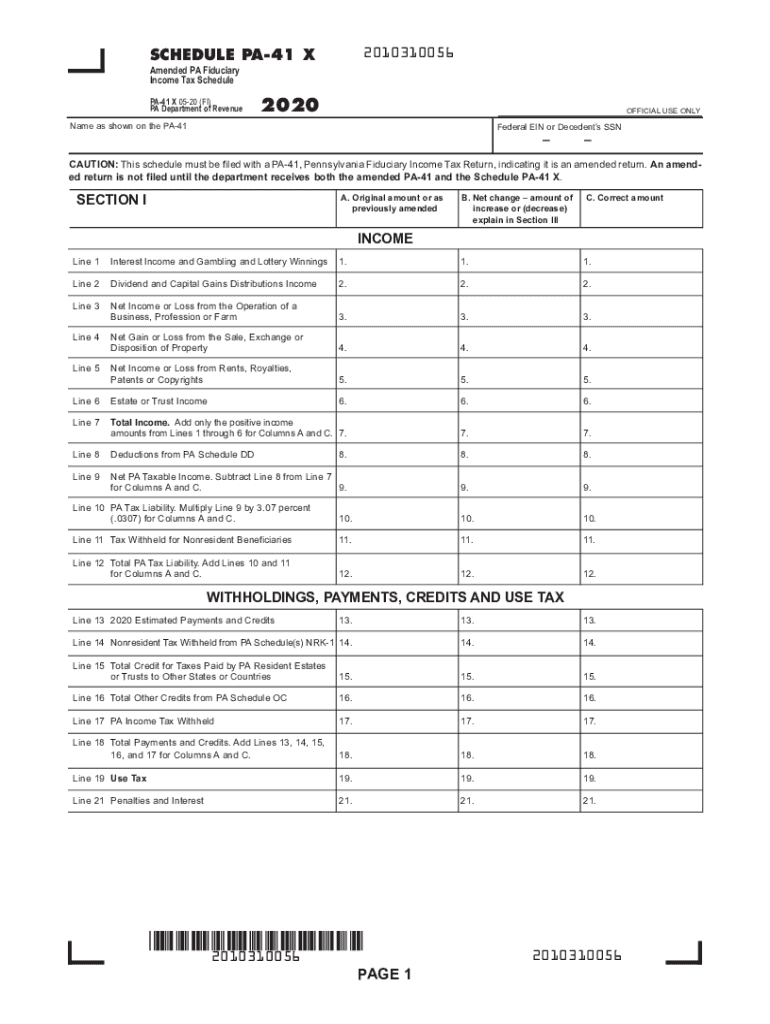
The "Amended PA" form refers to the Schedule PA-41 X, which is an Amended Pennsylvania Fiduciary Income Tax Schedule for the year 2020. This schedule is utilized when there is a need to report changes in income, deductions, or tax liabilities for estates or trusts after filing an original or previously amended PA-41 return. Understanding its purpose is crucial for fiduciaries managing trusts or estates, as it ensures that all income and deductions are accurately reported, resulting in the correct tax liabilities or refunds.
Key Features
- Income Adjustments: Schedule PA-41 X allows the reporting of changes in income categories, ensuring all income components are accurately reflected for the year.
- Deductions Updates: Provides a mechanism for updating deductions if there have been any changes since the original filing.
- Tax Liability Reassessment: Facilitates the reassessment of tax liabilities, which could result in refunds or payments due based on the amendments.
Practical Implications
- Tax Compliance: Ensures that estates or trusts remain compliant with Pennsylvania state tax regulations by updating financial information as necessary.
- Financial Accuracy: Enhances financial accuracy and accountability for fiduciaries responsible for filing these forms.
Steps to Complete the Amended PA
Completing the Schedule PA-41 X involves several steps, each requiring careful attention to detail to ensure accuracy.
Preparation
- Gather Necessary Documents: Collect all original documents, including the initially filed PA-41 return and any supporting documentation that reflects changes in income, deductions, or tax payments.
- Review Original Submission: Examine the previously submitted PA-41 return to understand its entries and note areas where amendments are required.
Completing the Form
- Enter Original and Corrected Amounts: Each relevant line on Schedule PA-41 X requires both the original and the corrected amounts for each category (i.e., income, deductions).
- Calculate Changes: Compute the net changes by subtracting original amounts from corrected amounts, which helps in identifying the variance that needs to be reported.
- Provide Explanations: Include detailed explanations justifying each change in the designated section on the form to ensure clarity for tax authorities.
Finalization
- Double-Check All Entries: Ensure all numerical entries and explanations are accurate and consistent throughout the document.
- Attach Supporting Documents: Include any relevant financial documentation that supports the changes reported on Schedule PA-41 X.
Important Terms Related to the Amended PA
Understanding key terms associated with the Amended PA form is essential for accurate completion and compliance.
Notable Terms
- Fiduciary Income: This term refers to any income derived by the trust or estate that must be accounted for in the fiduciary return.
- Net Changes: This involves the difference between the original and amended amounts of income or deductions.
- Refund or Payment Due: Outcomes of the amendment process, leading to either a tax refund owed to the fiduciary or additional payment required.
Implications of These Terms
- Accurate Filing: Knowledge of these terms assists fiduciaries in understanding their responsibilities and the potential outcomes of form filing.
- Compliance: Proper use of these terms on the amended form ensures compliance with state taxation requirements.
State-Specific Rules for the Amended PA
The Amended PA form is governed by specific rules pertinent to Pennsylvania state taxation laws.
Pennsylvania Taxation Rules
- Reporting Requirements: Fiduciaries must report all income, deductions, and tax liabilities relevant to Pennsylvania state laws, depending on the residency status of the decedent or trust.
- Filing Deadline: Generally, amended returns must be filed within three years of the original return filing date or two years from the date the tax was paid, whichever is later.
Implications for Tax Filers
- Timeliness: Understanding these rules helps ensure that fiduciaries file within the allowable time frame, avoiding potential penalties.
- Accurate Amendments: Adhering to state rules assists in ensuring that all amendments are accurately reflected and meet legal requirements.
Legal Use of the Amended PA
The legal framework surrounding the use of the Amended PA form determines its application and enforceability.
Legal Context
- Compliance with ESIGN Act: Document amendments made electronically are legally binding under this act, which supports the use of electronic signatures for the amended form.
- Regulatory Obligations: Adheres to state regulations that mandate accurate reporting of fiduciary income and tax liabilities.
Practical Considerations
- Document Validity: Ensures that all submissions are valid within the legal context, with adherence to state and federal regulations.
- Risk Mitigation: Proper use of the form reduces legal risks associated with incorrect or late tax reporting.
Examples of Using the Amended PA
Real-world applications of the Amended PA form showcase its utility in various scenarios.
Scenarios
- Revised Income Reporting: A trust discovers additional income sources not reported in the initial PA-41 return, necessitating an amendment.
- Deduction Discrepancies: An estate recognizes an error in deduction calculations originally claimed, prompting a correction through Schedule PA-41 X.
Outcomes
- Financial Adjustments: The example scenarios facilitate necessary financial adjustments aligning with accurate income and deduction figures.
- Audit Preparation: Proper amendments prepare fiduciaries in case of audits by ensuring all information is current and reflective of actual financial activities.
Filing Deadlines / Important Dates
Adherence to filing deadlines is critical to avoid penalties and ensure compliance.
Filing Timeline
- Three-Year Window: Amended returns are generally filed within three years of the original return filing.
- Two-Year Refund Rule: For refunds, filing must occur within two years of the payment date if this period is shorter than the three-year general rule.
Compliance Tips
- Calendar Scheduling: Creating a schedule or calendar reminders can help fiduciaries keep track of due dates to prevent late submissions.
- Documentation Retention: Maintaining organized records ensures that all relevant information is accessible for timely filing.
Required Documents
Gathering the correct documents supports the accurate completion of the amended return.
Necessary Documentation
- Original PA-41 Return: A copy of the initially filed return is essential for reference and comparison.
- Supporting Financial Records: Includes income statements, deduction records, and previous tax payment receipts.
- Explanatory Notes: Documentation that details reasons for income or deduction changes, providing clarity and justification for amendments.
Practical Benefits
- Streamlined Process: Having all documents readily available facilitates a smoother amendment process, preventing delays.
- Accuracy Assurance: Access to complete documentation enhances the precision and reliability of the amended return.
Penalties for Non-Compliance
Understanding potential penalties for non-compliance is crucial for fiduciaries handling the amended form.
Penalty Overview
- Late Filing Penalties: When forms are not filed by the deadline, there may be monetary penalties or interest on unpaid taxes.
- Accuracy Penalties: Incorrect reporting or failures to disclose required information can result in additional fines.
Mitigation Strategies
- Timely Filing: Submitting the amended return within the required deadline minimizes the risk of penalties.
- Professional Assistance: Consulting with tax professionals or attorneys can ensure compliance, reducing the likelihood of errors or omissions.
Taxpayer Scenarios
The Amended PA form can apply to a variety of taxpayer scenarios, each with unique considerations.


Common Scenarios
- Trust Revisions: Trusts needing to correct previously reported financial figures may require the amended form.
- Estate Adjustments: Estates reevaluating asset valuations or inheritance distributions might necessitate amendments.
Considerations
- Personalized Filing: Each scenario may require specific documentation and explanations, highlighting the necessity for tailored filing approaches.
- Impact on Beneficiaries: Amendments can influence beneficiaries' financial situations, necessitating accurate and timely updates.