Arkansas ar2210a 2026

Get Form
arkansas ar2210a Preview on Page 1

Here's how it works

01. Edit your form online
Type text, add images, blackout confidential details, add comments, highlights and more.

02. Sign it in a few clicks
Draw your signature, type it, upload its image, or use your mobile device as a signature pad.

03. Share your form with others
Send it via email, link, or fax. You can also download it, export it or print it out.

How to use or fill out arkansas ar2210a with our platform

Form edit decoration
9.5
Ease of Setup
DocHub User Ratings on G2
9.0
Ease of Use
DocHub User Ratings on G2
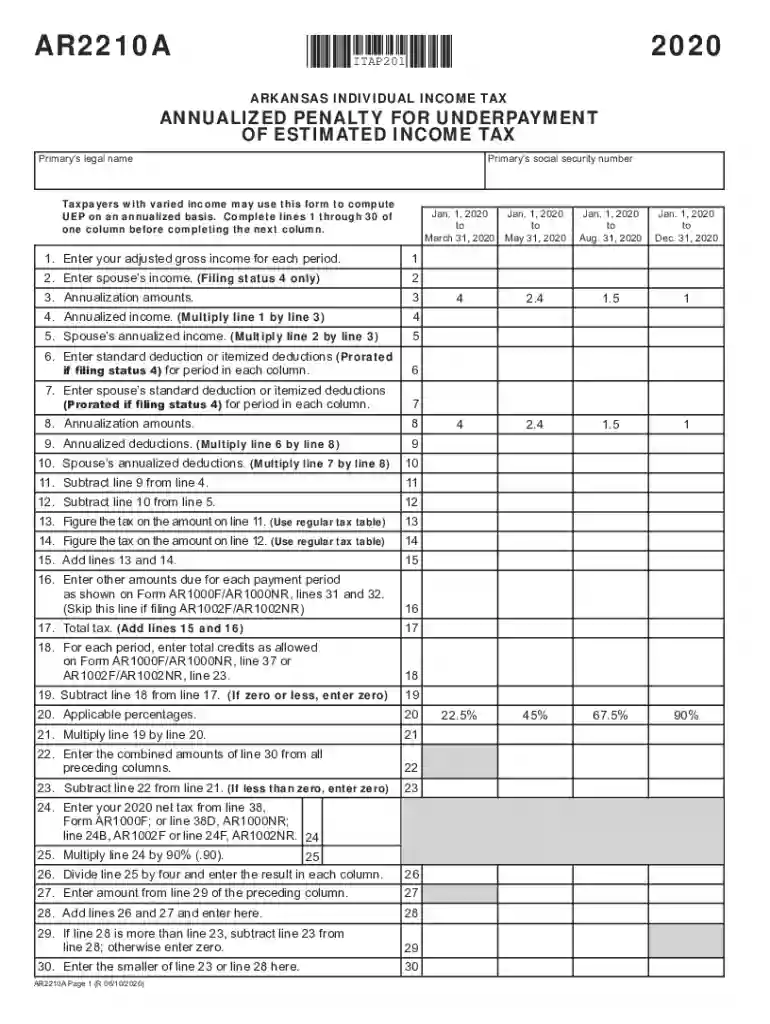
  1. Click ‘Get Form’ to open the Arkansas AR2210A in the editor.
  2. Begin by entering your legal name and social security number in the designated fields at the top of the form.
  3. For each period, input your adjusted gross income in line 1. If applicable, enter your spouse’s income in line 2.
  4. Proceed to calculate annualization amounts for each period and enter them in line 3.
  5. Multiply your adjusted gross income (line 1) by the annualization amount (line 3) and record this on line 4. Repeat for your spouse’s income on line 5.
  6. Enter standard or itemized deductions for yourself and your spouse in lines 6 and 7, respectively, prorated for each period.
  7. Continue filling out lines through to line 30, ensuring all calculations are accurate before moving on to subsequent sections.

Start using our platform today to easily complete your Arkansas AR2210A form online for free!

See more arkansas ar2210a versions

We've got more versions of the arkansas ar2210a form. Select the right arkansas ar2210a version from the list and start editing it straight away!
Versions Form popularity Fillable & printable
2023 4.1 Satisfied (40 Votes)
2022 4.5 Satisfied (25 Votes)
2021 4.9 Satisfied (47 Votes)
2020 4 Satisfied (55 Votes)
be ready to get more

Complete this form in 5 minutes or less

Get form

Got questions?

We have answers to the most popular questions from our customers. If you can't find an answer to your question, please contact us.
Contact us
The ten percent (10%) per annum penalty will be applied on a quarterly basis. A taxpayer who has an uneven income may compute the ten percent (10%) penalty on an annualized basis.
Under current law, Arkansas provides a ten-year statute of limitations on the collection of tax delinquencies and a ten-year period during which a certificate of indebtedness (tax lien) remains in force. Federal law tolls similar federal limitations periods during bankruptcy.
26-37-101. (1) (A) All lands upon which the taxes have not been paid for one (1) year following the date the taxes were due, October 15, shall be forfeited to the state and transmitted by certification to the Commissioner of State Lands for collection or sale.
The form AR2210 provides essential instructions for Arkansas taxpayers regarding underpayment penalties and exceptions. It includes detailed guidelines on annual payments and penalty computation.
An underpayment penalty is a charge the IRS imposes on taxpayers who did not pay all of their estimated income taxes for the year or paid their taxes late. Youll face an underpayment penalty if you: Didnt pay at least 90% of the tax on your current-year return or 100% of the tax shown on the prior years return.

Security and compliance

At DocHub, your data security is our priority. We follow HIPAA, SOC2, GDPR, and other standards, so you can work on your documents with confidence.

Learn more
ccpa2
pci-dss
gdpr-compliance
hipaa
soc-compliance

People also ask

If you have delinquent property taxes in Arkansas, you might lose your home to tax forfeiture, and the property will eventually be sold to a new owner. However, Arkansas law provides several opportunities to pay off the delinquent amounts, allowing you to save your home before the sale.
If the property is not redeemed within this Redemption period, a Limited Warranty Deed will be issued. The Commissioner will issue a Limited Warranty Deed conveying to the purchaser all rights, title, and interest received by the State in the tax-delinquent property through tax forfeiture.
If you file on time but do not pay on time, the Failure to Pay Penalty is 1% per month of the unpaid taxes up to a maximum of 35%. The total combined penalties for failure to file and failure to pay cannot exceed a maximum of 35%. The Individual Income Tax Section does not offer payment plans.

Related links