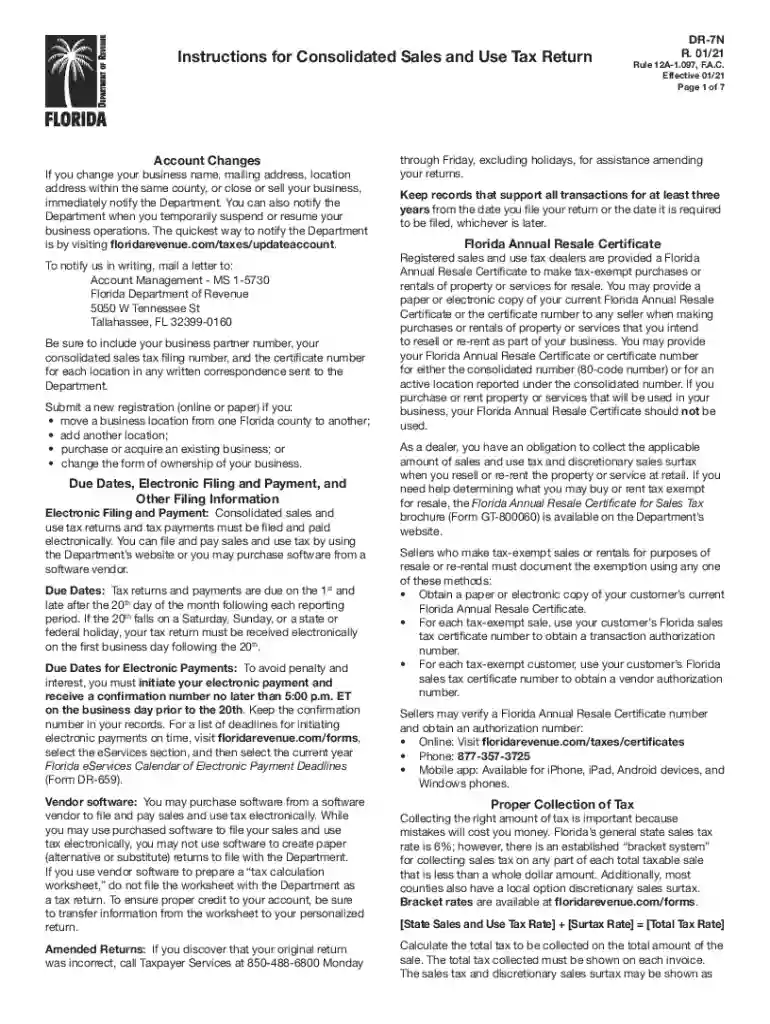
2021 FL DR-7N-2026

Get Form
2021 FL DR-7N Preview on Page 1

Here's how it works

01. Edit your form online
Type text, add images, blackout confidential details, add comments, highlights and more.

02. Sign it in a few clicks
Draw your signature, type it, upload its image, or use your mobile device as a signature pad.

03. Share your form with others
Send it via email, link, or fax. You can also download it, export it or print it out.

How to use or fill out 2021 FL DR-7N with our platform

Form edit decoration
9.5
Ease of Setup
DocHub User Ratings on G2
9.0
Ease of Use
DocHub User Ratings on G2
  1. Click ‘Get Form’ to open the 2021 FL DR-7N in the editor.
  2. Begin by entering your business name and address in the designated fields. Ensure accuracy to avoid issues with the Department of Revenue.
  3. In Column 1, report your total gross sales, excluding tax collected. Be mindful to follow the guidelines for what constitutes gross sales.
  4. For Column 2, enter any exempt sales. If there are none, simply input '0'.
  5. Calculate the taxable amount for Column 3 by subtracting exempt sales from gross sales and enter this figure.
  6. In Column 4, calculate and enter the total tax due, including any discretionary sales surtax applicable.
  7. Complete all relevant sections for commercial rentals and transient rentals as necessary, ensuring you adhere to local tax rates.
  8. Once all fields are filled out accurately, review your entries before submitting electronically through our platform.

Start using our platform today to simplify your form completion process for free!

See more 2021 FL DR-7N versions

We've got more versions of the 2021 FL DR-7N form. Select the right 2021 FL DR-7N version from the list and start editing it straight away!
Versions Form popularity Fillable & printable
2024 4.5 Satisfied (30 Votes)
2022 4.8 Satisfied (67 Votes)
2021 4.8 Satisfied (66 Votes)
2021 4.3 Satisfied (108 Votes)
2020 4.4 Satisfied (127 Votes)
2019 4.4 Satisfied (133 Votes)
2018 4.3 Satisfied (116 Votes)
2016 4.4 Satisfied (315 Votes)
2015 4.3 Satisfied (65 Votes)
be ready to get more

Complete this form in 5 minutes or less

Get form

Got questions?

We have answers to the most popular questions from our customers. If you can't find an answer to your question, please contact us.
Contact us
While the IRS initially provided an extended tax filing deadline to Florida residents and businesses that were impacted by Hurricanes Debby, Helene, and Milton, now all Florida residents and businesses throughout the state may choose to file their taxes on May 1 rather than the traditional April 15 deadline.
If you file your return or pay tax late, a late filing penalty of 10% of the amount of tax owed, but not less than $50, may be charged. The $50 minimum penalty applies even if no tax is due.
The declaration permits the IRS to postpone certain tax-filing and tax-payment deadlines for taxpayers who reside or have a business in the disaster area. For instance, certain deadlines falling on or after Oct. 5, 2024, and before May 1, 2025, are granted additional time to file through May 1, 2025.
Florida does not have an individual income tax. Florida has a 5.5 percent corporate income tax rate. Florida also has a 6.00 percent state sales tax rate and an average combined state and local sales tax rate of 7.00 percent. Florida has a 0.71 percent effective property tax rate on owner-occupied housing value.
Late Filing Penalty: The IRS can charge five percent of unpaid taxes each month your return is late, up to a maximum of 25 percent. Late Payment Penalty: If you do not pay by the deadline, you may be charged .

Security and compliance

At DocHub, your data security is our priority. We follow HIPAA, SOC2, GDPR, and other standards, so you can work on your documents with confidence.

Learn more
ccpa2
pci-dss
gdpr-compliance
hipaa
soc-compliance

People also ask

The Florida Department of Revenue can issue a warrant for the delinquent sales tax, interest, penalties, and the cost of collection. The county sheriff can execute the warrant to seize your real or personal property.
In Florida, you will be required to file and remit sales tax either monthly, quarterly, or annually. Florida sales tax returns are always due on the last day of the month following the reporting period. If the filing due date falls on a weekend or holiday, sales tax is generally due the next business day.

Related links