




01. Edit your form online
Type text, add images, blackout confidential details, add comments, highlights and more.

Type text, add images, blackout confidential details, add comments, highlights and more.

Draw your signature, type it, upload its image, or use your mobile device as a signature pad.

Send it via email, link, or fax. You can also download it, export it or print it out.
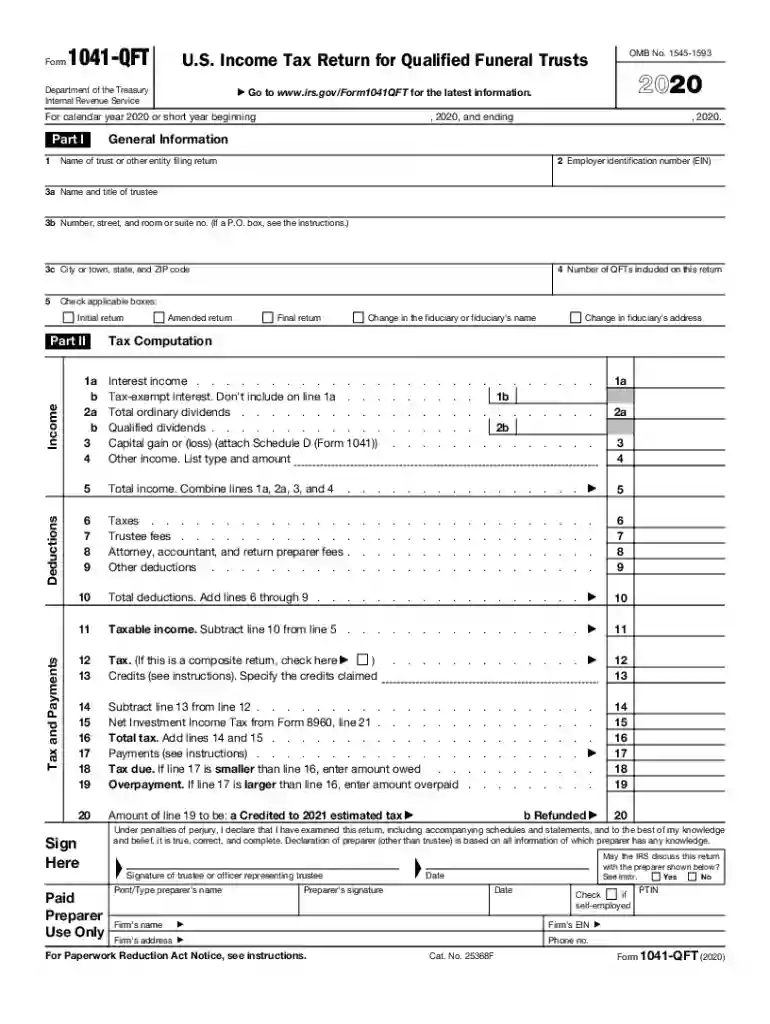
Form 1041-QFT, known as the U.S. Income Tax Return for Qualified Funeral Trusts, is designed to allow trustees to report income, deductions, gains, losses, and tax liabilities for Qualified Funeral Trusts (QFTs) to the Internal Revenue Service (IRS). This form helps trustees ensure that they comply with federal tax obligations specific to the arrangements made for pre-paid funeral services under a trust.
To efficiently utilize the QFT service information, trustees need to follow a step-by-step process:
QFTs are legally binding arrangements governed by specific IRS guidelines. Using the 1041-QFT form ensures that these trusts comply with federal tax laws. It is crucial to adhere strictly to legal specifications when completing this form:
Adherence to filing deadlines is imperative. For 1041-QFT, the filing date aligns with the standard individual tax return deadlines set by the IRS:
Understanding certain terms related to QFTs can help in accurately completing the form:
While manually completing the form is possible, leveraging software solutions can streamline the process. Specific software that supports the 1041-QFT form includes:
Failing to submit the form or inaccuracies in filing can lead to significant penalties:
Not all trusts qualify as QFTs. There are specific criteria that determine eligibility:
By thoroughly understanding the intricacies involved with the Form 1041-QFT, trustees can effectively manage compliance and fiduciary responsibilities associated with Qualified Funeral Trusts.


We've got more versions of the qft service information form. Select the right qft service information version from the list and start editing it straight away!
| Versions | Form popularity | Fillable & printable |
|---|---|---|
| 2025 | 4.1 Satisfied (23 Votes) | |
| 2024 | 4.3 Satisfied (33 Votes) | |
| 2023 | 4.4 Satisfied (58 Votes) | |
| 2022 | 4.9 Satisfied (38 Votes) | |
| 2021 | 4.8 Satisfied (59 Votes) | |
| 2020 | 4.2 Satisfied (44 Votes) | |
| 2019 | 4.1 Satisfied (69 Votes) | |
| 2018 | 4.2 Satisfied (79 Votes) | |
| 2017 | 4.2 Satisfied (95 Votes) | |
| 2016 | 4.4 Satisfied (573 Votes) | |
| 2015 | 4.1 Satisfied (74 Votes) | |
| 2014 | 4 Satisfied (27 Votes) | |
| 2013 | 4 Satisfied (23 Votes) | |
| 2012 | 4.3 Satisfied (43 Votes) | |
| 2011 | 4 Satisfied (34 Votes) |
At DocHub, your data security is our priority. We follow HIPAA, SOC2, GDPR, and other standards, so you can work on your documents with confidence.
The trustee of a trust that has elected to be taxed as a qualified funeral trust (QFT) files Form 1041-QFT to report the income, deductions, gains, losses, andRead more
If you are experiencing any difficulty in your installation or are having other issues please call our technical service phone line at 270-793-0900. OurRead more
A generalization for the quantum information retrieval protocol recently illustrated by Verlinde and van der Heijden for evaporating black holes is provided


