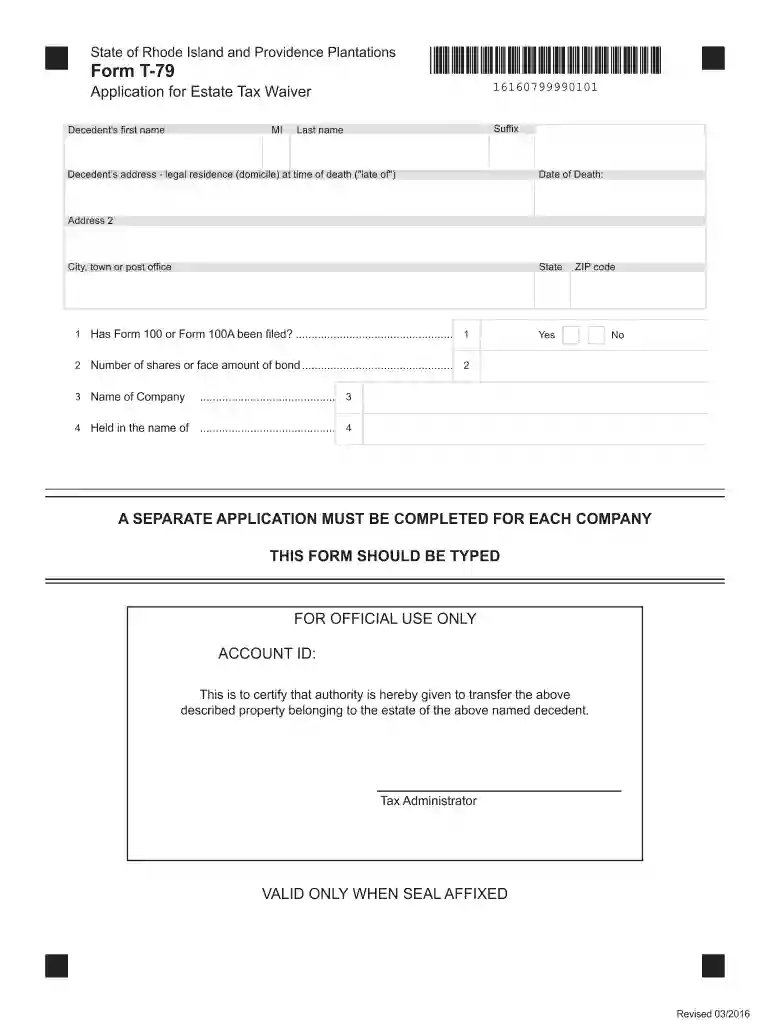
Rhode island 79 waiver providence form 2026

Get Form
rhode island 79 waiver providence form Preview on Page 1

Here's how it works

01. Edit your form online
Type text, add images, blackout confidential details, add comments, highlights and more.

02. Sign it in a few clicks
Draw your signature, type it, upload its image, or use your mobile device as a signature pad.

03. Share your form with others
Send it via email, link, or fax. You can also download it, export it or print it out.

How to use or fill out rhode island 79 waiver providence form with our platform

Form edit decoration
9.5
Ease of Setup
DocHub User Ratings on G2
9.0
Ease of Use
DocHub User Ratings on G2
  1. Click ‘Get Form’ to open the Rhode Island 79 Waiver Providence form in the editor.
  2. Begin by entering the decedent's first name, middle initial, suffix, and last name in the designated fields. Ensure accuracy as this information is crucial for identification.
  3. Fill in the decedent’s legal residence address at the time of death, including city, state, and ZIP code. This section helps establish jurisdiction.
  4. Input the decedent's social security number and date of death. These details are essential for processing the waiver application.
  5. Indicate whether Form 100 or Form 100A has been filed by selecting 'Yes' or 'No'. This informs tax authorities about prior filings related to estate taxes.
  6. Provide the number of shares or face amount of bonds held by the decedent and specify the name of the company associated with these assets.
  7. Complete any additional required fields as indicated on the form. Remember that a separate application must be completed for each company involved.

Start using our platform today to fill out your Rhode Island 79 Waiver Providence form online for free!

See more rhode island 79 waiver providence form versions

We've got more versions of the rhode island 79 waiver providence form form. Select the right rhode island 79 waiver providence form version from the list and start editing it straight away!
Versions Form popularity Fillable & printable
2021 4.7 Satisfied (57 Votes)
2020 4.2 Satisfied (89 Votes)
2016 4.2 Satisfied (84 Votes)
2007 4.3 Satisfied (218 Votes)
be ready to get more

Complete this form in 5 minutes or less

Get form

Got questions?

We have answers to the most popular questions from our customers. If you can't find an answer to your question, please contact us.
Contact us
In California, there is no state-level estate or inheritance tax. If you are a California resident, you do not need to worry about paying an inheritance tax on the money you inherit from a deceased individual. As of 2023, only six states require an inheritance tax on people who inherit money.
All estates must file Form RI-706, which is modeled after Federal Form 706. If the value of the gross estate is less than $1,802,431 (for deaths in 2025), no tax is owed. Your gross estate will include just about all of the property you own at your death: Real estate.
For decedents dying on or after January 1, 2025, the credit amount is $85,375, exempting from taxation the first $1,802,431 of an estate. This means that, in general, if a decedent passes away in 2025, a net taxable estate valued at $1,802,431, or less, will not be subject to Rhode Islands Estate Tax.
This means that, in general, if a decedent passes away in 2025, a net taxable estate valued at $1,802,431, or less, will not be subject to Rhode Islands Estate Tax. In certain circumstances, the Rhode Island Estate Tax will not apply regardless of the estates size.
How to Avoid the Estate Tax Give Gifts to Family. Set Up an Irrevocable Life Insurance Trust. Make Charitable Donations. Establish a Family Limited Partnership. Fund a Qualified Personal Residence Trust.

Security and compliance

At DocHub, your data security is our priority. We follow HIPAA, SOC2, GDPR, and other standards, so you can work on your documents with confidence.

Learn more
ccpa2
pci-dss
gdpr-compliance
hipaa
soc-compliance

People also ask

A statutory lien is placed on all real estate property, and on interest in certain securities, located in Rhode Island. That lien cannot be discharged until an estate tax return is filed and any taxes and fees for the decedent are paid in full.
If you are a Rhode Island resident and you are required to file a federal return, you must also file a Rhode Island return. Even if you are not required to file a federal return, you may still have to file a Rhode Island return if your income exceeds the amount of your personal exemption.

Related links