Arizona instructions income tax 2026

Get Form
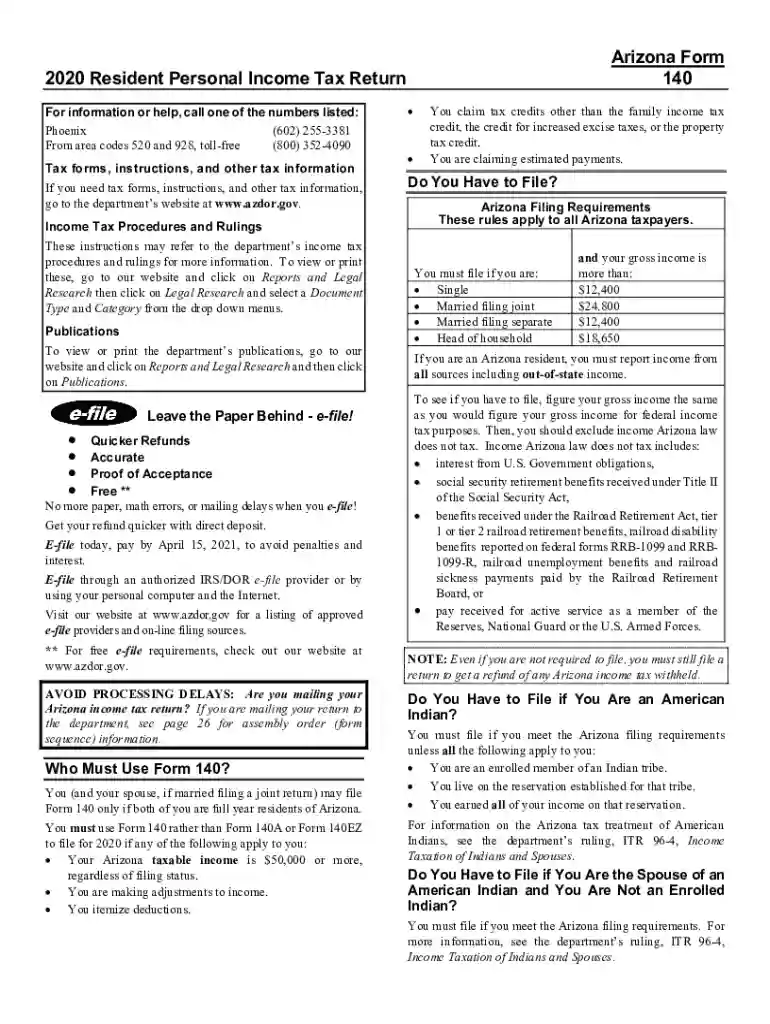
arizona form 140 instructions 2023 Preview on Page 1

Here's how it works

01. Edit your arizona form 140 instructions 2023 online
Type text, add images, blackout confidential details, add comments, highlights and more.

02. Sign it in a few clicks
Draw your signature, type it, upload its image, or use your mobile device as a signature pad.

03. Share your form with others
Send 140 az instructions via email, link, or fax. You can also download it, export it or print it out.

Definition and Purpose of Arizona Form 140

Arizona Form 140 is a crucial document for residents preparing their income tax return. It is specifically designed for individual taxpayers residing in Arizona who need to file a state income tax return. The form includes detailed sections to report income, claim deductions, and apply for various tax credits available to residents. Through Form 140, taxpayers can clearly outline their financial situation to determine any taxes owed or refunds due.

Key Elements of Arizona Form 140

  • Income Reporting: Includes wages, interest, dividends, and other forms of income.
  • Credits and Deductions: Information on claiming tax credits and deductions specific to Arizona.
  • Taxpayer Information: Requires details such as Social Security numbers and filing status.
  • Summary of Tax: Final calculation of tax due or refund after applying relevant credits and deductions.

How to Obtain Arizona Form 140

Obtaining Arizona Form 140 is straightforward. The Arizona Department of Revenue (ADOR) provides the form through several channels, ensuring accessibility for all taxpayers.

Available Methods

  1. Online Download: Visit the ADOR's website to download a printable PDF version of Form 140.
  2. In-Person: Obtain a paper copy from local ADOR offices or public libraries that stock state tax forms.
  3. Request by Mail: Taxpayers may request a physical copy to be mailed to them by contacting the ADOR.

Steps to Complete Arizona Form 140

Filing Form 140 efficiently involves several critical steps that help ensure accurate submission and processing.

Detailed Process

  1. Gather Required Documents: Collect W-2s, 1099s, and documentation of any additional income or tax-deductible expenses.
  2. Fill Out Personal Details: Enter personal information, including name, address, and Social Security number.
  3. Report Income accurately: Document all income sources as specified by the form’s instructions.
  4. Calculate Adjustments and Deductions: Apply any eligible deductions to lower taxable income.
  5. Compute Tax Credits and Payments: Review available credits and compare them against tax liabilities.
  6. Finalize and Review: Ensure all information is accurate before submitting the form.

Common Mistakes to Avoid

  • Incomplete or inaccurate income reporting.
  • Incorrect calculations of deductions or credits.
  • Failing to sign the completed form.

Important Deadlines and Filing Dates

Taxpayers in Arizona must adhere to critical deadlines to avoid penalties. Knowing these key dates ensures that taxes are paid timely and properly.

Key Filing Dates

  • Regular Deadline: Typically due by April 15, unless it falls on a weekend or public holiday, in which case it moves to the next business day.
  • Extension Requests: Submit by the April deadline to avoid late fees and penalties.

Required Documents for Filing

To complete the Arizona Form 140 accurately, taxpayers need to prepare various documents that support income declarations and deductions claimed.

Essential Documents

  • Income Statements: W-2s, 1099 forms for all income.
  • Proof of Deductions: Receipts or statements for deductible expenses.
  • Credit Eligibility Proofs: Documentation for any credits claimed.

Penalties for Non-Compliance

Failure to file the Arizona Form 140 on time or accurately can result in penalties imposed by the ADOR.

Potential Penalties

  • Late Filing Penalty: A percentage of the tax due, imposed monthly until the return is filed.
  • Late Payment Penalty: Imposed on the outstanding amount if the tax due is not paid by the deadline.
  • Interest on Overdue Taxes: Accumulated until the full amount is paid.

Examples of Taxpayer Scenarios

Understanding how different taxpayers might use the Arizona Form 140 can shed light on its application to various financial situations.


decoration image ratings of Dochub

Potential Scenarios

  • Self-Employed Individuals: May report business income and deductions to reduce taxable income.
  • Retirees: Often required to document pensions and annuity incomes while claiming applicable senior citizen credits.
  • Students: Might claim education-related credits to lower their tax burden.

Digital vs. Paper Version

Taxpayers in Arizona have the option to choose between filing digitally and using a paper version of the form.

Advantages of Each

  • Digital Filing: Offers automatic calculations, quicker refunds, and easier status tracking.
  • Paper Filing: Provides a tangible record for those uncomfortable with digital submissions.

These various facets surrounding Arizona Form 140 aim to facilitate a comprehensive understanding of its requirements and applications, helping taxpayers confidently navigate their state tax obligations.

See more arizona instructions income tax versions

We've got more versions of the arizona instructions income tax form. Select the right arizona instructions income tax version from the list and start editing it straight away!
Versions Form popularity Fillable & printable
2023 4.5 Satisfied (58 Votes)
2022 4.8 Satisfied (58 Votes)
2021 4.8 Satisfied (85 Votes)
2020 4.3 Satisfied (231 Votes)
2018 4.4 Satisfied (207 Votes)
2017 4.5 Satisfied (52 Votes)
be ready to get more

Complete this form in 5 minutes or less

Get form

Got questions?

We have answers to the most popular questions from our customers. If you can't find an answer to your question, please contact us.
Contact us
Arizona is a moderately tax-friendly state Lets assume youre a 65-year-old who earns $60,000 a year: $15,000 from Social Security, $30,000 from 401(k) and IRA distributions, and $15,000 from part-time employment. In this case, your total state taxes might rise as high as $1,125 (the 2025 state tax rate is 2.50%).
If you make $100,000 a year living in the region of Arizona, United States of America, you will be taxed $25,118. That means that your net pay will be $74,882 per year, or $6,240 per month.
Arizona Tax Rates, Collections, and Burdens Arizona has a flat 2.50 percent individual income tax rate. Arizona has a 4.9 percent corporate income tax rate. Arizona also has a 5.6 percent state sales tax rate and an average combined state and local sales tax rate of 8.38 percent.
Who must file a Arizona tax return? You must file an Arizona tax return if: Single AND gross income is more than $14,600. MFJ AND gross income is more than $29,200.
Picking up copies at an IRS Taxpayer Assistance Center. Going to the IRS Small Business and Self-Employed Tax Center page. Requesting copies by phone 800-TAX-FORM (800-829-3676). Hours of operation are 7 a.m. to 10 p.m., Monday-Friday, your local time except Alaska and Hawaii which are Pacific time.

Security and compliance

At DocHub, your data security is our priority. We follow HIPAA, SOC2, GDPR, and other standards, so you can work on your documents with confidence.

Learn more
ccpa2
pci-dss
gdpr-compliance
hipaa
soc-compliance

People also ask

Arizona Income Taxes Arizona charges a flat income tax of 2.50% on all income brackets and filing statuses. This flay income tax rate applies to Arizona taxable income. The starting point for computing Arizona taxable income is federal adjusted gross income (AGI).
Please note: An Arizona full-year resident is subject to tax on all income, including earnings from another state. Arizona will also tax retirement from another state. Residents are taxed on the same income they report for federal income tax purposes, subject only to the specific modifications allowed under state law.

arizona 140 instructions