Long-Term Care Insurance CreditMinnesota Department of Revenue 2026

Get Form
Long-Term Care Insurance CreditMinnesota Department of Revenue Preview on Page 1

Here's how it works

01. Edit your form online
Type text, add images, blackout confidential details, add comments, highlights and more.

02. Sign it in a few clicks
Draw your signature, type it, upload its image, or use your mobile device as a signature pad.

03. Share your form with others
Send it via email, link, or fax. You can also download it, export it or print it out.

How to use or fill out Long-Term Care Insurance Credit Minnesota Department of Revenue with our platform

Form edit decoration
9.5
Ease of Setup
DocHub User Ratings on G2
9.0
Ease of Use
DocHub User Ratings on G2
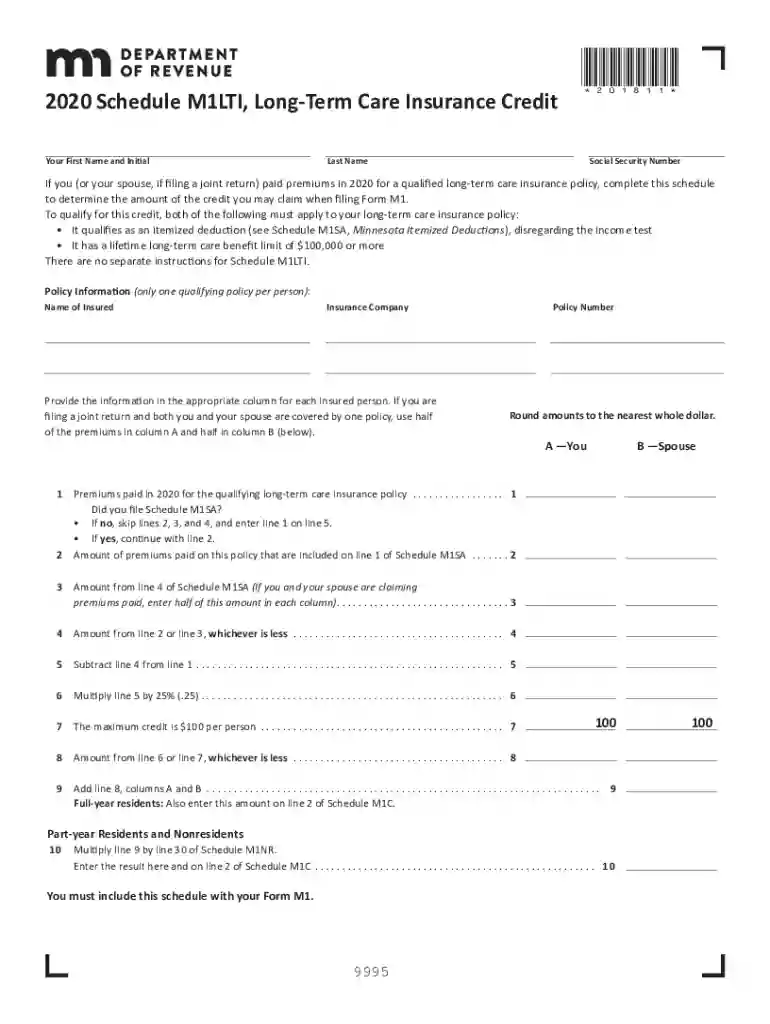
  1. Click ‘Get Form’ to open the Long-Term Care Insurance Credit form in the editor.
  2. Begin by entering your first name, middle initial, last name, and Social Security Number in the designated fields.
  3. In the Policy Information section, provide details for one qualifying long-term care insurance policy. Fill in the name of the insured, insurance company, and policy number.
  4. Enter the total premiums paid in 2020 for the qualifying policy in line 1. If filing jointly, split the premiums between you and your spouse as instructed.
  5. If you filed Schedule M1SA, follow the prompts to complete lines 2 through 4 based on your previous entries. If not, skip to line 5.
  6. Complete lines 5 through 10 by performing calculations as indicated on the form. Ensure all amounts are rounded to the nearest whole dollar.

Start using our platform today to easily fill out your Long-Term Care Insurance Credit form for free!

See more Long-Term Care Insurance CreditMinnesota Department of Revenue versions

We've got more versions of the Long-Term Care Insurance CreditMinnesota Department of Revenue form. Select the right Long-Term Care Insurance CreditMinnesota Department of Revenue version from the list and start editing it straight away!
Versions Form popularity Fillable & printable
2023 4.3 Satisfied (58 Votes)
2022 4.4 Satisfied (76 Votes)
2021 4.4 Satisfied (73 Votes)
2020 4.3 Satisfied (144 Votes)
be ready to get more

Complete this form in 5 minutes or less

Get form

Got questions?

We have answers to the most popular questions from our customers. If you can't find an answer to your question, please contact us.
Contact us
Minnesota Long Term Care Partnership Usually, in order to qualify for Medical Assistance, a consumer must first draw down his or her personal assets. The Long Term Care Partnership gives Minnesota consumers the ability to protect assets up to the amount of long-term care coverage they purchase.
The Minnesota credit equals 25 percent of qualifying long-term care insurance premiums for one beneficiary, up to a maximum of $100 for individuals and up to $200 for married couples filing jointly who both have coverage. A taxpayer may claim only one policy for each qualified beneficiary.
Minnesota taxes the same amount of Social Security benefits that is taxed federally. You may qualify for a subtraction from Minnesota taxable income if you receive these benefits. For details, see Social Security Benefit Subtraction.
What is the credit? The Minnesota long-term care insurance credit offsets the cost of long-term care insurance premiums by providing a credit against state income tax liability. The maximum Minnesota credit is equal to the lesser of $100 or 25 percent of the amount paid for each beneficiary.
Cons of Long-Term Care Insurance Cost is a docHub issue. To buy $165,000 worth of long-term care coverage in 2022, a 55-year-old man would pay an average of $2,220 per year. Rising premiums. It may not cover all expenses. Loss of premiums. Qualifying can be an obstacle.

Security and compliance

At DocHub, your data security is our priority. We follow HIPAA, SOC2, GDPR, and other standards, so you can work on your documents with confidence.

Learn more
ccpa2
pci-dss
gdpr-compliance
hipaa
soc-compliance

People also ask

Employers are eligible for a credit equal to 20% of the premiums paid during the tax year for the purchase of, or for continuing coverage under, a LTCi policy. The credit is not refundable and the credit may not reduce the tax to less than the minimum tax due.
More than 200,000 long-term care workers may qualify for bonuses of up to $1,000 from the state of Minnesota. With $84 million approved in 2023, the Minnesota Care Force Incentive program recognizes the essential work of direct support professionals.

Related links