Dc form estate tax return 2026

Get Form
dc form estate tax return Preview on Page 1

Here's how it works

01. Edit your form online
Type text, add images, blackout confidential details, add comments, highlights and more.

02. Sign it in a few clicks
Draw your signature, type it, upload its image, or use your mobile device as a signature pad.

03. Share your form with others
Send it via email, link, or fax. You can also download it, export it or print it out.

How to use or fill out DC Form Estate Tax Return with DocHub

Form edit decoration
9.5
Ease of Setup
DocHub User Ratings on G2
9.0
Ease of Use
DocHub User Ratings on G2
  1. Click ‘Get Form’ to open the DC Form Estate Tax Return (D-76) in our platform.
  2. Begin by entering the gross value of property located in the District of Columbia on Line 1. Ensure that this value is accurate as it will affect your total estate tax calculation.
  3. On Line 2, input the total gross estate amount from Line 13 of the Recapitulation. This should reflect fair market value appraisals from certified appraisers.
  4. For Line 3, enter the total allowable deductions calculated from Line 24 of the form. This will help determine your tentative taxable estate.
  5. Calculate your tentative taxable estate by subtracting the total allowable deductions (Line 3) from the total gross estate (Line 2) and enter this amount on Line 4.
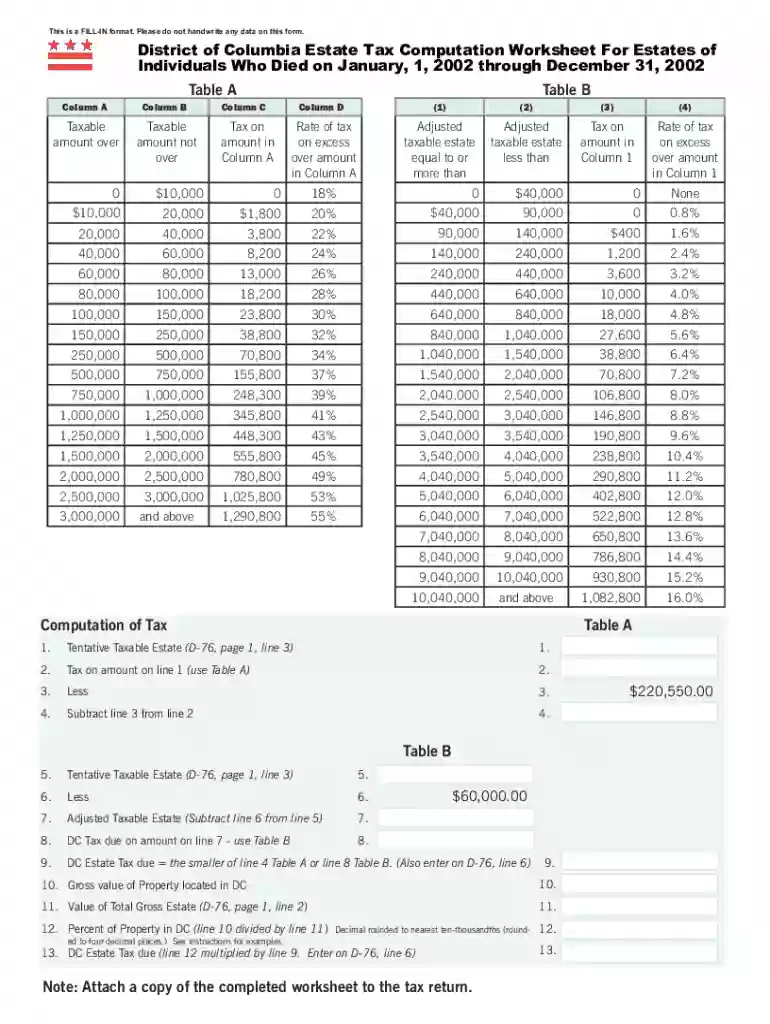
  6. Use the Estate Tax Computation Worksheet to find out how much DC Estate Tax is due based on your tentative taxable estate and enter this amount on Line 5.
  7. If applicable, complete any additional sections such as payment information or direct deposit details for refunds before submitting your form electronically via MyTax.DC.gov.

Start using our platform today to simplify your DC Estate Tax Return process!

See more dc form estate tax return versions

We've got more versions of the dc form estate tax return form. Select the right dc form estate tax return version from the list and start editing it straight away!
Versions Form popularity Fillable & printable
2025 4.5 Satisfied (28 Votes)
2022 4.8 Satisfied (23 Votes)
2022 4.9 Satisfied (22 Votes)
2021 4.8 Satisfied (50 Votes)
2020 4.4 Satisfied (111 Votes)
2019 4.3 Satisfied (37 Votes)
2018 4 Satisfied (28 Votes)
2013 4.3 Satisfied (115 Votes)
be ready to get more

Complete this form in 5 minutes or less

Get form

Got questions?

We have answers to the most popular questions from our customers. If you can't find an answer to your question, please contact us.
Contact us
After the death of the insured, estates that need to file an estate tax return will need to ask the insurance company to provide a Form 712 for each policy insuring the decedent.
The IRS Federal Form 712 reports the value of a life insurance policys proceeds after the insured dies for estate tax purposes.
Estate taxes are paid by a decedents estate before assets are distributed to heirs and are thus imposed on the overall value of the estate. Inheritance taxes are remitted by the recipient of a bequest and are thus based on the amount distributed to each beneficiary.
Estate tax returns are legal documents filed with the government after an individuals death to report the total value of their estate, including assets and liabilities, for tax assessment purposes.
A DC Estate Tax Return (Form D-76 or Form D-76 EZ) must be filed where the gross estate is: $675,000 or more for individuals dying on or after January 1, 2001, even if the Federal Estate Tax Return (IRS Form 706, for decedents dying in 2002 and thereafter) is not required to be filed.

Security and compliance

At DocHub, your data security is our priority. We follow HIPAA, SOC2, GDPR, and other standards, so you can work on your documents with confidence.

Learn more
ccpa2
pci-dss
gdpr-compliance
hipaa
soc-compliance

People also ask

Generally, life insurance proceeds you receive as a beneficiary due to the death of the insured person, arent includable in gross income and you dont have to report them. However, any interest you receive is taxable and you should report it as interest received.
The filing of the D 30 is a requirement for operating or continuing to operate a motor vehicle for hire in the District by a non resident. The minimum tax is $250 if DC gross receipts are $1M or less. Minimum tax is $1,000 if DC gross receipts are greater than $1M.
In the District of Columbia, if the taxable estate exceeds $4.528 million (and the deceased died in 2023), you will be subject to estate tax on that portion. The executor or personal representative will need to file an estate tax return. An estate with a gross value under $4.528 million is tax-exempt.

Related links