Maximum millage 2026

Get Form
maximum millage Preview on Page 1

Here's how it works

01. Edit your form online
Type text, add images, blackout confidential details, add comments, highlights and more.

02. Sign it in a few clicks
Draw your signature, type it, upload its image, or use your mobile device as a signature pad.

03. Share your form with others
Send it via email, link, or fax. You can also download it, export it or print it out.

How to use or fill out maximum millage with our platform

Form edit decoration
9.5
Ease of Setup
DocHub User Ratings on G2
9.0
Ease of Use
DocHub User Ratings on G2
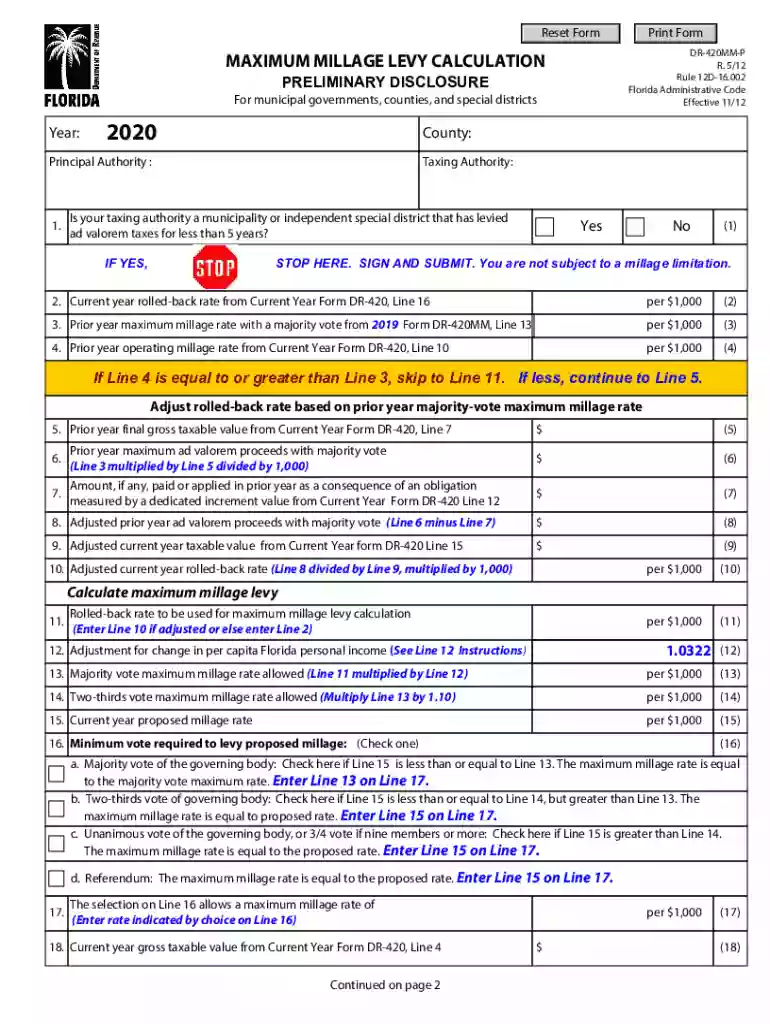
  1. Click ‘Get Form’ to open the Maximum Millage Levy Calculation form in the editor.
  2. Begin by entering the year for which you are calculating the maximum millage. This is crucial for accurate tax assessments.
  3. Indicate whether your taxing authority has levied ad valorem taxes for less than five years by selecting 'Yes' or 'No'. If 'Yes', sign and submit as you are not subject to a millage limitation.
  4. Fill in the current year rolled-back rate from the Current Year Form DR-420, Line 16, ensuring it reflects the correct amount per $1,000.
  5. Input prior year maximum millage rate from 2019 Form DR-420MM, Line 13. This will help determine your limits for this year.
  6. Continue filling out subsequent lines based on your previous year's data, adjusting rates as necessary according to instructions provided within each section.
  7. Once all fields are completed, review your entries for accuracy before signing and submitting the form to your property appraiser.

Start using our platform today to streamline your document editing and form completion process for free!

See more maximum millage versions

We've got more versions of the maximum millage form. Select the right maximum millage version from the list and start editing it straight away!
Versions Form popularity Fillable & printable
2023 4.7 Satisfied (25 Votes)
2022 4.8 Satisfied (21 Votes)
2021 4.8 Satisfied (55 Votes)
2020 4.4 Satisfied (136 Votes)
2019 4.4 Satisfied (294 Votes)
2018 4.3 Satisfied (76 Votes)
2012 4.1 Satisfied (65 Votes)
be ready to get more

Complete this form in 5 minutes or less

Get form

Got questions?

We have answers to the most popular questions from our customers. If you can't find an answer to your question, please contact us.
Contact us
How much, on average, do people claim on taxes? Since theres no upper limit to how many miles you can claim, tax deductions vary wildly from person to person and depend mostly on the cost of the car, how new it is, and how much you drive.
A conventional car can last for 200,000 miles. Some well-maintained car models will docHub 300,000 or more miles total. The average passenger car age is currently around 12 years in the United States.
The HMRC 10,000 mile threshold For cars and vans, a 10,000 mile threshold applies to mileage covered. For the first 10,000 miles, 45p/mile is the standard rate. For any miles covered beyond the first 10,000, the rate is 25p/mile.
Mileage claims are calculated by multiplying your work-related mileage throughout the tax year with the applicable HMRC mileage rate. What mileage rate can I claim? You can claim 45p per mile for the first 10,000 miles and 25p per mile after that for cars.
If you use your own car for business journeys, you can claim a tax-free mileage allowance based on HMRCs approved rates. These rates are currently: 45p per mile for the first 10,000 business miles in a tax year.
be ready to get more

Complete this form in 5 minutes or less

Get form

People also ask

200,000 miles is generally the upper limit for even well-maintained vehicles. However, mileage alone shouldnt be the deciding factor. A cars maintenance history, number of previous owners, and overall condition are equally important.
You can claim a maximum of 5,000 work-related kilometres per car. You need to keep records that show how you work out your work-related kilometres. If you and another joint owner use the car for separate income-producing purposes, you can each claim up to 5,000 work-related kilometres.

Related links